Every aikido dojo on the planet traces its line back to one small, wiry Japanese farmer who died in 1969. His name was Morihei Ueshiba, his students called him O-Sensei, and the story of how a sickly boy from Wakayama built a martial art now practiced on six continents is stranger and better than most people realize. It also explains a lot about the dojo you train in, or the one you’re thinking of joining.
Walk into almost any aikido dojo in America and look at the front wall. Somewhere near the kamiza, the place of honor, you’ll find a framed black-and-white photograph of an elderly Japanese man with a white beard and piercing eyes, often mid-technique, sometimes holding a wooden staff. Nobody introduces him. Beginners figure it out eventually: that’s O-Sensei, Morihei Ueshiba, the founder of aikido, and the reason everyone in the room is wearing the same funny white outfit. I remember asking my own sensei, maybe six months in, why we bowed toward the picture. He thought about it for a second and said, “We’re not bowing to him. We’re bowing to the people he trained, who trained the people who trained me.” Fair enough. But I kept wondering about the man in the frame.
Ueshiba’s life, if anything, reads like somebody made it up. A frail farm boy who bullied his own body into strength, then a soldier who came home from war and found his calling on a freezing northern island, then a terrifying jujutsu master who softened into something like a pacifist, depending on which decade you catch him in, and it’s a lot to reconcile. And a network of students so devoted that after he died, they carried his art to every corner of the world, arguing the whole way about what he really meant. Understanding that arc won’t make your irimi any sharper, I think, but it will make the dojo make sense in a way it didn’t before.
Why a Tuesday-Night Student Should Care About 1883
History isn’t trivia here. It’s the reason your dojo does things the way it does.
Most of us got into aikido for practical reasons. A friend dragged us to a free class, or we wanted to move more and sit less, or we watched a demo where a small person sent a big person flying and thought, I want to learn whatever that is. The history feels like homework by comparison. I get it. But aikido is unusual among martial arts in how tightly its practice is bound to one man’s biography and beliefs, and the biography explains the practice in ways that matter on the mat.
When a dojo says it follows “O-Sensei’s vision,” that’s not marketing fluff. It usually means something specific about how techniques are shaped, how hard the training is, and how much of the philosophical material gets talked about versus just drilled. Worth asking about. Ueshiba taught differently in 1935 than he did in 1965, and his senior students, scattered across the globe, froze those different versions in place. Which version your lineage froze is one of the most useful things to know before you pick a school.
The Sickly Boy Who Refused to Stay Sick
Morihei Ueshiba was born on December 14, 1883, in a farming village outside Tanabe, on the Kii Peninsula of Wakayama Prefecture, south of Osaka. Farm country. His father, Yoroku, was a prominent local landowner, and the family was comfortably off. The boy himself was anything but comfortable in his own skin. He was a small, skinny, sickly kid, the sort who spent more time watching the other boys wrestle than joining them. Accounts of his early years, including the standard biography of Morihei Ueshiba, describe a child whose determination far outran his body.
Determination, in this case, meant something close to obsession. Young Morihei threw himself into whatever built strength within reach. He did farm work alongside adults until his hands toughened. He took up sumo at a local level and swimming in the cold Pacific water off the peninsula, which locals of the time considered borderline insane and which he apparently loved. The pattern you’d see repeated his whole life was already there: find the thing that frightens you, then grind at it until it doesn’t.
Two other threads from these years matter later. His father was politically active and physically formidable, a man who once reportedly fought off a gang of thugs with a wooden staff, and Morihei grew up with a reverence for the warrior ideal that sat oddly next to his bookish, religious streak. And somewhere in his teens, after watching his father get roughed up in a local political dispute, the boy decided he wanted real martial skill, the kind that works when it counts. Sport wasn’t the point.
He tried. Around the turn of the century he spent time in Tokyo, where he sampled the martial arts on offer, reportedly training a little in Tenjin Shin’yo-ryu jujutsu and later getting a taste of judo at the Kodokan. None of it held him. He drifted through jobs, ran a small stationery and photography shop that failed, and by most measures was a young man without direction. Then, in 1903, he joined the army.
The army agreed with him more than it agrees with most people. He served through the Russo-Japanese War of 1904-1905, distinguished himself as a tough, willing soldier despite his small frame, and came home to Tanabe with the body he’d wanted since boyhood. Somewhere in there, in 1905, he married Hatsu Itokawa, his childhood acquaintance, and settled into the respectable life of a farmer’s son. He built up his physique further with timber work, hauling logs, more sumo. If the story ended here, he’d be a footnote, a country strongman who made good. Instead his father sent him north in 1912, to help colonize the wild frontier of Hokkaido, and the whole direction of martial arts history bent.
Takeda Sokaku and the Art of Daito-ryu
Hokkaido in the 1910s was Japan’s rough edge, a place of settlers and ex-samurai making new lives. It suited him. In the small town of Shirataki, Ueshiba heard that a martial arts master was teaching nearby and went to look. The master’s name was Takeda Sokaku, and what he taught was called Daito-ryu aiki-jujutsu.
If you only learn one thing about aikido’s ancestry, learn this: aikido’s techniques, the pins and locks and throws that fill your syllabus, come overwhelmingly from Daito-ryu. Takeda was the heir to a family martial tradition claiming descent from the samurai of the Takeda clan, and unlike his predecessors, who had kept the art within the family, he taught it openly, traveling constantly and charging by the technique. Sokaku Takeda was a small, intense man with a reputation for being flat-out dangerous; stories about his temper and his skill are legend, and some of them are even documented. Ueshiba, already in his thirties and strong as an ox, took one look at what Takeda could do and dropped everything.
He trained obsessively, and he paid for it. Literally. Takeda’s fees were steep, and students were expected to host him, feed him, absorb whatever he chose to teach on a given day. Nobody got a discount. Ueshiba liquidated property, a fact that reportedly irritated his wife for decades, and immersed himself in an art far harsher than anything most modern aikido students would recognize. Daito-ryu of that era was built around immediate effectiveness: joint locks applied at full speed, throws onto hard ground, atemi strikes to vital points, no padding, no pulling punches, and the whole point was that a smaller person could wreck a bigger one before the bigger one understood what was happening.
Every graceful, flowing aikido technique you’ve ever seen descends from an art designed to end a fight in two seconds on packed dirt.
In 1917, Ueshiba earned Takeda’s kyoju dairi, a teaching certification, and by 1922, after a famous reunion where Takeda reportedly stayed at Ueshiba’s home for months, he received the full transmission scroll of Daito-ryu. On paper, Ueshiba was now one of Takeda’s senior exponents, licensed to teach the complete system. Some Daito-ryu schools today look at that 1922 scroll and consider aikido a branch of their lineage, which is fair. The techniques match, especially in the early films and photos, but between 1917 and 1922 something else had happened to the man that Takeda never fully understood and never much liked.
The Religious Turn: Ayabe and Omoto
When his father fell ill around 1915, Ueshiba began visiting a new religious movement headquartered in Ayabe, near Kyoto, called Omoto-kyo. It stuck. Its spiritual leader, Deguchi Onisaburo, was a charismatic figure who blended Shinto with esoteric Buddhism and folk mysticism into a message of universal brotherhood and world peace. Ueshiba had always been devout in an eclectic way; Omoto gave that instinct a home. He moved his family to Ayabe in 1920 and became one of Onisaburo’s close disciples, farming and studying between religious obligations.
This is where the aikido story splits from the Daito-ryu story, and it’s the part new students find hardest to square with the techniques. Ueshiba became convinced that martial arts should not exist to destroy opponents. His new idea, worked out over years of meditation and farming, was that true budo wins without fighting at all. The highest martial art, in his telling, absorbs an attack and neutralizes it so completely that nobody has to be harmed. To many of Takeda’s other students, this sounded like a beautiful excuse for losing. They had a point, in a way. Ueshiba didn’t care. He kept the Daito-ryu engine and began rebuilding the chassis around it.
Deguchi encouraged him. Omoto had money and connections to spare, and its members studied Ueshiba’s budo with devotion. When the sect ran into trouble with the Japanese government in the early 1920s (Omoto’s leaders were arrested in 1921 and again, more severely, in 1935, when the sect was suppressed), Ueshiba’s martial fame became something like a liability in polite society. So a group of military patrons, some of them martial arts enthusiasts he’d impressed, invited him to Tokyo.
The Kobukan: Tokyo’s “Hell Dojo”
Ueshiba opened a dojo in 1927 and, in April 1931, formally established the Kobukan, the “Institute for the Cultivation of the Spirit,” in the Ushigome district of Tokyo. The Kobukan era is the aikido origin story that hardcore traditionalists love most, and for good reason. This was pre-war Japan with militarism rising, and Ueshiba’s teaching was ferocious, closer to what he’d learned from Takeda than to what most dojos practice now.
His uchi-deshi, live-in students, endured a regimen that earned the place its nickname: the “hell dojo.” Students trained from before dawn until long after dark, took falls on hardwood, and served as uke for a teacher who could be rough even by the standards of the day. Nobody complained twice. Ueshiba was famous among martial artists of 1930s Tokyo for being nearly impossible to attack; judoka and kendo men reportedly visited to test him and left confused about what had just happened to them. The Kobukan attracted serious martial artists and serious nationalists alike, and Ueshiba taught at military academies during this period, a chapter of his life that his later pacifist image tends to swallow whole. That chapter mattered.
Students of the Kobukan era included Gozo Shioda, who would later found Yoshinkan aikido, and Kisshomaru Ueshiba, Morihei’s son, then a teenager, who absorbed the family art from the inside and would one day be responsible for most of the world knowing it existed. If you train at a Yoshinkan-affiliated dojo today, the directness and precision you feel comes straight from this period. The pre-war Ueshiba taught a hard art for a hard time.
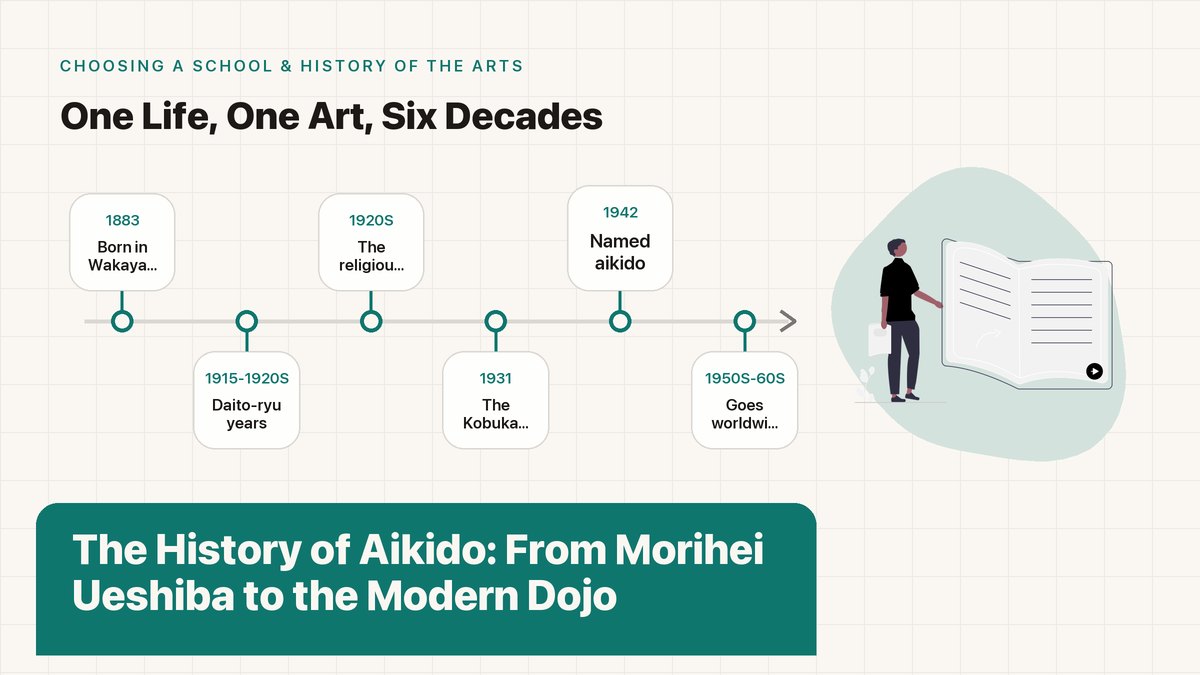
Timeline: The Shape of One Life
The dates blur together, so here’s the arc at a glance. One caveat before you quote any of this: Ueshiba’s biography is unusually tangled, contested between lineages, and documented partly through hagiography, so treat any single source, including this one, as a version rather than the final word.
| Year | Event | Why it matters |
|---|---|---|
| 1883 | Born in Tanabe, Wakayama | Sickly farm boy who rebuilt himself through hard labor and cold-water swimming |
| 1915 | Meets Takeda Sokaku in Hokkaido | Absorbs Daito-ryu jujutsu, the technical ancestor of every aikido technique |
| 1922 | Receives Daito-ryu transmission scroll | Full teaching license, even as his spiritual vision starts diverging from Takeda’s |
| 1931 | Opens the Kobukan in Tokyo | Pre-war “hell dojo” trains the generation who will carry the art worldwide |
| 1942 | Moves to Iwama; art named “aikido” | The Dai Nippon Butoku Kai registers the name; Ueshiba farms and refines the art |
| 1953-64 | Students take aikido overseas | Tohei in Hawaii (1953), Ueshiba’s own Hawaii visit (1961), Yamada founds the New York Aikikai (1964) |
| 1969 | Ueshiba dies, aged 85 | Son Kisshomaru consolidates the Aikikai; O-Sensei’s students spread the art to dozens of countries |
Iwama: Farming, a Shrine, a Softer Art
In 1942, with Tokyo being bombed and Japan’s war effort consuming everything, Ueshiba left the capital for a small farming village called Iwama, in Ibaraki Prefecture, about a hundred kilometers northeast. He was nearly sixty. Sixty, and starting over. There he farmed and meditated and slowly built the Aiki Shrine, a small Shinto shrine dedicated to the spirits of aikido, on land that remains a pilgrimage site for aikidoka to this day. This is the era when the art visibly became what we now recognize as aikido.
The Iwama Ueshiba moved larger. Techniques that in Daito-ryu had been tight, wrenching joint locks opened into big circular movements; throws that had dumped uke now sent them rolling; the footwork widened and softened. He talked more and more about ki, about love, about the unity of all things, in language that drove some of his martially-minded students to distraction. And here a detail worth knowing. Ueshiba never sat still. Even into his eighties, the art kept changing under him, which is why his senior students ended up teaching somewhat different versions of it. Which one a given lineage preserves is partly an accident of when that student trained with him most intensively.
Morihiro Saito, a young farmer Ueshiba took under his wing in Iwama, became his closest training partner for over twenty years and the guardian of the founder’s weapons work, the paired sword and staff practices (aiki-ken and aiki-jo) that many aikidoka, myself included, find humbling. Saito’s Iwama lineage preserves the middle-period Ueshiba: flowing and martially serious, big on weapons. His books and seminars shaped a huge share of Western aikido in the 1970s and 80s, especially in Europe.
The old man in Iwama wasn’t winding down. He was editing.
How Aikido Crossed the Pacific
Ueshiba himself barely traveled. The worldwide spread of aikido was almost entirely the work of his students, and it happened astonishingly fast. The watershed year was 1953, when Koichi Tohei, then the Aikikai’s chief instructor and Ueshiba’s most famous student, accepted an invitation to teach in Hawaii. Hawaii had a large Japanese-American population eager to connect with the homeland’s culture, and Tohei found a ready audience. He returned repeatedly, planted the seed, and within a decade there were thriving dojos across the islands.
From Hawaii and Japan, the art jumped to the mainland United States. Yoshimitsu Yamada arrived in New York in 1964 and founded the New York Aikikai, which became a hub for American aikido and still operates today. Still there. Mitsugi Saotome moved to the US in the mid-1970s and built a federation across the country. Other senior students carried aikido to France, Germany, Italy, the UK, Brazil, Australia, and beyond; aikido was maybe the first Japanese martial art to take root globally without being a sport, carried entirely by traveling teachers and devoted local students. Ueshiba did make one foreign trip of his own, a famous 1961 visit to Hawaii at age 77, where he was greeted like a head of state by the Japanese-American community. He mostly seemed pleased by the food.
Back home, the quiet hero of the spread was his son Kisshomaru Ueshiba. While Morihei retreated to Iwama, Kisshomaru rebuilt the Tokyo dojo after the war, ran it as a working professional organization, welcomed foreigners, codified the teaching, and gave the art administrative shape. Boring, essential work. Modern aikido as an international practice exists largely because the son did the unglamorous work of turning one man’s genius into an institution that could survive him. The Aikikai Foundation, headquartered at the Hombu Dojo in Tokyo and led today by the founder’s grandson Moriteru Ueshiba, is that institution’s present-day form, and it’s the organization that most dojos in North America affiliate with, directly or indirectly.
Ueshiba died on April 26, 1969, at the age of 85. By then, dojos existed on four continents and the art had been given the name by which the world knows it. The title O-Sensei, “great teacher,” is how the aikido world refers to him now, and the reverence is real. Whether you find the reverence helpful or a little thick depends on your dojo, and honestly both kinds exist.
Why Lineages Differ Today
Same founder, different decades, different students. That’s the whole story.
If you’ve browsed dojos, you’ve noticed aikido comes in flavors. Aikikai-affiliated dojos, usually the easiest to find, teach the standardized curriculum Kisshomaru and the Hombu Dojo developed, respectful of the founder’s late style. Ki Society dojos, descended from Tohei after his 1974 split with the Aikikai, emphasize ki testing and a softer, principle-first approach. Yoshinkan dojos, from Gozo Shioda, keep the pre-war directness. Iwama-style dojos preserve Saito’s weapons-heavy middle period. And plenty of independent dojos just teach “aikido,” drawing from several wells at once.
None of these are wrong. They’re different snapshots of a moving target. Ueshiba in 1935 and Ueshiba in 1965 taught recognizably related but truly different arts, and each senior student froze the version they had learned best. This is also why belt ranks and testing standards differ between organizations, a topic we’ve covered separately in our guide to kyu and dan ranks and their tradition. If you ever switch dojos, expect your rank to be evaluated, honored, or politely re-calibrated depending on the lineage. It’s not politics, mostly. It’s history.
What This Means for Choosing a School
History is only worth your time if it changes a decision, so let’s land this where it started. The practical takeaways, as far as I can tell from years of watching beginners choose dojos:
- Lineage is a preview more than a verdict. An Aikikai dojo and a Ki Society dojo can both be excellent or both be sleepy. Visit, watch a class, and feel the energy of the room before you weigh the organizational chart.
- The founder’s biography is a lens on the training. A dojo that talks about O-Sensei’s hard pre-war years will probably train hard. One quoting his late peacemaking years will probably emphasize blending and control. Match that to what you actually want out of Tuesday and Thursday nights.
- Every legitimate dojo connects to the same tree. Arguments between lineages are real, but for a beginner the differences matter far less than teacher quality, the class schedule, whether you like the people. You’ll absorb your dojo’s particular flavor long before the distinctions between flavors become relevant to you. Give it time.
- The reverence is optional; the respect isn’t. You’ll be expected to bow toward that photograph and behave with courtesy, whichever flavor you choose. If you’re new to that side of things, our beginner’s guide to what aikido is and how it works covers the etiquette basics before your first class.
One more thought, because it doesn’t fit neatly in a bullet. Ueshiba spent his last decades insisting that aikido was a gift for the world, not a weapon for one nation, and the astonishing international spread after his death proved the point better than any speech. The old man’s students argued about everything, and the art still ended up on six continents. However your dojo interprets him, you’re training inside that argument, which is maybe the most honest inheritance a martial art has ever handed down.
Sources and further reading: the Aikikai Foundation’s official site (aikikai.or.jp), the Wikipedia entries on Morihei Ueshiba, Takeda Sokaku, and Daito-ryu Aiki-jujutsu, the Kodokan’s history as covered in the Kodokan Judo entry, and the general aikido overview on Wikipedia. Dates for the founder’s life are widely agreed; interpretations of what he meant vary by lineage, and where they vary, this article says so. Related reads on this site: kyu vs. dan ranks and aikido basics explained. Last updated October 2026.
Leave a Reply