Aikido promises something no other martial art quite does, a way of handling violence without becoming violent yourself. But what does that promise mean when someone grabs your wrist for real? A beginner’s honest tour of the tension between aikido’s fighting roots and its philosophy of harmony, and how today’s teachers square the two.
Ask a room full of aikido students why they train and you’ll get a dozen answers, but ask them whether what they do would work in a real fight and the room goes quiet in a hurry. That silence matters. It sits at the center of what aikido is. Every martial art has a sales pitch. Karate has power, judo has throws that visibly work, boxing has the ring. Aikido’s pitch is stranger and subtler. You can defend yourself while protecting the person who attacked you. It sounds beautiful on a dojo wall. It also sounds, to a skeptical beginner standing in a trial class, a little too good to be true. It’s a fair question. So let’s look at it honestly — where did this philosophy come from, what did its founder actually mean, and what can you reasonably expect to get from the art if self-defense is on your list of reasons to train?
Where the Harmony Story Comes From
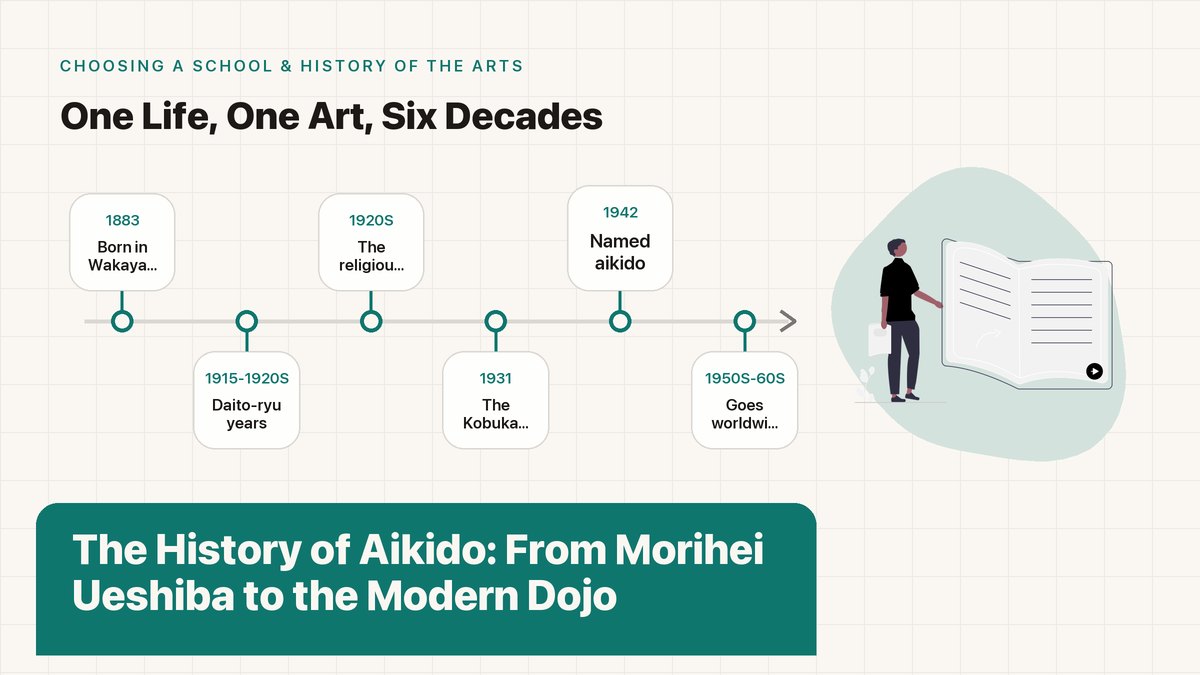
Aikido wasn’t always a peace art, and this part gets skipped in a lot of beginner classes. Morihei Ueshiba, the founder students call O-Sensei (“great teacher”), was born in 1883 in a rural part of Japan and spent his early adult years training hard in a very rough school of jujutsu called Daito-ryu aiki-jujutsu. His teacher there, Sokaku Takeda, had a reputation for brutal precision, and the techniques Ueshiba taught in the 1920s and 1930s, in his private Kobukan dojo in Tokyo, were small, vicious joint locks and throws meant to disable a person fast. Anyone who wants the full arc can read our overview of what aikido is and how its basics fit together, but the short version is that the art you see tonight at a community dojo descends from something much harsher. Keep that in mind.
Somewhere along the way, Ueshiba changed. He became deeply involved with a Shinto sect called Omoto-kyo, absorbed its ideas about harmony between human beings and the natural world, and gradually reworked what he taught. The joint locks softened into spiraling movements. The throws grew circular. By the time he settled in the town of Iwama after the war, he was describing his art in spiritual terms that had very little to do with fighting. The standard English-language starting point for his thinking is the collection of his sayings published as The Art of Peace, where he writes, in one frequently quoted line, that “to control aggression without inflicting injury is the Art of Peace.”
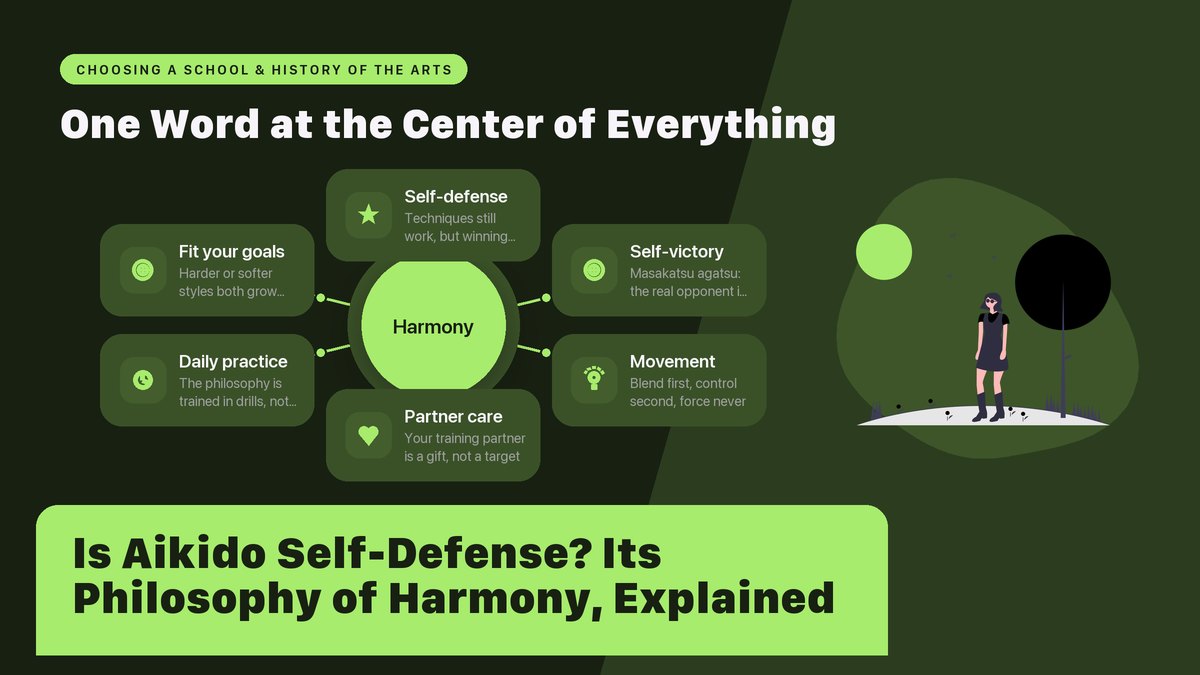
That quote is where most students meet aikido philosophy, and most students misunderstand it on first contact. Nobody is claiming that people never get hurt in aikido. Watch a class and you’ll see people hitting the mat hard enough to knock the wind out of them. What changed is the aim. Ueshiba reframed the winner of an encounter. Victory stopped being the other person on the ground and became, in his phrase, masakatsu agatsu, “true victory is victory over oneself.” The enemy to defeat is your own aggression, your fear, the part of you that wants the fight. Everything else flows from that.
His son Kisshomaru, who rebuilt the art after the war and spread it worldwide through the Aikikai organization, spent decades translating that message for ordinary people. The standard biography of Kisshomaru describes a man who deliberately moved aikido away from its founder’s esoteric spirituality and toward something a working adult in Osaka or Chicago could practice twice a week. Most of the aikido on the planet today (steady classes, mixed abilities, an emphasis on cooperative training) is Kisshomaru’s aikido more than O-Sensei’s. It matters for you, because the dojo you can actually join is usually not training the way the founder trained.
“To control aggression without inflicting injury is the Art of Peace.” The aim moved. The physics never left.
What O-Sensei’s Famous Sayings Actually Mean
Students hear a handful of Ueshiba quotes so often they stop registering, and each one carries a load-bearing piece of the philosophy. It helps to slow down and read them the way a beginner is actually meant to, one at a time. Each one earns its keep.
“The secret of aikido is to harmonize with the movement of the universe.”
This one sounds like poetry until you’ve done a few months of technique training, and then it starts sounding like a training instruction. Blending, the thing our article on tenkan and body movement drills into you from day one, is physically this — you don’t stop the incoming force, you join it, redirect it a few degrees, and let it complete its journey somewhere harmless. The philosophical version of blending is the same sentence with bigger words. Also, the claim scales. Ueshiba believed that a person fully in harmony with the universe couldn’t be attacked successfully. Speed had nothing to do with it; aggression aimed at them kept missing its target. Take that as metaphor or as spiritual claim — it was the latter for him — and it still changes how you train. You stop meeting force with force, because meeting force is the one thing the art tells you is always wrong.
“Masakatsu agatsu — true victory is self-victory.”
On the wall this sounds like an instruction to be calm. In practice it’s harsher than that, because self-victory has to happen before the technique rather than after. If someone grabs your wrist and your first response is a surge of fear and anger, you’ve already lost the internal fight, and an aikido teacher will tell you the external one is already gone too. Beginners find this idea either inspiring or infuriating, sometimes in the same week. Both reactions are reasonable.
One honest caution is that a lot of what’s quoted in English was translated by people who loved the founder, and the translations lean mystical. If a saying in your dojo sounds confusing, that’s not you failing to get it. Nobody’s grading you. The original is often ambiguous on purpose, and different senior students will give you different readings with total confidence. I’ve asked three instructors about the same sentence and gotten three incompatible explanations, each delivered with a small bow. Pick whichever reading helps your technique.
How Different Teachers Square Harmony With Self-Defense
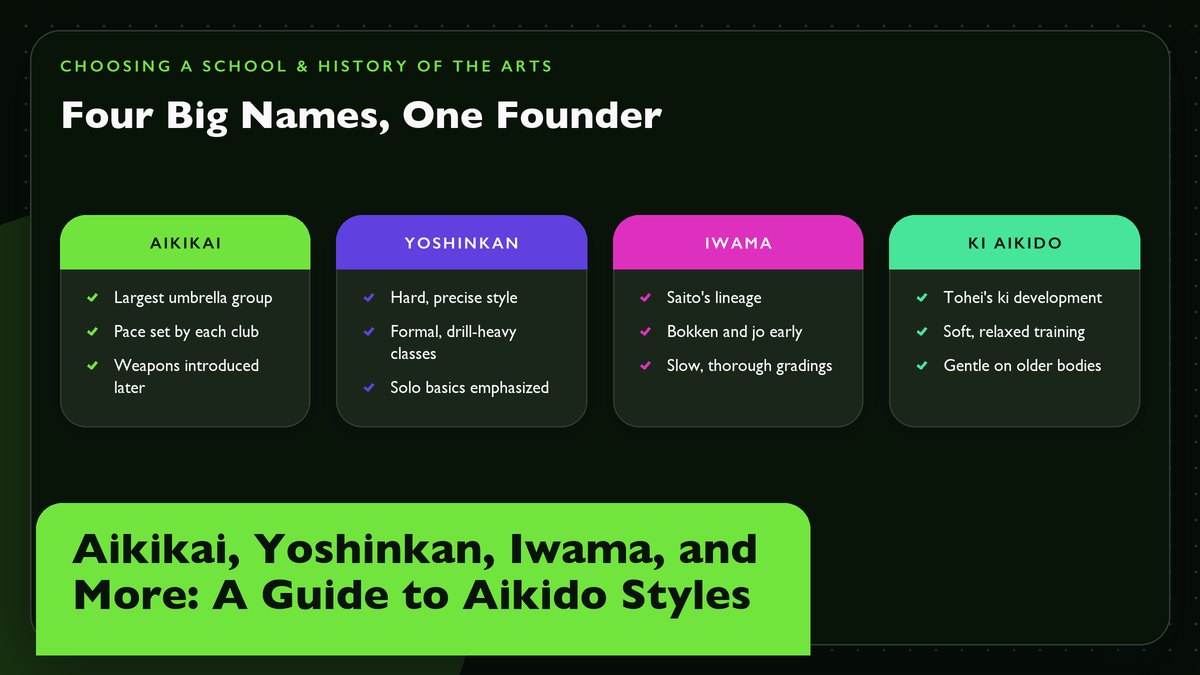
Beginners are usually surprised to learn there is no single answer to whether aikido “works” for self-defense, because aikido isn’t one thing. The major lineages took the founder’s tension and resolved it in opposite directions, and the dojo nearest you is probably an expression of one of them. A rough map follows.
| Approach | Represented by | How they resolve the tension |
|---|---|---|
| Hard and martial | Yoshinkan aikido, founded by Gozo Shioda in 1955 | Keep the founder’s early, pre-war Daito-ryu method: precise, repetitive, physically demanding training aimed squarely at effectiveness. Shioda’s organization taught the Tokyo Metropolitan Police riot squad for decades, which tells you where the emphasis sat. |
| Traditional middle path | Iwama lineage, carried by Morihiro Saito | Teach exactly what Ueshiba taught in Iwama after the war, full technique, weapons and empty hand together, with no talk about whether it’s soft or hard because the founder’s late style contained both. |
| Cooperative and philosophical | Most Aikikai-affiliated community dojos | Prioritize harmony, blending, and the founder’s spiritual teaching; treat self-defense capability as a side effect of correct training rather than the point of it. |
| Competitive | Shodokan (Tomiki) aikido | Add sparring and randori with rules, on the theory that you can’t claim effectiveness you’ve never tested under pressure. Kenji Tomiki, a student of both Ueshiba and judo’s Jigoro Kano, believed competition was the honest way to keep a martial art honest. |
None of these is the “correct” aikido. They’re four answers to the same question the founder left open, and each answer produces different training. A Yoshinkan class will leave your thighs burning and your wristlocks crisp, while a typical Aikikai evening class has you moving in big, flowing circles with a partner who is cooperating with you, and Tomiki students get thrown by people who are actually trying to throw them. If you visit a dojo and want to know which lineage you’re looking at, our piece on dojo etiquette for beginners doubles as a field guide to what different schools signal before anyone says a word.
It’s also worth saying out loud that Gozo Shioda, the hardest of the hard stylists, trained directly under Ueshiba in the 1930s and considered himself completely faithful to the founder. So did his rivals. Read his early interviews and you find him insisting that aikido done right is ferocious, and that the “harmony” talk has a physical meaning — you harmonize with the attacker’s movement precisely so their aggression has nowhere to land. The biography of Shioda is a good window into how un-peaceful the founder’s own pre-war teaching could be.
What the Philosophy Does to Actual Training
Set the metaphysics aside and the philosophy has concrete, physical consequences that you’ll notice in your first month. Three of them shape everything else.
- Cooperative partner practice. Almost all aikido training is done with a partner who attacks in a known way and follows the technique, rather than resisting it. This is the famous aikido training method, and it’s also the famous criticism of aikido, because real attackers don’t cooperate. Supporters reply that ukemi (the art of receiving a technique) builds skills a resisting opponent would never let you practice ten times in a row; critics reply that you eventually have to test what you’ve built. The debate is real and ongoing, and both sides have a point.
- Multiple attackers as the measure. Aikido is one of the few arts that regularly drills against more than one person. A single attacker can be overpowered; three can’t, so the techniques are built around constant movement, off-balancing, and never being where the grab lands. This is the most practical-looking part of the art and also the hardest, which is why most of us spend years just trying to handle one cooperative partner.
- Atemi, the undiscussed strikes. Hidden inside nearly every aikido technique is a strike to the face or body that creates the opening. Some lineages teach atemi openly; in others it’s barely mentioned. Shioda claimed atemi was ninety percent of aikido. That’s a disputed number, but the underlying point stands. The “peaceful” art was designed by a man who could hit, and the throws assume he sometimes did.
And the honest part, because you deserve it before you sign up. If your goal is pure self-defense efficacy with the minimum time invested, mixed martial arts, judo, or boxing will get you competent against a resisting person faster, full stop. That’s the trade. Aikido’s value proposition is different. It assumes you have years to give it, and it asks what kind of person you become during those years. That question is either the point of the art or a dodge, depending on who you ask. Both views exist inside every dojo I’ve ever set foot in, usually in the same changing room.
Aikido’s promise runs slower than that. Stay long enough and you become hard to push around in ways that have nothing to do with muscles.
What Practitioners Today Actually Take From It
So what do the people on the mat get? After watching training partners over the years, the honest answer is that it depends on the person, and the art is unusually tolerant of different goals. A rough taxonomy of what I see on any given week follows.
| If you want… | Aikido delivers… | Be aware… |
|---|---|---|
| Fitness and mobility | Low-impact full-body movement, balance, flexibility that stays useful into your sixties and beyond | It’s not cardio. Supplement with something else if conditioning is the goal |
| Self-defense capability | Gradual skills in distance, positioning, and controlling grabs, best in the Yoshinkan/Iwama end of the spectrum | Expect years before it’s pressure-tested; cross-training closes the gap faster than style-switching |
| Stress relief and calm | The blending mindset is effective at defusing daily conflict, and many students report carrying it off the mat | That’s a side effect. There’s no syllabus for it |
| Community and tradition | Strong dojo culture, long-term training partners, etiquette that builds real respect | Every dojo’s culture differs; visit before you commit |
| A lifelong physical practice | Techniques that keep revealing new depth at forty, sixty, eighty — many dojos have students in their seventies | Progress is slow by design. The art measures in decades |
The cross-training crowd deserves its own paragraph, because it keeps growing. Judoka, BJJ players, karateka, and the occasional boxer filter into aikido classes looking for exactly one thing. The movement. Angles, spirals, entering off the line, controlling a wrist without a wrestling grip. A lot of them take that piece back to their home art and never grade in aikido at all, and the aikido world is mostly fine with that now. The old purists grumbled; the modern dojo shrugs. Honestly, some of the best aikido I’ve felt came from people who treated it as a supplement rather than a religion, precisely because they weren’t defending a worldview — they were just trying to move better.
Which brings the tension full circle. The founder’s own life ran from ferocity to harmony, and every serious student runs some version of the same path. I’ve had evenings where the philosophy clicked and I understood every word on the dojo wall, and evenings where a partner twice my size grabbed my wrist and all the poetry evaporated and what saved me was a plain, hard, unfancy entry I’d drilled a thousand times. The art holds both. That’s not a bug in the design, it’s more or less the design itself.
Deciding Whether Aikido Fits Your Goals
None of this decides the question for you, but a few practical checks will tell you quickly whether a particular school squares with what you’re after. Treat these as a short visit list, and bring the questions to a trial class rather than an email.
- Ask how they train against resistance. Any honest answer is fine — “we don’t, and here’s why,” or “our advanced class does randori,” or “we cross-train with judo people.” Dodge answers are data too.
- Watch how the instructor treats stiff beginners. A teacher who adjusts technique to the student understands blending in the physical sense. A teacher who forces every student into one mold is teaching obedience rather than aikido.
- Ask what atemi they teach. “Atemi? Never” tells you one thing; “it’s everywhere, watch” tells you another. Both exist, and the art’s official history supports the second one.
- Check the vibe when someone asks the self-defense question. Some dojos get defensive; good ones get thoughtful, because it’s the question the founder spent his whole life answering.
If what you mainly want is a peaceful, sustainable practice with real physical depth and a philosophy you’ll still be chewing on in twenty years, aikido fits well and there isn’t much like it. If what you mainly want is proven, pressure-tested fighting skill on a short timeline, take judo or boxing alongside it, or instead of it, and feel no guilt — aikido borrowed half its syllabus from harder arts in the first place, through the Daito-ryu connection that runs straight through the founder. The two goals can coexist. They’re simply different goals, and the dojo that admits that out loud is usually the healthiest one on your list.
Sources and further reading: quotations attributed to Morihei Ueshiba follow the standard translations in The Art of Peace (Shambhala); background on the Aikikai organization at aikikai.or.jp, the headquarters federation at aikido-international.org, and the art’s general history at Wikipedia’s aikido article. Related reads on this site: What Is Aikido?, Ikkyo, the First Technique, and Kyu and Dan Ranks. This article reflects common practice across North American dojos as of October 2026; individual schools vary widely, and the best source on any dojo is the dojo itself.