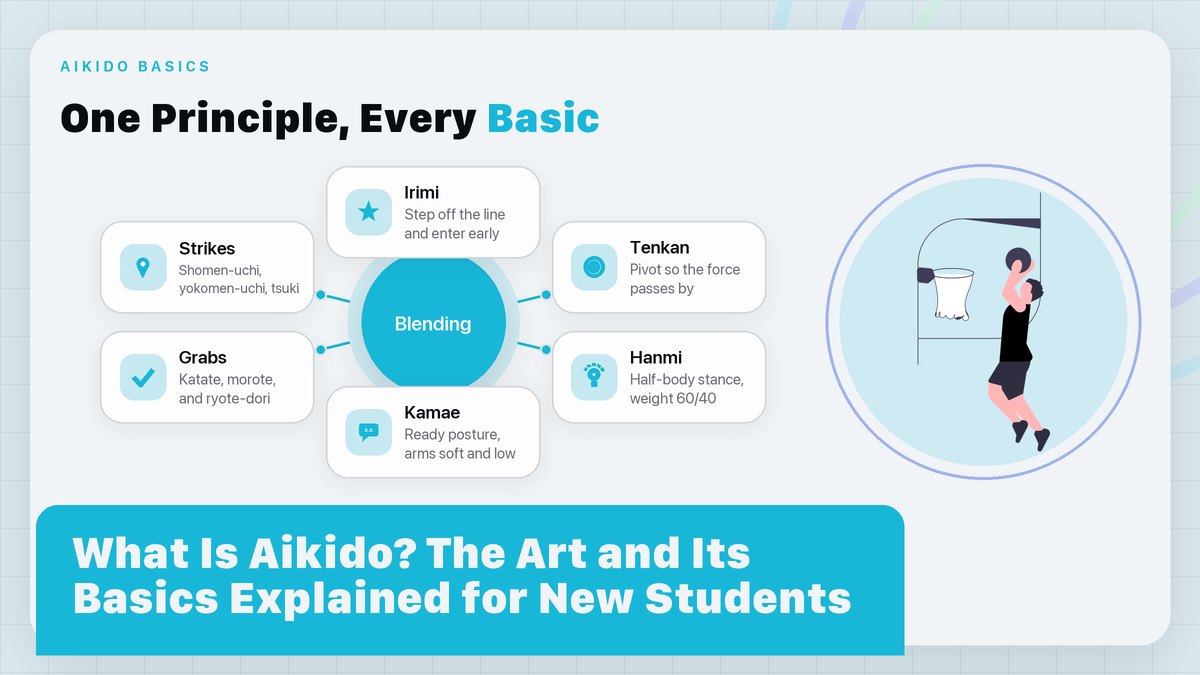
A plain-language tour of the Japanese martial art that redirects force instead of meeting it head-on, plus the basic stances and the first grabs and strikes every beginner meets on the mat.
Walk into almost any aikido dojo in the US or Canada on a weeknight and you’ll see something that doesn’t look much like a fight. Two people bow to each other on a padded mat. One reaches out and takes the other’s wrist, slow and deliberate, the way you’d hand someone a fragile package. The second person turns, the first person’s arm floats up as if pulled by a string, and within a second or two somebody is lying on the mat looking mildly surprised. Nobody got hit hard. Nobody seemed to muscle anything. If you’ve signed up for a beginner class, this is roughly what your first hour will look like, and I’d guess your first reaction will be a mix of curiosity and mild suspicion that the uke, the partner doing the falling, is being polite. Some of it is politeness. Most of it is physics, and the physics takes a while to make sense.
That’s what this article is for. Before the stances and the Japanese vocabulary, it helps to know the single idea the whole art is built around, because every basic technique you’ll learn in your first year is just that idea wearing different clothes.
A Short History, Told Quickly
Aikido is a Japanese martial art founded by Morihei Ueshiba, who was born in 1883 in a small town in Wakayama prefecture and spent most of his long life becoming the kind of person students write books about. In his younger years he trained hard in several arts, most importantly Daito-ryu aiki-jujutsu under a famously demanding teacher named Takeda Sokaku. The core material of early aikido comes straight from that Daito-ryu curriculum, and you can trace the connection in any overview of aikido’s history.
What Ueshiba did over the following decades was reshape that older jujutsu around a different intention. He’d had religious experiences, studied a spiritual movement called Omoto-kyo, and come to believe that a martial art should neutralize an attacker without destroying them, that the highest victory is the one nobody has to win out loud. He called the result aikido, and the name became official around 1942. After the Second World War his students carried the art well beyond Japan, and today the headquarters organization, the Aikikai Foundation in Tokyo, affiliates dojos on every continent. A fuller account of the founder’s own path, from frail small-town boy to teacher with students on five continents, is in any biography of Morihei Ueshiba.
One honest caveat. Ueshiba himself was a complicated man, and the art he taught changed noticeably over his lifetime, softer in his later years than his earlier. Two dojos teaching “aikido” can look quite different from each other, and that’s normal.
The One Idea Underneath Everything
Blending first. Everything else is footwork.
Every martial art answers the question of what to do when someone uses force against you. Aikido’s answer is unusual. You meet the force early, join with it for a moment, and redirect it somewhere harmless, usually past you and down into the mat. The Japanese words you’ll hear for the pieces are irimi, the entering step that takes you off the attack’s line and puts you beside it, and tenkan, the pivoting turn that completes the redirect. Between them sits the idea the art is named for. Ai means joining or harmony, ki means energy or intent. Harmony with the incoming thing.
My first teacher explained it with a door. If somebody leans their shoulder into a door you’re holding, yanking the door shut against them means a shoving match you’ll eventually lose to somebody bigger. Aikido is the option where you stop holding the door shut, step to the hinge side, and let their own lean carry them through the space where the door used to be. Their momentum does the work. You just stopped being where they were pushing.
Two words for the same skill exist in most dojos, and students mix them up for years. Awase is the blending itself, the act of moving together with the attack so early that it never becomes a collision, and musubi is the connection you keep once you’ve made contact. A wrist grab in aikido class is never just a wrist being held. It’s a line of communication, and the whole game is who reads it better.
None of this means the art is passive. Walk into a committed attack too late and you’ll get a strike to the head for your trouble, because timing is the entire technique. The softness people notice from the door is what good structure looks like when it arrives at exactly the right moment.
Aikido doesn’t ask you to be stronger than the person grabbing you. It asks you to stop standing where their strength is pointed.
The First Thing You Learn Is How to Stand
Beginners are sometimes disappointed to spend their first several classes mostly standing still. There’s a reason. Aikido techniques all come out of a balanced, mobile position called hanmi, which means “half-body.” One foot sits ahead of the other at roughly shoulder width, your hips turn so your torso presents itself at an angle rather than square-on, and your weight splits something like 60/40 between the back leg and the front. Picture a fencer’s stance and you’re close, though aikido’s version is lower and calmer. From hanmi you can step, turn, or drop without first reorganizing your whole body, and that readiness matters more than any single move.
On top of the stance comes kamae, your ready posture. Kamae covers more than feet. The arms stay in front with a soft bend, hands open, head up, weight settled down through your legs instead of floating in your chest. In many dojos you’ll learn a specific arm shape early called tegatana, the “hand blade,” where the fingers stay together and the whole hand acts like a small wooden sword. A surprising number of aikido techniques are just tegatana placed accurately on somebody’s arm or shoulder at the right moment.
Two details teachers watch for in a new student’s stance. The first is the back foot, which newcomers turn outward like a duck; it should stay closer to parallel so the pivot is already loaded. The second is the shoulders, which creep up toward the ears the moment a grab lands. Drop them. Every instructor I’ve met has said some version of “relax” at least once per class, and after a while you realize it’s the single instruction that never stops applying.
You’ll also kneel a lot. Seiza, sitting on your heels with a tall back, is how classes in most traditional dojos begin and end, and some techniques are even practiced from the knees to isolate the upper body. Give your ankles a few weeks to adjust. Mine complained for about a month before quietly giving up.
The Three Grabs Every Beginner Meets
Before anyone throws a punch at you in an aikido class, they’ll grab you. Grabs are the training wheels of the art, and there’s a logic to starting there. A held wrist slows everything down and gives both partners time to feel what’s happening, and it forces the person being grabbed to actually move their body instead of swatting at a hand. The standard curriculum opens with three of them.
Katate-dori is one hand taking one wrist. It comes in two flavors depending on which side it lands on. Ai hanmi katate-dori happens when your partner’s front hand grabs the wrist on the same side, and gyaku hanmi katate-dori is the cross-hand version, their front hand taking your opposite wrist. They feel completely different once techniques start, so teachers drill both. Morote-dori tightens the puzzle. Two of your partner’s hands grip your single wrist, which teaches you to move from your center because one arm against two is arithmetic you won’t win. Ryote-dori finishes the set with both of your wrists held at once, a grab that pins your arms apart and forces the whole response to happen through footwork and posture rather than hands.
The three grabs, side by side:
| Grab | Japanese name | What it looks like | What it teaches you |
|---|---|---|---|
| One wrist, one hand | Katate-dori (ai hanmi / gyaku hanmi) | A single hand closes around your wrist, same side or cross hand | Extension, entering off the line, not pulling back |
| One wrist, two hands | Morote-dori | Your partner’s both hands clamp your leading wrist | Moving from your center instead of your arms |
| Both wrists | Ryote-dori | Each of your wrists held, arms pinned apart | Footwork first, since your hands are busy |
Notice what’s absent from that list. Any reason to yank your arm away is missing, and pulling straight back against a grab is the first habit every aikido teacher spends months unteaching, because it loads up your partner’s grip and plants your weight on your back foot, handing them the line they wanted. The response runs forward or around, almost never backward.
The Three Strikes You’ll Practice Against
Once the grabs feel familiar, attacks start arriving as strikes. Aikido has a short canonical list, and beginners meet three of them early. Shomen-uchi is a vertical downward strike aimed at the top of the head, delivered with tegatana, the hand blade, swinging up and then cutting down like a sword. Yokomen-uchi is its diagonal cousin, a rising-then-slicing arc that targets the side of the head or neck. Tsuki is a straight punch, usually aimed at the midsection, and it arrives on time rather than on a cue, which makes it the most honest of the three by a wide margin.
That honesty matters, because the strikes in a beginner class are pre-agreed drills. Your partner, in the role of uke, gives you an attack of a known shape and speed so you can practice the response, called the waza. As you improve, the attacks get faster and less announced. But at every level, aikido practice is a conversation with assigned parts. Uke provides something real enough to work with, nage (the person doing the technique) answers it, and both partners reset and go again. The long-running magazine Aikido Journal has published decades of writing on exactly this partnership, and the forums at AikiWeb are where students argue about it at length, which they do with great enthusiasm.
One thing that surprises newcomers is how much time you’ll spend being thrown. That’s by design. Being uke well, attacking honestly and taking the fall safely, is half the art, and it’s the half that makes you safe to train with for the next twenty years.
The Words You’ll Hear in Your First Month
Japanese vocabulary floats around an aikido dojo constantly, and nobody translates it in real time. A handful of terms covers most of what a beginner overhears. The mat itself is the tatami. Partner practice starts when you bow and say onegai shimasu, a phrase that means roughly “please train with me,” and it ends with a second bow and arigato gozaimashita, thanking your partner for the practice they just gave you. The teacher is the sensei, though plenty of dojos in the US and Canada are relaxed about the word and some instructors prefer their first name. And the spacing between you and your partner, the distance that makes the next attack possible or impossible, is called ma-ai.
None of this vocabulary is ever tested. But I’d learn the two bowing phrases before anything else, because saying them out loud to someone you’re about to grab is a small skill of its own, and it changes how the whole hour feels.
How the Basics Fit Together in a Real Class
A typical beginner class runs about an hour, and the pieces you’ve just read about show up in a fixed rhythm. Classes usually open with a brief seated bow toward the front of the dojo, where a picture of the founder hangs, followed by warm-ups. Light stretching, some wrist and shoulder rotations, a few minutes of rolling practice, because falling safely, called ukemi, gets trained from day one rather than left for later.
The middle of class is partner work. The instructor demonstrates a technique against one of the grabs or strikes above. Pairs form, and you take turns as nage and uke for ten or so minutes before the teacher calls “change” and shows the next variation. Between technique rounds you’ll usually drill footwork on your own, walking irimi and tenkan steps up and down the mat until the pivot stops feeling like choreography and starts feeling like walking. Many dojos finish with a short weapons segment, a few suburi cuts with a wooden sword or wrist-spinning drills with the jo staff, because the weapon movements are the empty-handed movements with the details made visible. Everyone lines up and bows out. Which is also when the senior students stay to sweep the mat.
That’s the whole shape of it. And honestly, the hardest part for most adults isn’t physical at all. It’s accepting that for the first six months you’ll feel like you’re moving through wet concrete while the person next to you glides. They’re gliding because their hundredth class is somewhere behind them. Yours is ahead. The stance, the grabs, the strikes described above are more or less the entire vocabulary of your first year, and there’s enough depth in just those to keep anyone busy.
What to Take From All This
Aikido is a young martial art by the standards of the genre, barely a century old, and it wears its philosophy on its sleeve more than most. I’d call the practical skill it builds redirection. It means seeing force arrive early enough to join it instead of blocking it, then ending the exchange with both people able to stand up and bow. The basics are deliberately plain. Stand in hanmi, hold kamae, meet katate-dori without pulling back, let shomen-uchi slide past on your tenkan, and trust that the tenth repetition of a thing is where it starts to live in your body rather than your head.
So if this sounds like something worth trying, the best next step is unglamorous. Find a dojo near you, watch a beginner class, and notice whether the senior students move like people who enjoy being grabbed. That tells you most of what you need to know about the place.
Sources and notes. This guide reflects common practice in Aikikai-affiliated and independent dojos across the US and Canada; the exact vocabulary and class structure vary between styles and organizations. External links were checked and working as of October 2026. This is training guidance for a supervised martial-arts class, not medical advice; for any injury or health concern, see a qualified professional.
Leave a Reply