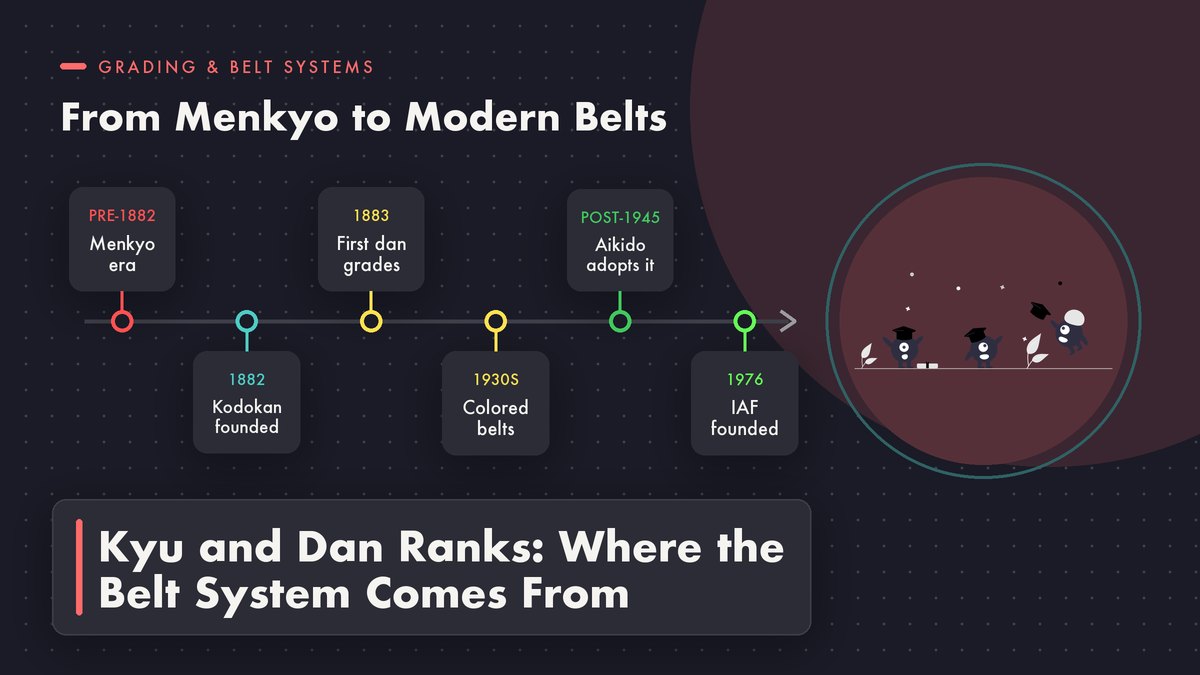
Colored belts feel eternal when you’re tying one on three nights a week, but the whole system is younger than the bicycle. This is the story of how a schoolteacher named Jigoro Kano replaced centuries-old teaching licenses with numbered ranks, and why nearly every martial art on earth, aikido included, eventually followed him.
My first sensei had a story he told every time a new crop of white belts complained about how far away their black belts looked. He’d hold up his own black belt, which was faded to a gray-green at the edges, and point out that it used to be white. Same piece of cloth the whole time. He’d bought it years ago, worn it through hundreds of classes, and it had simply absorbed everything, sweat most of all. The joke landed differently every year, but the point underneath it never changed. The belt is a label somebody had to invent, and the invention is a lot more recent, and a lot more interesting, than most students assume.
If you train in aikido today, you almost certainly train under some version of the kyu/dan system. You start at sixth or fifth kyu, work your way up through the colored ranks, and if you stick around long enough, somewhere around three to six years in, you test for shodan, first-degree black belt, and the numbering inverts so the small numbers mean more instead of less. That whole architecture, the colored rungs, the black belt, the dan ranks going up to ten, descends from a decision one man made in Tokyo in the early 1880s. Everything before that looked completely different. And understanding what he replaced is the fastest way to understand what your own rank actually means, and what it was never supposed to mean.
Before Belts: The Menkyo System
For most of Japanese martial history, there were no ranks at all. There were licenses.
For roughly six hundred years, from the medieval battlefield arts through the peaceful Edo period, a Japanese martial-arts student didn’t progress through colored belts because belts weren’t the currency. Scrolls were. The old schools, called koryu, ran on a licensing system called menkyo, and the shape of it tells you everything about what training meant at the time. A student joined a school, often as a live-in disciple, and spent years learning a catalog of techniques. When the teacher decided the student actually knew a portion of that catalog, he’d issue a certificate called a mokuroku, literally a “catalog” or list, which recorded that the named techniques had been transmitted. Deeper into the curriculum came the menkyo proper, a teaching license, and at the top sat menkyo kaiden, the license covering the entire tradition, which made you a successor, more or less, who could pass the art on unchanged.
The details varied wildly between schools. Some issued multiple graduated mokuroku before any real license, so a student might collect two or three scrolls across a decade. Others kept the whole thing inside one family for generations. The common thread is that certification tracked transmission of a specific body of material from a specific teacher, the way an apprenticeship in any craft guild did, and it said nothing about how good you were relative to strangers in other towns. There was no fifth kyu in 1750, partly because there was no standardized curriculum to measure against, and partly because comparison with other schools was beside the point. You weren’t competing. You were inheriting. A good overview of how these licenses structured the old schools lives in the Wikipedia article on menkyo kaiden, and the whole apparatus is still alive today in the surviving koryu, which issue the same scrolls their predecessors issued four centuries ago.
This system had real strengths. The certificate meant your teacher had watched you perform every technique on it, sometimes for years, and had staked his own name on your competence. But it had one enormous weakness, and by the late nineteenth century that weakness had become impossible to ignore.
Nobody else could read it. A menkyo from one jujutsu school told a potential employer or an army recruiter almost nothing, because there was no common scale underneath it, and in a Japan that was industrializing, conscripting an army, and sending students to European universities, that opacity was becoming a genuine problem. Schools, militaries, and employers all wanted to know what a person could do, on a scale that meant the same thing everywhere. The old licenses were beautiful, personal, and useless for that.
Kano’s Fix: A Scale Anyone Could Read
A 22-year-old schoolteacher and competitive go player invented the answer.
Jigoro Kano was born in 1860, the son of a sake-brewing family, and he’s one of those historical figures whose biography reads like a parody of a reformer. Frail as a boy, bullied, he threw himself into jujutsu as a teenager and was good enough to earn teaching credentials in more than one school of it. Then, at twenty-two, in 1882, he opened his own institution in a small Tokyo temple hall, which he called the Kodokan. The art he taught there he named judo, “the gentle way,” and his project was bigger than self-defense. He believed martial training could be a system of physical education that developed a complete person, and he’d eventually spend decades pushing that belief as a school principal, a Ministry of Education official, and Japan’s first member of the International Olympic Committee. The article on the Kodokan gives the founding story in detail, drawing on the institute’s own published histories, and it’s worth reading before you train a single judo class.
Part of Kano’s genius was that he didn’t invent the kyu/dan idea from nothing. He borrowed it from board games. He was an accomplished go player, and in go, kyu grades mark the rungs below amateur master while dan grades begin at first dan, and the numbers run in opposite directions, small kyu numbers meaning stronger play, large dan numbers meaning higher mastery. Kano saw that a ladder like this could be lifted straight out of the game room and bolted onto physical training, and sometime in his first years at the Kodokan, around 1883, he did exactly that, dividing his students into dan-ranked seniors and kyu-ranked juniors on a single shared scale. He is generally credited with awarding the first two shodan ranks, first-degree black belt, in 1883, to Shiro Saigo and Tsunejiro Tomita. By 1886 the system had acquired its most famous accessory, when Kano introduced a uniform, the judogi, with a belt whose color visibly separated the dan holders, who wore black, from everyone else, who wore white.
Two colors. That’s the whole original invention. There was no rainbow ladder in 1886, no orange or green or purple, just a binary you could spot across a crowded hall: the black belts, who had crossed some threshold, and the white belts, who hadn’t. Everything else got added later, much later, and mostly outside Japan.
Kano took a private contract between one student and one teacher and turned it into a scale a stranger could read in two seconds. That single move is the ancestor of every belt system on earth.
The comparison with what came before is worth spelling out, because the two systems embody opposite ideas about what a rank is for:
| Menkyo licenses (before 1880s) | Kyu/dan ranks (from 1880s) | |
|---|---|---|
| What it certifies | Transmission of specific techniques from a named teacher | Overall level on a shared, comparable scale |
| Who can read it | Members of that school; opaque to outsiders | Anyone, in any dojo, in any country |
| How it looks | Calligraphed scrolls, kept and treasured | A belt color and a number |
| What it implies | Inheritance of a tradition; duty to preserve it | Progress; the next rung is always visible |
| Still used today by | The surviving koryu schools | Judo, aikido, karate, kendo, and most modern arts |
Notice what’s missing from the new system: any claim that you’ve inherited something. A dan grade is a measurement, not a bequest, and that distinction is the philosophical hinge the entire modern belt system swings on. It’s also, if you talk to old-school practitioners, the part some of them still mourn in private.
Why It Spread So Fast
Kano built the kyu/dan system for a local problem, his own growing school, but the timing was uncanny. Japan was modernizing at breakneck speed, building a school system, an army, and a national sports culture almost simultaneously, and judo was deliberately positioned inside all three. Kano himself pushed judo into the school curriculum, and the Army adopted it for hand-to-hand training. A rank system that an army officer or a school principal could understand at a glance was exactly the artifact the moment called for, and judo spread through Japanese institutions like water finding cracks. The dan/kyu structure spread with it, until by the early twentieth century it had simply become how Japanese martial arts organized themselves. When other arts modernized, and nearly all of them eventually did, they reached for the same template.
One practical feature did most of the work. The old menkyo system had no intermediate rungs, or rather its rungs were so spaced out that a student might train for a decade between certificates. Kano’s ladder had frequent, reachable steps, and each one gave a student a visible finish line and a visible next one. Whatever you think of colored belts as a measure of skill, and reasonable people argue about this constantly, they are an extraordinarily effective piece of motivational engineering. A beginner who can see the next rank from where she stands trains differently than one staring at a ten-year horizon, and by the 1920s judo schools across Japan had organized whole class structures around that observation.
The Colored Belt Is a European Invention
The rainbow arrived decades later, and it arrived in France.
This is the part that surprises almost everyone. If you train in a Western dojo today, you probably move through something like yellow, orange, green, blue, and brown before black. That ladder did not come from Kano, and it didn’t come from Japan. The credit usually goes to Mikonosuke Kawaishi, a judoka who moved to Paris in the late 1930s and spent years teaching judo across Europe. His European students, the story goes, wanted more frequent and more visible signs of progress than the austere Japanese white-until-you’re-black scheme offered, and Kawaishi obliged, assigning a color to each kyu grade so a student could glance at a lineup and know exactly where everyone stood. The scheme was a hit, European judo federations standardized it, and it flowed back into the global bloodstream so completely that most people now assume it’s traditional.
Japan noticed the commercial logic and followed suit, especially in the postwar decades, when the martial arts were rebuilding and competing for students. But plenty of Japanese schools kept the old binary well into the twentieth century, and some still do. The point worth holding onto is that the colored kyu ladder, the thing most of us mean when we say “belt system,” is a mid-century layer bolted onto Kano’s framework, younger than radio broadcasting and not much older than television. It spread because it works, mostly. A white belt can see exactly how many rungs are left, and so can the instructor assigning partners.
How the System Reached Aikido
Aikido adopted the framework last, and adapted it the most.
Morihei Ueshiba, aikido’s founder, was born in 1883, the year Kano awarded his first shodans, and the new rank culture was simply in the air of Japanese martial arts throughout the man’s entire life. Ueshiba himself trained in a classical school of jujutsu and had a brush with judo in his youth, so he grew up fluent in the world Kano had built. But his own teaching career took a strange path through history. In the prewar decades, teaching Daito-ryu and then his own evolving art, which he called aiki-budo for a time, Ueshiba mostly did not run a ranked program of the Kano type. His inner-circle students of that era received things like scrolls and teaching permissions, structures with a distinctly menkyo flavor, and the whole operation was small, rural, and personal.
Everything changed after 1945. The occupying authorities banned martial-arts training for a few years, and when it became legal again, Ueshiba’s son Kisshomaru, a young man with modern sensibilities, began rebuilding the art as something that could exist in postwar Japanese cities: organized classes, public enrollment, a headquarters dojo. That headquarters, the Aikikai Hombu Dojo, moved to its permanent home in Tokyo’s Shinjuku district in 1967, and the Aikikai Foundation’s official English pages describe how the art is organized today. Adopting the kyu/dan framework was part of that modernization, almost a foregone conclusion, since by the 1950s there was no other credible way to run a Japanese martial art that wanted to be taught in cities and sent abroad. Ranks were simply how Japanese budo communicated.
Aikido did make the framework its own in a couple of ways, though. Most styles kept Kano’s original restraint about colors, running white belt for all kyu grades in the traditionalist schools and adding colored belts only where the local market expected them. And aikido grading exams, unlike judo’s, are not competitions. There’s no sparring match to win. You’re evaluated on paired technique, usually with a partner attacking in a pre-agreed way, plus some schools add weapon forms and free practice. The International Aikido Federation, the umbrella body that coordinates the art’s national organizations worldwide, was founded in 1976, and the IAF’s site is a good window into how standardized the ranking side has become across dozens of countries. Which is itself a little ironic, and worth pausing on.
Standardization was the whole original selling point. A judoka’s black belt meant the same thing in Osaka and Oslo, and an aikidoka’s shodan now more or less does too. But visit five aikido dojos and you’ll meet five opinions about what shodan means, running from “solid beginner” to “teaching credential,” and they’re all correct within their own organization. The menkyo system had this same property, of course, with every school’s certificates meaning something slightly different. The kyu/dan ladder gave us a shared scale, and then promptly handed the interpretation of the numbers back to each style. Some problems outlive every solution.
What Actually Changed
Step back and look at the full arc. A transmission system built on personal scrolls got replaced by a measurement system built on visible grades, and the replacement conquered the world because it was legible, motivating, and easy to administer. That’s the whole story, and it’s honestly hard to overstate how much it changed. Consider what rank means on the mat now compared to what a menkyo meant in 1750.
- Ranks are now comparable across schools. A fifth kyu in Seattle and a fifth kyu in Stuttgart share a label, even if the contents of their exams differ. This was exactly the thing the menkyo system couldn’t do, and it made the modern world of martial arts, with international federations, visiting instructors, and open seminars, possible at all.
- Progress became visible and frequent. Rungs you can see from where you stand are a powerful engine. A student who tested last month has a date, a certificate, and a next test on the calendar, none of which existed in the menkyo era, where you might train for years with no external sign of movement at all.
- Teaching became separable from ranking. In the old system, the license to teach and the record of what you knew were the same document. Today a first dan can be a fine assistant in one organization and ineligible to run a class in another. The rank measures the person; the permission to teach comes from somewhere else entirely.
- And some things got thinner. A scroll named a teacher and a curriculum and carried the weight of a lineage stretching back generations. A belt color names a level. All the meaning that used to live inside the certificate, the obligation to preserve, the duty to transmit, got left for the student to supply. Most don’t even know it was ever there.
I’d argue that last trade is the real legacy of the kyu/dan system, and I say that as someone quite happy to train under it. We gained a universal language for progress and lost, mostly without noticing, the old contract that made rank a responsibility rather than a trophy. If you want the practical side of what each modern rank typically involves, from kyu exams up through the dan grades, our companion guide aikido belt ranks explained walks through the whole ladder as it’s used in North America today.
What This History Means at Your Dojo
Knowing all this changes a few practical things for a working student, starting with how to read the black belts. In most aikido organizations, shodan means “first step,” and the word dan itself shares a root with the verb to step or to grade, which the traditionalists will tell you, with some relish, means a first dan is literally a beginning. Kano’s framework was designed so that the dan grades describe a curriculum of deepening principle rather than a pile of new techniques, and aikido inherited that shape. The difference between a shodan and a sandan usually isn’t that the sandan knows different throws. It’s that the sandan’s throws work on people who are trying to stop them, with less muscle and more structure, at a speed that would embarrass the shodan.
It also explains the weird inversions you’ll encounter as you climb. At kyu level the numbers count down toward one as you improve, sixth kyu being a beginner and first kyu being nearly ready for black belt, and then the dan numbers count up from one, with meaning getting sparser as they rise. An eighth or ninth dan is a person your organization considers to have spent a lifetime on the art, and there are very few of them anywhere. The twin ladders descend from Kano’s go-board borrowing and have never been rationalized since, which occasionally produces the charming situation of a fourth dan explaining to a new student that yes, the numbering flips, no, nobody is entirely sure why we all kept it, and it’s probably best not to think about it too hard.
Finally, the history hands you a decent yardstick for judging a school. Any organization that treats rank as a pure motivational ladder, testing students on a calendar regardless of readiness, is leaning on the framework as Kawaishi’s European students wanted it. Any that treats rank as a sacred transmission is leaning on the menkyo ghost inside it. Healthy organizations sit in the middle, where the ranks are earned and honest but nobody pretends the belt is the point. You can usually tell within two visits which kind of dojo you’re standing in. Watch what the senior students do when they think nobody’s grading them, because that behavior is the culture, and the culture is the real curriculum.
The belt system was a modernizing reform, a motivational trick, and a borrowed go-board ladder, all at once. Knowing that doesn’t cheapen your rank. It tells you what to do with it.
So the next time you retie your belt before class, it might be worth remembering that you’re participating in a solution to a nineteenth-century paperwork problem, refined by European marketing in the 1930s, and adopted by aikido almost as an afterthought. The system is younger than your great-grandparents. Which, honestly, makes it more interesting to be inside of, and gives you better questions to bring to your own grading than the new students in my old dojo ever thought to ask.
Sources and notes. Historical details throughout follow the published accounts of the Kodokan (for Kano and early judo), the Aikikai Foundation (for postwar aikido organization), and the International Aikido Federation (for the modern federation structure), with the Wikipedia biography of Jigoro Kano as a useful cross-reference. Rank requirements vary between organizations, so always treat your own dojo’s guidelines as authoritative. If you’re newer to the art, what aikido is and how it works is the right starting point, and our guide to bowing and dojo etiquette covers the culture the ranking system floats in. External links were checked and working as of October 2026.
Leave a Reply