Category: Grading & Belt Systems

  • How Long Does It Take to Earn a Black Belt in Aikido?

    How Long Does It Take to Earn a Black Belt in Aikido?

    Grading & Belt Systems

    The honest answer, broken down by how often you actually train: what the timelines look like at one class a week, at two or three, and at the committed end, plus why aikido’s first black belt usually arrives later than in most other arts.

    Updated October 2026 · 15 min read

    Someone asks this question in almost every beginner class I’ve ever been part of, usually in the parking lot after the trial lesson, gi still on, questions already forming. And the answers floating around the internet are a mess. One site promises a black belt in eighteen months if you pay for the accelerated track. Another warns it takes a decade. Both are describing real dojos, which is exactly the problem. The true answer depends on things most articles skip: how many hours a week you train, which organization your school belongs to, and what the art itself believes a black belt is for. So let me give you the straight version, with numbers, and no sales pitch waiting at the end of it.

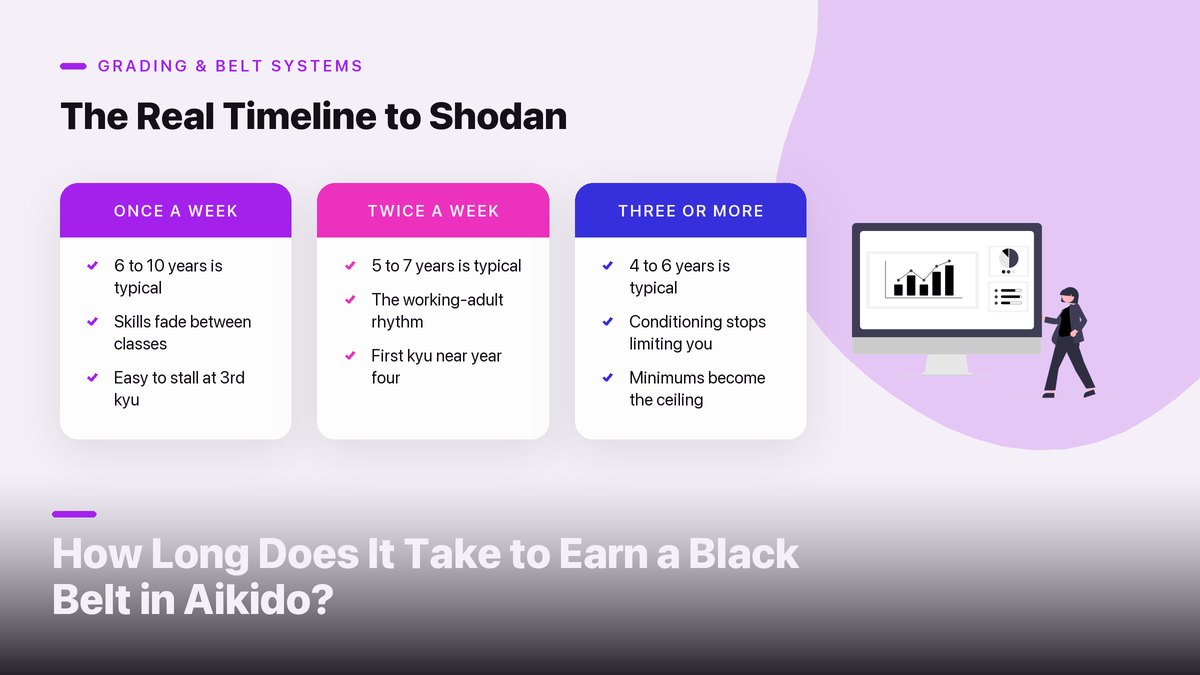
    First, the short answer. For a typical adult training two to three times a week, earning shodan, the first-degree black belt in aikido, takes roughly four to six years in most Aikikai-affiliated and independent schools in North America. Train once a week and the same journey stretches to six or ten years, if it stays on track at all. Train four or more times a week, add seminar travel on top, and some organizations with aggressive minimums will get you to shodan in closer to three or four years. Those are honest ranges rather than guarantees; later in this article I’ll show you exactly which variables push you toward either end.

    What “Black Belt” Means in Aikido

    In Japanese it’s called shodan: “first level.”

    Before the timeline makes sense, you need to know what the destination actually is, because aikido’s first black belt is not the same object as a first-degree black belt in most other martial arts. Shodan (初段) breaks down as sho, “beginning,” and dan, “grade.” Read that again slowly. The name of the rank itself says that the holder has reached the first stage of serious study, the point at which the foundations are considered solid enough to start learning the art properly. The history of the dan ranking system explains how judo founder Jigoro Kano borrowed the idea from board games like go in the 1880s and spread it through Japanese budo, where it stuck.

    This isn’t false modesty on the part of senior aikidoka. It’s structural. An aikido shodan is expected to move correctly, fall safely, know the basic vocabulary of throws and pins, handle a wooden sword and staff at an introductory level, and train in a way that doesn’t endanger a partner. That’s a real list of skills, and it takes real time to build; nobody expects a shodan to have their own mature aikido yet, and growing one takes years more through nidan, sandan, and beyond.

    A useful comparison: calling an aikido shodan a “master” would be like calling a college freshman a professional. They’ve earned something real. It’s the doorway, rather than the house. In my experience this is also why aikido people answer the “how long” question with a shrug more often than a number. They know the questioner usually pictures a finish line, and in this art the first black belt is closer to a starting line with a small ceremony attached. Morihei Ueshiba, the founder, kept the ranking frame modest on purpose, considering the dan grades bookkeeping next to actual training. Any biography of Ueshiba makes clear the man graded almost nobody for long stretches of his life, which is part of why early aikido ranks were rare and slow to earn.

    Why does this matter for your timeline? An art that treats first-degree black belt as a foundation-level credential has more material to cover before it hands one out, and no shortcut is built into the definition.

    The Kyu Grades Before the Black Belt

    Between white belt and shodan sits a ladder of kyu grades, numbered in descending order. Most North American schools run sixth kyu down to first kyu, though some fold several together or start new students partway up. At each step the examiners expect a wider slice of the curriculum: a fifth kyu demonstrates five or six techniques competently, while a first kyu demonstrates most of the art’s standing and kneeling techniques plus the weapons syllabus at a level that won’t hurt anyone.

    Our article on how aikido’s belt ranks work walks the whole ladder step by step. The point for your timeline is simpler. Every organization sets minimum time-in-grade between kyu ranks, and those minimums add up. A school requiring roughly six to twelve months per kyu grade, times five or six grades, lands at three to five years before you’re even eligible to test for shodan. That’s just the arithmetic of the ladder, before anything about your personal progress enters the picture.

    Which is where the honest caveat comes in. Minimum time-in-grade is a floor rather than a schedule, and meeting the minimum at every step gets you eligibility, nothing more. Many students spend an extra grading cycle or two at one rank because their instructor wants something cleaner before signing the test form. I’ve watched perfectly dedicated people sit at the same kyu for two years while a quicker peer moved up, and the slower ones usually turned out better aikidoka for it. Ranks in aikido are awarded by people, not by calendars, and that’s a feature even when it frustrates you.

    The calendar gets you eligible. Your movement gets you promoted. The second one is slower, and it should be.

    Why Aikido Takes Longer Than Most Arts

    Compare timelines across martial arts and aikido sits toward the slow end, and the reasons are worth understanding rather than just accepting. None of them are accidents or gatekeeping for their own sake, though it can feel exactly like gatekeeping around your third year, and four of them do most of the work between you and shodan.

    A broad syllabus, tested in full

    Karate schools often grade on a smaller technical core at the early ranks. Judo tests a well-defined set of throws. Aikido, especially in Aikikai-style curricula, asks you to demonstrate a wide spread of technique drawn from grabs, strikes, multiple attackers and kneeling variations, plus paired weapons work, all on the same exam. Breadth costs time. A student can be good at half the syllabus and still need two more years to make the other half presentable. The worldwide umbrella around the Aikikai in Tokyo exists partly because this broad curriculum needed a common frame, so a rank earned in one country means something in another.

    Ukemi as a second skill

    Learning to throw people is one skill. Learning to be thrown, over and over, without injury, with the timing and relaxation that make your partner’s practice possible, is another skill entirely, and aikido grades you on both at once. Building safe falling ability takes most people a year of regular practice before it stops being the thing that limits everything else. Some arts have this too, judo most of all, but in aikido the ukemi standard stays high right through the dan ranks, which stretches every timeline by a season or two and never gets counted in anyone’s math.

    Partner dependence

    You can’t rehearse aikido alone the way you can drill a kata or hit a bag. Every technique exists in the space between two people, and your progress is partly hostage to the partners you draw in a given class. Our guide to how aikido grading exams actually run covers what examiners watch for, and it’s almost all relational. Say you train twice a week. Some nights you get a calm black belt who feeds you exactly the right energy; other nights you get a nervous beginner who grabs like a falling bookshelf. Both nights teach you something, but the second kind slows measurable progress, and no solo workaround fully replaces mat time.

    Culture and conservatism

    Finally, aikido organizations are, as a group, conservative about rank. The Aikikai Foundation, the organization Ueshiba’s family still leads from Tokyo’s Hombu Dojo, sets a tone that trickles down through national bodies like the United States Aikido Federation to your local school. Fast promotions happen, but the system’s center of gravity leans toward “make sure.” Contrast that with commercial karate or taekwondo chains where a black belt in two to three years keeps students enrolled, and you’ll see why aikido numbers skew high. Sometimes that’s wisdom. Occasionally it’s inertia wearing wisdom’s clothes. Mostly it’s the former, I think, but after a decade around dojos I’d be lying if I claimed the two never get confused.

    Realistic Timelines by Training Frequency

    This is the section you scrolled for. These ranges assume an adult beginner starting from zero, training in a typical North American Aikikai or independent dojo, with no relevant background in judo or another grappling art. Treat them as weather forecasts instead of appointments. Requirements vary by dojo and by organization, and any table that forgets to say so is selling something.

    Training frequency Typical path to shodan What the years actually look like
    Once a week 6 to 10 years, sometimes longer. Slow skill consolidation; long gaps mean each class re-warps the body; kyu minimums pile up; easy to stall around 3rd or 2nd kyu for years.
    Twice a week 5 to 7 years The most common rhythm for working adults; steady visible progress; most students land near first kyu around year four.
    Three times a week 4 to 6 years. Fast enough that conditioning stops being the bottleneck; technique detail and weapons work start compounding; the classic “committed hobbyist” arc.
    Four or more times a week, plus seminars 3 to 5 years, where the organization allows it Close to a part-time job in intensity; only feasible for some; minimum time-in-grade rules become the real limit on speed.

    The table says one thing without quite spelling it out. Frequency matters most at the low end. Going from one class a week to two does more for your timeline than going from three to four, because at one class a week you’re spending a third of each session re-teaching your body what it forgot. Going from three to four mostly adds refinement. The returns diminish, which is worth knowing before you reorganize your life around five classes.

    Also, the table assumes you stay healthy and keep showing up, and that’s a bigger assumption than it sounds. Over a six-year span, almost everyone loses months somewhere to a job change, a move, a balky knee, a new baby, or some pandemic-sized curveball nobody scheduled. I said four to six years for the two-to-three-times-a-week student, and I stand by it, but the students who actually arrive in that window usually trained closer to five years of mat time across six or seven calendar years. Mat years and calendar years are not the same thing, and only the mat years count when an examiner decides you’re ready.

    Quick tipIf you can only train once a week but want faster progress, the single best add-on is a second weekly session of whatever your school offers, even a one-hour weapons or fundamentals class. Twenty minutes of solo weapons practice in your garage on off nights helps too. What doesn’t speed things up is collecting video tutorials instead of mat time; aikido is corrected in person or it isn’t corrected at all.

    The Variables Nobody Puts in the Table

    Beyond frequency, five things move your personal number up or down by a year or more each, and at least three of them sit partly outside your control, which is worth accepting early in the journey rather than late. None of them appear in the table above, and all of them will find you eventually.

    • Your organization and its minimums. Aikikai-affiliated schools, USAF schools, independent dojos, plus styles like Tomiki or Yoshinkan, all publish different expectations for time-in-grade. Ask your instructor directly what the minimums are at your school; a good one will answer in one sentence.
    • Prior martial-arts experience. A judo brown belt often tests through the kyu ranks quickly because ukemi and body organization transfer. A dancer’s balance transfers; everything else mostly starts from zero, and that is completely fine.
    • Seminars and intensives. A weekend seminar with a senior teacher from outside your school can expose problems your home dojo has stopped seeing. Many organizations expect seminar attendance before dan grades; almost all reward it. Budget for two or three a year, treat the travel as part of the training, and pick at least one seminar outside your own style.
    • Instructor availability. Some dojos only test when a senior examiner visits, which can mean waiting an extra season for a test you were ready for months earlier, and across a five-year path those waiting seasons add up to real months.
    • Age and body. Adults over fifty routinely earn shodan, and it’s one of the better things about this art, but timelines stretch when the body needs gentler progressions, with no shame in that; aikido’s older dan grades are some of the most instructive people on any mat.

    Stack a couple of the slow versions of those variables on top of a once-a-week schedule and eight years to shodan stops sounding like a worst case. Stack the fast versions under a three-times-a-week schedule and four years becomes realistic, since the same art yields very different arithmetic once those variables stack.

    Faster Paths, and What They Cost

    Since the slow answer drives some people away, let’s deal with the fast ones honestly. Some organizations and some schools do produce shodan in two to three years. When it’s legitimate, the path usually involves daily training or a compressed curriculum, sometimes a style like Tomiki with fewer techniques required on the exam. When it’s dubious, it involves a checkbook, and the wider aikido community treats those ranks the way you’d expect. A rank nobody recognizes outside one building isn’t a shortcut around the timeline; it’s a timeline with nothing in it.

    The cost question is subtler even on the legitimate fast path. A student who reaches shodan in three years on five classes a week has, in calendar terms, the same mat hours as a five-year twice-a-week student, and the mat hours are the real currency. What they sometimes lack is the seasoning that comes from watching their own technique evolve across more years of partners, more injuries survived, more boring Tuesday nights. Some of that transfers, some doesn’t, and honest fast-path black belts will usually tell you the second dan took longer than the first.

    There’s also a motivation trade worth naming. For many students the black belt functions as fuel, and stretching the timeline feels like cruelty. Fair enough. But in aikido specifically, the students who burn out fastest are often the ones who treated shodan as the finish line, because they arrive at it and discover the art has just opened up underneath them. The ones who last are the ones who found a reason to enjoy Thursday class by week six. The belt shows up eventually if that’s true. If it isn’t true, no belt will fix it, and the years between tonight and the test will feel exactly as long as they are.

    What Shodan Actually Tests

    Knowing the destination in detail makes the journey legible, so here’s what a typical first-dan exam looks like in most organizations, drawn from published requirements and from sitting in the audience at more of these than I can count. You’ll be asked to demonstrate a broad set of techniques against standard attacks, show both standing and kneeling forms, handle some randori (free-style movement against more than one attacker), perform the paired sword and staff kata your school teaches, and take ukemi for your own examiners at full speed. There’s often a written or oral component about dojo etiquette and basic history, and sometimes a short essay on the school’s lineage, etiquette vocabulary, and basic history.

    Two things stand out when you look at that list. The first is that none of it is exotic. Everything on a shodan exam is something you’ll have done hundreds of times before the test date; the exam is mostly a test of whether the basics survive pressure and fatigue in front of a watching room of black belts. The second is that the requirements exist on paper, but the pass/fail decision is made by humans applying judgment. That’s why the timeline stays fuzzy no matter how precise the minimums look. Human judgment over years of watching you move is the actual mechanism, and no article can compress it, this one included.

    What to Do While You Wait

    Whether your number is four years or eight, you’re going to spend most of that time as someone without a black belt, so the practical question is how to make those years productive rather than merely endured. A few things I’d pass along from watching a lot of people make this trip:

    • Train consistently, week in and week out. Two classes a week for five uninterrupted years beats four classes a week for six months followed by a nine-month gap. Continuity, not intensity, is the compounding interest of martial arts, and it pays out in ways you only notice around year four.
    • Fall well on purpose. Ukemi practice outside of regular technique work pays back across every other skill, so ask a senior student to spend ten minutes just throwing you and pay attention to the quality of your landings.
    • Write down what you were corrected on. One line per class, in a notebook or a phone note. You’ll be startled, in year three, by the pattern of which corrections keep repeating, and by how few of them were ever new.
    • Go to seminars, especially the ones that scare you a little. Training under unfamiliar senior teachers exposes the gaps your home dojo has gone politely blind to.
    • Help the newest person on the mat. Teaching is the fastest way to discover what you only half-understand, and dojos remember who helped.

    And one mindset note before the close, offered with the humility of someone who badly needed it himself: the wait is the training. The person who earns shodan in five years did not just endure five years. They’re someone whose character was formed by five years of bowing, falling, being corrected, showing up anyway. Shrink the timeline artificially and you’d shrink the person it produces.

    Sources and notes. Timelines reflect common practice in Aikikai-affiliated and independent dojos in the US and Canada; minimum time-in-grade and exam requirements vary by organization, so confirm specifics with your own school. Related reads on this site: aikido belt ranks explained and how aikido grading tests work. External links were checked and working as of October 2026.
  • What Happens at an Aikido Grading Test

    What Happens at an Aikido Grading Test

    Grading & Belt Systems

    From the first bow to the moment your name is read out loud, here’s what actually happens inside an aikido grading exam, what the examiners are scribbling on their clipboards, and why most people pass.

    Updated October 2026 · 13 min read

    Somewhere in the weeks before my first grading, I developed a theory that the exam would be the hard part. Ten years and several ranks later, I can report that the hardest part was the waiting, and the second hardest part was parking. The test itself turned out to be the most familiar hour of my aikido life so far, because I’d spent months rehearsing almost every minute of it without realizing. That’s the secret nobody tells nervous candidates. A grading exam in aikido is less an audition and more a demonstration of what you already do three nights a week, performed in front of people with clipboards. If you’re about to test, this article walks you through the whole thing, from the warm-up you already know to the bow you’ll take at the end.

    One caveat before we start. Aikido has no single world federation that runs every exam. The big umbrella organizations, like the Aikikai Foundation in Tokyo, set broad expectations, and almost everyone shares the kyu-and-dan rank system borrowed from older Japanese arts, but your instructor runs your exam your way, and details vary from dojo to dojo, sometimes from year to year. What follows is the common shape of a grading in a typical North American dojo. If your sensei tells you something different, your sensei wins.

    The Weeks Before the Test

    Nobody springs a grading on you. There’s a ritual to getting permission.

    In most traditional dojos, you don’t just sign up for a test. Your instructor invites you, or you ask formally and they consider it, and that consideration is the first filter. The teacher has watched you train for months, sometimes years, and they’re asking themselves a practical question, roughly: “Can this person demonstrate their rank, safely, in front of a panel, without embarrassing themselves or hurting a partner?” If the answer is yes, you get a yes. If the answer is “almost,” you get a “not yet,” which stings for an evening and then turns out to be the correct call more often than not.

    Once you’re approved, expect the next month or two of classes to change character. Your instructor will quietly steer the whole room toward your syllabus, calling the techniques you’ll be tested on, drilling the ukemi you hate, and correcting the small habits that have survived this long because nobody had a reason to fix them. Partners you barely spoke to last month start giving you unsolicited advice, which is how you know the dojo has decided you’re testing whether you like it or not. I think of this period as the exam arriving early. The actual test date is just the part with an audience.

    Logistics are simple but worth listing, because stress makes people forgetful:

    • Know your syllabus. Write down the techniques for your rank, in the order your dojo teaches them, and drill the list until you can recite it cold. Exams get failed on forgotten syllabus items more often than on bad technique.
    • Gather your gear the night before. A clean gi, your belt, and if your dojo uses name tags, your zekken. Some exams include weapons, so ask whether your bokken and jo should come along.
    • Sort out fees and paperwork early. Rank certificates usually involve a registration fee that flows up through your national organization to the Aikikai, and since groups like the United States Aikido Federation process rank registration for their member dojos, it takes time, which is why certificates often arrive weeks after the test.
    • Sleep, eat, hydrate. Boring advice, but an exam is an hour of continuous movement, and showing up depleted is the one avoidable mistake on this list.

    The Day of the Test

    Show up early. I mean twenty to thirty minutes early, not the breezy five-minute version you get away with on a regular Tuesday. Exams run on a schedule, candidates are often grouped by rank, and the chief examiner will want to confirm who’s testing, in what order, with which partners. Being present and squared away when those decisions get made is the first impression, and it’s made before any bow is called. So use the extra minutes to warm up your ankles and slow down your head, in that order.

    There’s usually a check of your gi, too. A clean, white, reasonably fitted uniform is the unspoken expectation, belt tied properly, no torn sleeves flapping around your elbows. Some examiners have strong opinions about zekken, the white name tag worn on the chest in many traditional dojos, and whether yours is present and legible. It seems fussy until you remember that the panel may include a visiting teacher who has never seen you before and will be identifying you by that tag for the next hour.

    If the schedule lets earlier groups go first, watch them. Not to psych yourself out, but because the mat you’ll test on has a personality. The corners are closer than they look, the floor may be slick near the door, and seeing how the first candidates handle the space settles something in your own movement. Anyway, the waiting room before a grading is one of the friendliest places in the martial arts world. Everyone is nervous, everyone is pretending not to be. And the black belts telling calm stories are all remembering their own shaky first exams.

    Bow In, Then Warm Up

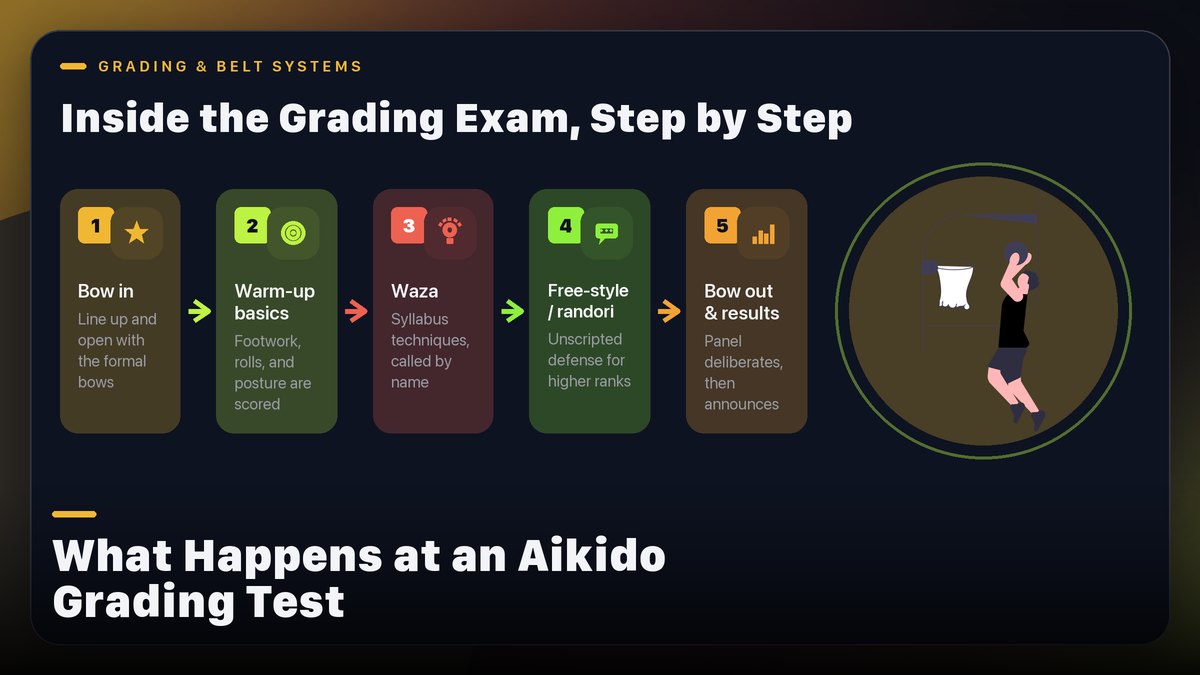
    The exam usually starts the way every class starts, which is deliberate. You’ll line up, the senior student will call the bows, and the room will bow to the front, to the examiners, and to each other. The examiners, by the way, are often senior teachers from other dojos. Bringing in outside eyes is standard practice, because it keeps standards honest and stops any one school from drifting into its own grading habits. The opening bows are the same ones from any class, just performed a little more carefully than usual.

    Then comes the warm-up, and it counts. Most candidates miss that. It won’t be announced. Nobody will say “the exam has begun.” The senior examiner simply calls the first exercise, usually something basic like stretches, footwork, or rolling practice, and the panel starts watching. Your posture during stretches, whether you’re focused or chatting, how cleanly you take your falls, all of it goes in the notes before a single named technique is called.

    Basics at this stage typically mean the things you do every single class. Tai no henko, the blending pivot. Forward and backward ukemi, maybe breakfalls if your rank expects them. Suburi, the basic sword cuts, in schools that fold weapons into warm-up. None of it is exotic. Which is the point. The panel wants to see the floor of your ability, the stuff that should be automatic by now.

    Examiners start grading the moment you step on the mat. There is no “just the warm-up.”

    The Demonstrated Techniques

    After basics, the examiners begin calling techniques, and the format is simple. A name is called, you bow to your partner, and you demonstrate, usually with the partner assigned to you from your own dojo. Depending on the rank, you might do each technique once or several times, from one attack or several, and at some point the panel will swap your roles and watch you take ukemi for the same techniques. Sometimes a technique you did early in the hour comes back near the end, called again without warning, just to see whether the second version improved on the first while you were busy thinking about everything else.

    What are they looking for? Not perfection, mostly. I want to be honest about that, because candidates torture themselves trying to perform the “correct” version of ikkyo. What the panel actually watches is whether the shape of the technique is recognizable and safe: did you get off the line of attack, did you control the partner’s balance before moving them, did you finish with posture instead of leaning, did your partner land somewhere predictable. If you train regularly, those things are already in your hands. If you’re newer to aikido, our walkthrough of ikkyo, the first technique everyone learns, covers the shape examiners expect from the very first rank upward.

    Expect the unexpected to be called. Most panels deliberately throw in a technique you weren’t anticipating, or ask for a variation from the side instead of the front. This isn’t a trap. It’s how they check that you own the material instead of having memorized a sequence, because a sequence breaks the first thing a real attacker does something unscripted. When an odd call comes, pause, bow to your partner, and take your time setting up. A composed three-second setup reads far better on a clipboard than a hurried technique that half-works.

    The examiners may also stop you mid-technique to ask for a correction or a repeat. Don’t argue, don’t apologize, just nod and do the version they asked for. Some of the friendliest examiners correct the most, because they’re engaged enough to bother. A panel that has gone quiet and stopped offering notes is usually a worse sign than a chatty one.

    Partners matter here more than people expect. A good uke for a test is not a passive rag doll and not a tank. They attack honestly at an agreed speed, they give you their balance so the technique has something to work with, and they protect themselves if something goes wrong. In return, you owe them the same when the roles swap. Most candidates test with a partner they’ve trained with for months, which is why those last few pre-test classes matter: you’re really rehearsing the pair of you, not just yourself.

    Ukemi, Randori, and the Higher-Rank Extras

    At every rank, part of the exam is dedicated to ukemi on its own, rolling and falling as a skill rather than a byproduct. For early kyu ranks that might mean a line of forward rolls across the mat and a few backward breakfalls. Higher ranks get thrown harder and faster, sometimes by the examiners themselves. If ukemi is the shaky part of your game, our ukemi basics guide is worth a slow read before test day, because nothing else in the exam reveals nerves quite like a stiff fall.

    From roughly third kyu upward in most schools, expect jiyu waza, free-style defense against a single attacker who can choose their grabs and strikes, and at dan level, randori against multiple attackers. This is the part of the exam that looks chaotic to a beginner watching from the sideline and is actually the most honest part of the whole day. Without a script, the panel sees how you move when nobody tells you what comes next. That’s the real test. Keeping your feet under you, staying aware of the whole mat, and not panicking into muscle are the actual criteria, in my opinion.

    Aikikai-style schools often add weapons kata as well, the thirteen-count bokken and thirty-one-count jo patterns, for the middle and upper kyu ranks. These are demonstrations of solo form, so they show something the partner work can’t: whether your posture, distance, and movement hold up with no one else on the mat to react to. Organizations descended from the founder’s teaching, which you can read about on the Wikipedia overview of aikido, treat these kata as the connective tissue between empty-hand technique and weapons work.

    The extras vary enough that a table is the honest way to show it:

    Rank level What’s typically tested What the panel adds
    Beginner kyu (5th-6th) Basic ukemi, a short list of techniques from set grabs, etiquette throughout Focus and safety; whether the candidate is coachable in the moment
    Middle kyu (3rd-4th) Longer syllabus, multiple attacks, both roles (nage and uke), solo weapons kata Timing, posture under pressure, smooth transitions between techniques
    Advanced kyu (1st-2nd) Full syllabus from any attack, jiyu waza against one attacker Consistent control, spacing, calm when a technique fails and needs redoing
    Dan grades (black belt) Everything above plus randori against multiple attackers, teaching demonstration at some schools Authority on the mat, economy of movement, whether lower ranks could learn from watching this person

    Notice the last column drifting away from technique as the ranks climb. That’s the whole story of aikido gradings in one table, honestly.

    What Examiners Are Actually Scoring

    Candidates obsess over this part, and almost nobody explains it. There are no points. Most aikido exams don’t use a numerical scorecard. The panel holds a mental model of what your rank should look like, watches you for an hour, and then votes. Pass or fail, with a discussion in between.

    That mental model has four buckets, and it helps to know them before you’re inside one:

    What they watch Passing looks like Failing looks like
    Basics Footwork and falls are automatic; stance stays upright even when tired Stumbling through warm-up rolls, posture collapsing halfway through
    Techniques Recognizable shape, off-the-line entry, partner controlled and safe, finishes with balance Arm-wrestling the partner, forcing throws, lost techniques followed by visible panic
    Ukemi Falls are relaxed and quiet, partner trusts you with speed and power Stiff, noisy falls; protecting yourself so hard the technique can’t happen
    Attitude Calm bow in and out, takes correction without argument, keeps going after a mistake Arguing with examiners, sighing at errors, treating partners roughly

    A few things in that table deserve unpacking. Attitude genuinely counts, and it counts from the warm-up, because rank in a traditional art is a statement about character as much as skill. The founder’s framing of aikido as a discipline of the person, not just the body, is old news to anyone who has read a biography of Morihei Ueshiba, and examiners who grew up in that tradition grade what they see of the person.

    Also, mistakes are allowed. A failed technique that you notice, redo calmly, and complete correctly reads better to a panel than a shaky one you rushed through. Examiners watch what happens after the mistake more closely than the mistake itself, so the one skill worth rehearsing above all others is the recovery. I’ve seen nervous candidates melt down over one wobbling ikkyo and calm ones turn the same wobble into their best throw of the day, and the difference was rarely the technique.

    How Passing and Failing Actually Work

    When the last technique is done, you’ll line up and bow out, and the panel will ask you to step off the mat while they talk. This conversation can take two minutes or twenty, depending on the rank and the politics of the panel. Sometimes the decision is obvious to everyone, sometimes a candidate splits the examiners down the middle, and the chief examiner’s opinion carries the weight. Use the break to breathe.

    If you pass, you’ll be called back in, the result is announced, you bow, and everyone claps. Certificates usually come later, because rank has to be registered up the organizational chain, which in Aikikai-affiliated schools runs from your dojo through the national organization to Hombu Dojo in Tokyo. Your new rank is real the moment it’s announced, even if the paper takes two months to arrive in the mail.

    Should you fail, the news arrives kindly and privately, with reasons. Retesting waits some months, often six. Take it from someone who’s watched several friends go through it: failing a kyu exam is a bruise, not a break, and almost everyone who fails once passes the next time, because they’ve now seen exactly what the exam feels like from the inside. The candidate who failed and kept training is, in the long run, indistinguishable from the one who passed on the first try.

    Quick tipOn test day, arrive twenty to thirty minutes early and treat the waiting time as part of the exam. Stretch, stay quiet, watch the candidates ahead of you if the schedule allows it, and skip the hallway huddles where people swap horror stories. The nerves you feel are the same nerves every person on that panel has felt in the same spot on the same mat.

    The Part Nobody Warns You About

    The strangest part of grading day isn’t the exam. It’s the day after. You trained for months toward one morning, the morning is over, and there’s a hollow feeling where the goal used to be. Old-timers have a standard answer for this, which is that the rank you just earned is now the floor of what’s expected from you, and the next rank started the moment you bowed out. It sounds like a motivational poster. It also happens to be true, and most people who stick with aikido long enough end up nodding along with it.

    There’s a lighter side too. Grading days are usually followed by food. Dojos celebrate at a nearby restaurant, the new ranks get toasted, and the people who just tested you turn back into the people you train with every week, sometimes for the first time you can remember. If your first exam is coming up, I’d say go in expecting exactly what you’ve been practicing, give your partners clean attacks and safe falls, and save some appetite for afterward.

    Sources and notes. Practice described here reflects common exam formats in Aikikai-affiliated and independent dojos in the US and Canada; your own dojo’s syllabus and customs always take precedence. If you’re new to aikido altogether, start with what to expect at your first aikido class, then the etiquette and ukemi guides linked above. External links were checked and working as of October 2026.
  • Aikido Belt Colors and Ranks Explained

    Aikido Belt Colors and Ranks Explained

    Grading & Belt Systems

    Six kyu grades, ten dan ranks, and a rainbow of belt colors that changes every time you switch organizations. This article walks the whole ladder, from your first test to the far side of black, and answers honestly what your belt will and won’t tell anyone about you.

    Updated October 2026 · 14 min read

    At my first grading, I was so nervous I tied my belt backwards. Sixth kyu, the lowest rung on the ladder, a test that basically asks “can you fall down and get back up without hurting yourself,” and there I was in front of two examiners with the knot pointing off to one side like a wilted flower. My partner for the test, a quiet accountant named Dennis who outranked me by exactly one belt, whispered “leave it” as we bowed in. He was right. Nobody was grading my laundry skills, and by the end of the morning I’d learned the most useful early lesson this system has to teach: the belt is a marker. The progress itself lives somewhere off the rack.

    That’s a hard lesson to hold onto, because everything about martial arts marketing pushes the other way. A belt feels like a verdict. If you’ve just started aikido, or you’re comparing schools and trying to decode what “we test up to fourth dan” even means, this article walks the whole ladder. The kyu grades beginners climb, the dan ranks on the far side of the black belt, why your white-belt cousin in karate wears a different color than your aikido training partner at the same experience level, and an honest answer to what any of it actually proves.

    The Shape of the Whole System

    Two ladders stitched together at the bottom rung of the tall one.

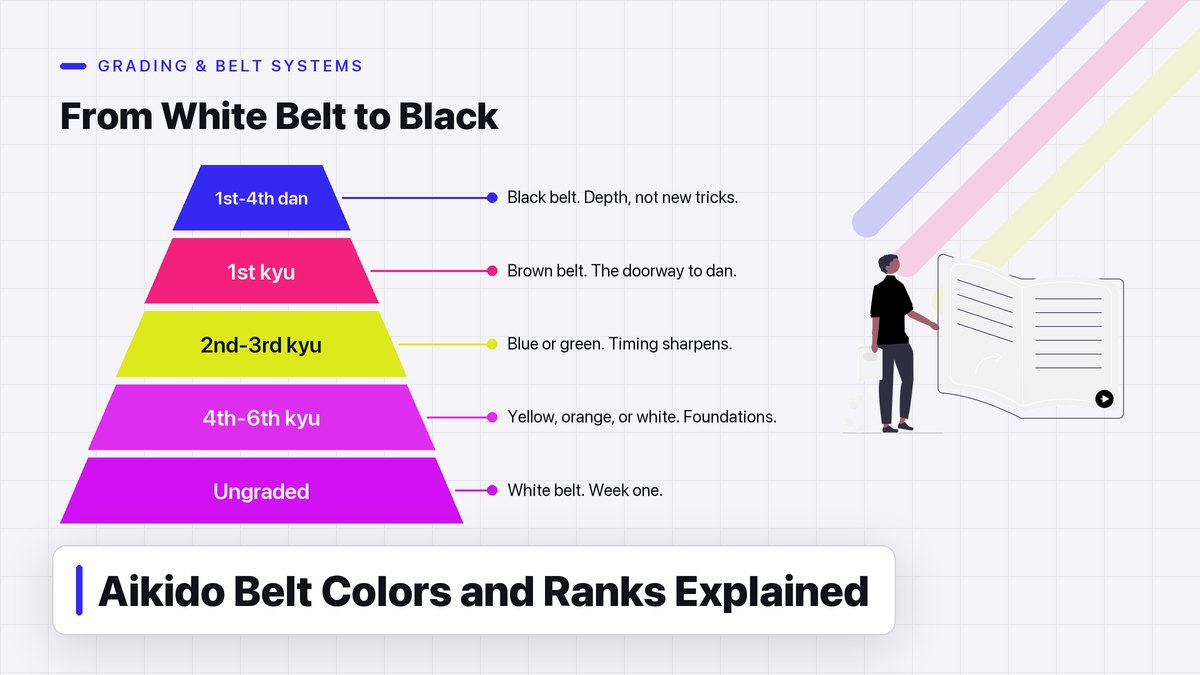
    Aikido uses the kyu-dan ranking structure shared by most modern Japanese budo, the same bones you’ll find under judo, kendo, and karate. The system has two halves. Kyu grades (級, the word for “class” or “grade”) are the student ranks, and in aikido they typically count down, from 6th kyu at the bottom to 1st kyu at the top. Dan ranks (段, “step” or “stage”) count up from there, 1st dan through 10th, and 1st dan is where the black belt starts. This countdown-then-countup arrangement confuses nearly everyone their first year. You’re six months in, proudly announcing you’re now a “fifth” something, while the person beside you is a “second” something who’s been training three times as long.

    The countdown has logic, though. A lower kyu number means you’re closer to the door of the dan ranks, so kyu numbers shrink as you improve, while dan numbers grow as you keep going. Think of kyu as distance remaining and dan as distance traveled and the whole thing untangles. Judo adopted a version of this structure in the 1880s, and the grading-culture site overview of the kyū system traces how it spread through Japanese martial arts and into nearly every art practiced in the West.

    10th dan, by the way, is mostly historical furniture. A handful of people in the art’s entire history have held it. In most organizations you’ll never meet anyone above eighth, and the practical ceiling for a dedicated lifetime of training sits around fifth or sixth. That’s fine. The ladder isn’t meant to be finished.

    One more oddity that surprises people coming from other arts. Aikido has no official record book, no central registry you can query to see who holds what. The certificates are issued by organizations and signed by senior teachers, and their authenticity rests on the organization’s standing, which is one reason lineage matters so much when people compare credentials. Two framed certificates with identical kanji can carry completely different weight depending on whose signature is at the bottom, a fact that seems scandalous until you remember most martial-arts history was passed down exactly this way long before anyone kept databases.

    The Kyu Grades: Where Everyone Starts

    Unranked beginners walk in the door, and within three to six months most dojos hold their first kyu test. The exact number of kyu grades varies a little by organization, but six is the common North American structure, and the skills tested at each level build in a deliberate order. Roughly speaking:

    • 6th kyu. Falling safely (ukemi), basic footwork, your first technique. The exam proves you can train without hurting yourself or your partner.
    • 5th kyu. A working handful of entries and controls, plus the first time you’re asked to move with a partner rather than at them.
    • 4th kyu. Flow between techniques starts mattering. Examiners want to see you recover when something goes wrong, which it will.
    • 3rd kyu. Timing and posture get graded. This is the first test where a bad day can actually cost you the rank.
    • 2nd kyu. Precision across a wider syllabus, and usually your first weapons requirements in traditional schools.
    • 1st kyu. The capstone student grade. You’re expected to move like someone the 6th kyus instinctively copy.

    Between tests, the wait time is measured in months at the bottom and years at the top. A motivated student might pass a kyu test every four to six months early on, then wait a year or more between 2nd and 1st kyu. The system deliberately slows you down as you climb, and I’d argue that’s the sanest thing about it. Early grades come fast. That keeps you hooked. Later grades force you to stay long enough for the material to actually sink in.

    Stripes deserve a mention, since you’ll see them everywhere. Many North American dojos put tape stripes on belts, one per step between full kyu grades, so a white belt with two stripes is somewhere south of 5th kyu. There’s no standard for what a stripe means across schools, which makes them the loosest currency in the whole system. Inside your own dojo they’re a helpful progress bar. Outside it, they’re decorative.

    Some schools also fold weapons work into the kyu requirements, which surprises students who expected empty-hand technique only. By 2nd or 1st kyu you may be tested on the suburi basic cuts with a wooden sword, or the first jo staff kata, because the founder taught weapons and unarmed practice as one study. Other schools ignore weapons until dan entirely. Ask about this before you join if it matters to you, since it changes what two years of training actually looks like.

    What Color Is That, Exactly?

    The honest answer: ask your dojo, then ask the dojo across town.

    This is where every beginner gets tripped up, and where the “explained” in this article’s title earns its keep. There is no universal aikido belt color chart. None. The Aikikai, the largest organization in the world and the one founded by aikido’s own family tested adults for decades without using colored belts at all, just white belts all the way up to black. Many traditional dojos still run exactly that way. If you’re reading this in a gi you bought last month, you might well train for years in the same white belt you started in.

    Schools that do use colors mostly settled on a loose North American convention, and it goes something like this:

    Kyu grade Common belt colors What it roughly signals
    6th kyu White Brand new. Still learning to fall.
    5th kyu White, sometimes yellow A few months in. First techniques stick.
    4th kyu Yellow or orange About a year. Moves with a partner.
    3rd kyu Green or blue Intermediate. Timing enters the picture.
    2nd kyu Blue or brown Advanced student. Helps lower ranks.
    1st kyu Brown Last stop before the black belt test.

    Treat that table as folklore with a grain of truth rather than as binding law. One dojo’s green is the next dojo’s blue, Tomiki-style schools run their own color sequence because competition needs clearer divisions, and kids’ programs often add a dozen extra colors so young students get rewarded on a shorter leash. I trained at a club in the Midwest where 3rd kyu wore purple, and for years I assumed that was normal everywhere. It was normal nowhere else.

    If you ever transfer between schools, don’t throw your old belts away, but do ask before your first class. Most instructors will simply tell you what the equivalent is, or politely suggest you wear white again for a few months while you absorb the local syllabus. That stings the first time. It’s also a useful reset, since different lineages emphasize different material. The national bodies each publish their own expectations. The United States Aikido Federation runs its own testing requirements for affiliated dojos, the Aikikai Foundation in Tokyo sets the tone for the largest worldwide network of schools, and the long-running magazine Aikido Journal has documented how grading standards play out across organizations for decades. Three sources, three slightly different answers to “what does a 3rd kyu need to know.”

    A belt color tells an outsider almost nothing. It tells the people on your own mat exactly who to watch and who to help.

    The Dan Ranks: Life on the Far Side of Black

    1st dan, shodan, is the rank everyone romanticizes, and it arrives with the least dramatic ceremony you’ll ever imagine. In many traditional dojos you bow, receive a certificate, maybe a handshake, and then go straight back to the class you were already in, where the brown belts keep throwing you. The Japanese phrase people repeat is that shodan means “first step,” and while that sounds like modesty, it’s structurally true. The kyu grades teach you the vocabulary of the art. Nothing more. Dan is where you’re finally expected to compose sentences.

    The ranks above it stretch far longer than most beginners expect. 2nd dan (nidan) usually comes two to three years after shodan and signals solid, dependable technique. 3rd dan (sandan) is the rank of the people actually running warm-ups and correcting beginners in most dojos. Somewhere around 4th dan (yondan) the expectations shift from doing techniques well to understanding them deeply enough to explain why they work, and this is where many dedicated practitioners stall for years, since the test stops being about physical memory long before the body gives out. 5th dan and beyond belong to teachers of teachers, the people whose names appear on the certificates your own instructor frames.

    Minimum time in grade

    Every serious organization publishes minimum training intervals between dan grades, usually a year or two at the low end and many years higher up. These are floors. The averages run much longer. Earning shodan typically takes somewhere between four and seven years of consistent training, give or take, and each dan above it takes proportionally longer. A 6th dan represents thirty years of mat time more often than not. I once did the arithmetic on a seminar instructor I trained under and realized his total hours on the mat probably exceeded my hours awake during the same span. Numbers like that recalibrate what “advanced” means.

    What a Rank Actually Proves

    Less than you hope, more than the cynics say.

    This is the section I wish someone had handed me at my first grading, backwards belt and all. A rank is a local credential. It says this person met this organization’s standard on this day, in front of these examiners. That’s a real achievement, and it’s also a much narrower claim than the martial-arts mystique suggests. I’ve trained with a 4th dan whose rolls were creaky and a 1st kyu who moved like water. Rank correlates with experience, but it never substitutes for watching someone actually move.

    Three things a belt does tell you, honestly. First, consistency. Anyone wearing a brown belt has kept showing up through sore weeks, boring drills, and plateaus that filter out half the people who started beside them. That reliability is worth something in every dojo on earth. Second, safety. A ranked aikidoka has been thrown thousands of times and knows how to receive your technique without getting hurt, which matters more than it sounds. Third, a syllabus. Each rank is a checklist of material, so a rank tells an instructor what you were at least taught, whether it stuck or not.

    And two things it doesn’t. It doesn’t tell you who’s “better” in any absolute sense, because there’s no scoreboard in aikido and never has been. You can see this most clearly in the organizations that keep competition, where Tomiki aikido and the mainstream part ways over whether a match score means anything about the art. It also doesn’t tell you anything about character, which is worth saying plainly because dojo marketing sometimes implies otherwise. I’ve met gracious high ranks and petty ones. The mat filters for persistence, not virtue.

    None of that makes grading pointless. The test itself is the useful part. A grading compresses months of training into twenty minutes of visible pressure, and the week before a test you’ll train harder than you have all year. Which is, if we’re honest, most of the point. The certificate is just the receipt.

    Quick tipDon’t grade-hop. If you’re shopping dojos, ask when students typically test for their first rank and how long a shodan takes. A school that hands out first-grade tests after three weeks, or promises a black belt in two years, is selling you belts. A school where the senior students have been there fifteen years and still train like beginners is, oddly, usually the stronger sign.

    How a Grading Actually Works

    Testing formats vary, but the bones are similar everywhere. Your instructor decides you’re ready, or in some organizations you apply and an examining board from outside your club runs the test, which is the whole idea behind the Aikikai structure: someone with no investment in your dojo watches you move, which keeps standards from drifting entirely local.

    The exam itself is demonstrations rather than sparring. You’ll be called forward, usually paired with a partner of equal or higher rank, and asked to run through a set of techniques. Names get called in Japanese, ikkyo through yonkyo, shihonage, irimi-nage, and you’re expected to produce the right response from an attack the examiner specifies. Attendance beats any single technique. Examiners talk afterward about a candidate’s posture, distance, and whether they looked calm, and two of the three have almost nothing to do with physical skill.

    Fail rates exist but stay low at the kyu level, because a decent instructor doesn’t put you forward until you’d pass on an average day. Dan tests are different. I’ve watched a sandan candidate fail publicly at a seminar, bow, and be re-tested a year later. The failure stung, he said, but the corrective feedback was the most precise coaching he’d ever received. Many schools now record gradings on video for exactly that reason.

    Kids, Ranks, and the Color Carousel

    If your child trains, expect a belt rack that looks nothing like the adult chart. Junior programs in North America commonly award stripes and micro-grades every few months, sometimes ten or twelve color steps before a junior black belt. It’s a sensible adaptation. Kids measure progress in weeks, and waiting two years between visible rewards loses most of them by spring.

    A wrinkle arrives later, when a twelve-year-old with a junior black belt walks into an adult class and discovers the rank doesn’t transfer. Most organizations handle this with a conversion: junior black belt roughly equals adult 1st kyu, and the young practitioner tests for adult shodan somewhere between fifteen and eighteen. Whether that feels like a demotion depends entirely on how the instructors frame it. The good ones frame it as what it is, a change of measuring stick, and the kids I’ve seen take it in stride were usually the ones whose parents never made the belt the point in the first place.

    Which, come to think of it, is decent advice for adults too.

    Where to Put Your Attention Instead

    Ranks will accumulate on their own if you keep training, and they do mark real milestones. But the people who get the most out of aikido, in my observation, are the ones who grade because the test is scheduled and let the belt come along for the ride. They watch the senior students, they ask for the corrections that sting, and they show up on the rainy Tuesdays. Belts take care of themselves.

    If you’re early in this, tie your belt carefully (our guide to tying a belt so the knot stays flat will save you a grading-day wardrobe malfunction), learn what the ranks mean in your specific organization rather than the internet’s generic version, and read what to expect at a first aikido class if you haven’t started yet. For the bigger picture of what the art is building toward, the basics of aikido covers it better than any belt chart can. Dennis, the accountant who saved me from retying my belt mid-test, finally took his shodan last year. Sixteen years after he started. He brought the same quiet competence to the exam that he brought to every Tuesday class, and the certificate he framed is almost beside the point. Almost.

    Notes and sources. Kyu and dan requirements differ between organizations and even between affiliated dojos; always follow your own school’s testing requirements first. Background reading: the dan rank system as used across Japanese budo, plus the organizational pages linked above. External links were checked and working as of October 2026.

  • Kyu and Dan Ranks: Where the Belt System Comes From

    Kyu and Dan Ranks: Where the Belt System Comes From

    Grading & Belt Systems

    Colored belts feel eternal when you’re tying one on three nights a week, but the whole system is younger than the bicycle. This is the story of how a schoolteacher named Jigoro Kano replaced centuries-old teaching licenses with numbered ranks, and why nearly every martial art on earth, aikido included, eventually followed him.

    Updated October 2026 · 14 min read

    My first sensei had a story he told every time a new crop of white belts complained about how far away their black belts looked. He’d hold up his own black belt, which was faded to a gray-green at the edges, and point out that it used to be white. Same piece of cloth the whole time. He’d bought it years ago, worn it through hundreds of classes, and it had simply absorbed everything, sweat most of all. The joke landed differently every year, but the point underneath it never changed. The belt is a label somebody had to invent, and the invention is a lot more recent, and a lot more interesting, than most students assume.

    If you train in aikido today, you almost certainly train under some version of the kyu/dan system. You start at sixth or fifth kyu, work your way up through the colored ranks, and if you stick around long enough, somewhere around three to six years in, you test for shodan, first-degree black belt, and the numbering inverts so the small numbers mean more instead of less. That whole architecture, the colored rungs, the black belt, the dan ranks going up to ten, descends from a decision one man made in Tokyo in the early 1880s. Everything before that looked completely different. And understanding what he replaced is the fastest way to understand what your own rank actually means, and what it was never supposed to mean.

    Before Belts: The Menkyo System

    For most of Japanese martial history, there were no ranks at all. There were licenses.

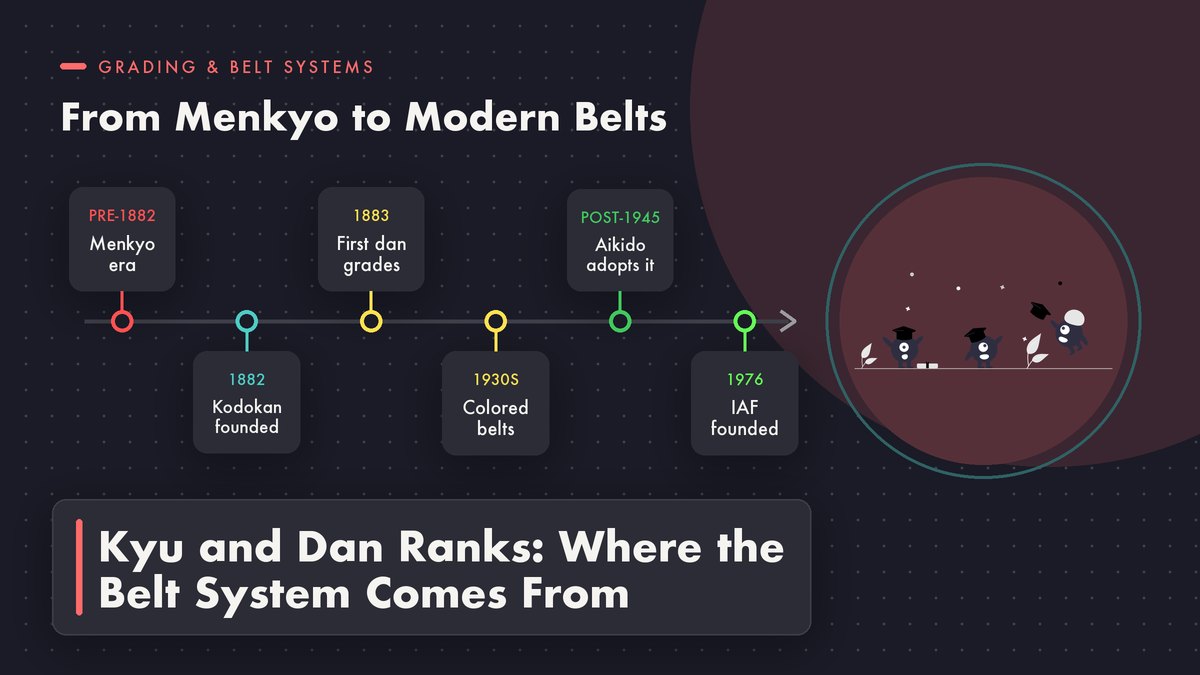
    For roughly six hundred years, from the medieval battlefield arts through the peaceful Edo period, a Japanese martial-arts student didn’t progress through colored belts because belts weren’t the currency. Scrolls were. The old schools, called koryu, ran on a licensing system called menkyo, and the shape of it tells you everything about what training meant at the time. A student joined a school, often as a live-in disciple, and spent years learning a catalog of techniques. When the teacher decided the student actually knew a portion of that catalog, he’d issue a certificate called a mokuroku, literally a “catalog” or list, which recorded that the named techniques had been transmitted. Deeper into the curriculum came the menkyo proper, a teaching license, and at the top sat menkyo kaiden, the license covering the entire tradition, which made you a successor, more or less, who could pass the art on unchanged.

    The details varied wildly between schools. Some issued multiple graduated mokuroku before any real license, so a student might collect two or three scrolls across a decade. Others kept the whole thing inside one family for generations. The common thread is that certification tracked transmission of a specific body of material from a specific teacher, the way an apprenticeship in any craft guild did, and it said nothing about how good you were relative to strangers in other towns. There was no fifth kyu in 1750, partly because there was no standardized curriculum to measure against, and partly because comparison with other schools was beside the point. You weren’t competing. You were inheriting. A good overview of how these licenses structured the old schools lives in the Wikipedia article on menkyo kaiden, and the whole apparatus is still alive today in the surviving koryu, which issue the same scrolls their predecessors issued four centuries ago.

    This system had real strengths. The certificate meant your teacher had watched you perform every technique on it, sometimes for years, and had staked his own name on your competence. But it had one enormous weakness, and by the late nineteenth century that weakness had become impossible to ignore.

    Nobody else could read it. A menkyo from one jujutsu school told a potential employer or an army recruiter almost nothing, because there was no common scale underneath it, and in a Japan that was industrializing, conscripting an army, and sending students to European universities, that opacity was becoming a genuine problem. Schools, militaries, and employers all wanted to know what a person could do, on a scale that meant the same thing everywhere. The old licenses were beautiful, personal, and useless for that.

    Kano’s Fix: A Scale Anyone Could Read

    A 22-year-old schoolteacher and competitive go player invented the answer.

    Jigoro Kano was born in 1860, the son of a sake-brewing family, and he’s one of those historical figures whose biography reads like a parody of a reformer. Frail as a boy, bullied, he threw himself into jujutsu as a teenager and was good enough to earn teaching credentials in more than one school of it. Then, at twenty-two, in 1882, he opened his own institution in a small Tokyo temple hall, which he called the Kodokan. The art he taught there he named judo, “the gentle way,” and his project was bigger than self-defense. He believed martial training could be a system of physical education that developed a complete person, and he’d eventually spend decades pushing that belief as a school principal, a Ministry of Education official, and Japan’s first member of the International Olympic Committee. The article on the Kodokan gives the founding story in detail, drawing on the institute’s own published histories, and it’s worth reading before you train a single judo class.

    Part of Kano’s genius was that he didn’t invent the kyu/dan idea from nothing. He borrowed it from board games. He was an accomplished go player, and in go, kyu grades mark the rungs below amateur master while dan grades begin at first dan, and the numbers run in opposite directions, small kyu numbers meaning stronger play, large dan numbers meaning higher mastery. Kano saw that a ladder like this could be lifted straight out of the game room and bolted onto physical training, and sometime in his first years at the Kodokan, around 1883, he did exactly that, dividing his students into dan-ranked seniors and kyu-ranked juniors on a single shared scale. He is generally credited with awarding the first two shodan ranks, first-degree black belt, in 1883, to Shiro Saigo and Tsunejiro Tomita. By 1886 the system had acquired its most famous accessory, when Kano introduced a uniform, the judogi, with a belt whose color visibly separated the dan holders, who wore black, from everyone else, who wore white.

    Two colors. That’s the whole original invention. There was no rainbow ladder in 1886, no orange or green or purple, just a binary you could spot across a crowded hall: the black belts, who had crossed some threshold, and the white belts, who hadn’t. Everything else got added later, much later, and mostly outside Japan.

    Kano took a private contract between one student and one teacher and turned it into a scale a stranger could read in two seconds. That single move is the ancestor of every belt system on earth.

    The comparison with what came before is worth spelling out, because the two systems embody opposite ideas about what a rank is for:

    Menkyo licenses (before 1880s) Kyu/dan ranks (from 1880s)
    What it certifies Transmission of specific techniques from a named teacher Overall level on a shared, comparable scale
    Who can read it Members of that school; opaque to outsiders Anyone, in any dojo, in any country
    How it looks Calligraphed scrolls, kept and treasured A belt color and a number
    What it implies Inheritance of a tradition; duty to preserve it Progress; the next rung is always visible
    Still used today by The surviving koryu schools Judo, aikido, karate, kendo, and most modern arts

    Notice what’s missing from the new system: any claim that you’ve inherited something. A dan grade is a measurement, not a bequest, and that distinction is the philosophical hinge the entire modern belt system swings on. It’s also, if you talk to old-school practitioners, the part some of them still mourn in private.

    Why It Spread So Fast

    Kano built the kyu/dan system for a local problem, his own growing school, but the timing was uncanny. Japan was modernizing at breakneck speed, building a school system, an army, and a national sports culture almost simultaneously, and judo was deliberately positioned inside all three. Kano himself pushed judo into the school curriculum, and the Army adopted it for hand-to-hand training. A rank system that an army officer or a school principal could understand at a glance was exactly the artifact the moment called for, and judo spread through Japanese institutions like water finding cracks. The dan/kyu structure spread with it, until by the early twentieth century it had simply become how Japanese martial arts organized themselves. When other arts modernized, and nearly all of them eventually did, they reached for the same template.

    One practical feature did most of the work. The old menkyo system had no intermediate rungs, or rather its rungs were so spaced out that a student might train for a decade between certificates. Kano’s ladder had frequent, reachable steps, and each one gave a student a visible finish line and a visible next one. Whatever you think of colored belts as a measure of skill, and reasonable people argue about this constantly, they are an extraordinarily effective piece of motivational engineering. A beginner who can see the next rank from where she stands trains differently than one staring at a ten-year horizon, and by the 1920s judo schools across Japan had organized whole class structures around that observation.

    The Colored Belt Is a European Invention

    The rainbow arrived decades later, and it arrived in France.

    This is the part that surprises almost everyone. If you train in a Western dojo today, you probably move through something like yellow, orange, green, blue, and brown before black. That ladder did not come from Kano, and it didn’t come from Japan. The credit usually goes to Mikonosuke Kawaishi, a judoka who moved to Paris in the late 1930s and spent years teaching judo across Europe. His European students, the story goes, wanted more frequent and more visible signs of progress than the austere Japanese white-until-you’re-black scheme offered, and Kawaishi obliged, assigning a color to each kyu grade so a student could glance at a lineup and know exactly where everyone stood. The scheme was a hit, European judo federations standardized it, and it flowed back into the global bloodstream so completely that most people now assume it’s traditional.

    Japan noticed the commercial logic and followed suit, especially in the postwar decades, when the martial arts were rebuilding and competing for students. But plenty of Japanese schools kept the old binary well into the twentieth century, and some still do. The point worth holding onto is that the colored kyu ladder, the thing most of us mean when we say “belt system,” is a mid-century layer bolted onto Kano’s framework, younger than radio broadcasting and not much older than television. It spread because it works, mostly. A white belt can see exactly how many rungs are left, and so can the instructor assigning partners.

    Quick tipWhen you visit a new dojo, the colored belts tell you who the regulars are and roughly how long they’ve been training, but they tell you almost nothing about how good any individual is on any given night. I’ve been thrown through the floor by a second-kyu who trained four nights a week, and I’ve flowed pleasantly with a sandan who’d been busy with work for a year. Treat the color as a rough calendar, not a verdict.

    How the System Reached Aikido

    Aikido adopted the framework last, and adapted it the most.

    Morihei Ueshiba, aikido’s founder, was born in 1883, the year Kano awarded his first shodans, and the new rank culture was simply in the air of Japanese martial arts throughout the man’s entire life. Ueshiba himself trained in a classical school of jujutsu and had a brush with judo in his youth, so he grew up fluent in the world Kano had built. But his own teaching career took a strange path through history. In the prewar decades, teaching Daito-ryu and then his own evolving art, which he called aiki-budo for a time, Ueshiba mostly did not run a ranked program of the Kano type. His inner-circle students of that era received things like scrolls and teaching permissions, structures with a distinctly menkyo flavor, and the whole operation was small, rural, and personal.

    Everything changed after 1945. The occupying authorities banned martial-arts training for a few years, and when it became legal again, Ueshiba’s son Kisshomaru, a young man with modern sensibilities, began rebuilding the art as something that could exist in postwar Japanese cities: organized classes, public enrollment, a headquarters dojo. That headquarters, the Aikikai Hombu Dojo, moved to its permanent home in Tokyo’s Shinjuku district in 1967, and the Aikikai Foundation’s official English pages describe how the art is organized today. Adopting the kyu/dan framework was part of that modernization, almost a foregone conclusion, since by the 1950s there was no other credible way to run a Japanese martial art that wanted to be taught in cities and sent abroad. Ranks were simply how Japanese budo communicated.

    Aikido did make the framework its own in a couple of ways, though. Most styles kept Kano’s original restraint about colors, running white belt for all kyu grades in the traditionalist schools and adding colored belts only where the local market expected them. And aikido grading exams, unlike judo’s, are not competitions. There’s no sparring match to win. You’re evaluated on paired technique, usually with a partner attacking in a pre-agreed way, plus some schools add weapon forms and free practice. The International Aikido Federation, the umbrella body that coordinates the art’s national organizations worldwide, was founded in 1976, and the IAF’s site is a good window into how standardized the ranking side has become across dozens of countries. Which is itself a little ironic, and worth pausing on.

    Standardization was the whole original selling point. A judoka’s black belt meant the same thing in Osaka and Oslo, and an aikidoka’s shodan now more or less does too. But visit five aikido dojos and you’ll meet five opinions about what shodan means, running from “solid beginner” to “teaching credential,” and they’re all correct within their own organization. The menkyo system had this same property, of course, with every school’s certificates meaning something slightly different. The kyu/dan ladder gave us a shared scale, and then promptly handed the interpretation of the numbers back to each style. Some problems outlive every solution.

    What Actually Changed

    Step back and look at the full arc. A transmission system built on personal scrolls got replaced by a measurement system built on visible grades, and the replacement conquered the world because it was legible, motivating, and easy to administer. That’s the whole story, and it’s honestly hard to overstate how much it changed. Consider what rank means on the mat now compared to what a menkyo meant in 1750.

    • Ranks are now comparable across schools. A fifth kyu in Seattle and a fifth kyu in Stuttgart share a label, even if the contents of their exams differ. This was exactly the thing the menkyo system couldn’t do, and it made the modern world of martial arts, with international federations, visiting instructors, and open seminars, possible at all.
    • Progress became visible and frequent. Rungs you can see from where you stand are a powerful engine. A student who tested last month has a date, a certificate, and a next test on the calendar, none of which existed in the menkyo era, where you might train for years with no external sign of movement at all.
    • Teaching became separable from ranking. In the old system, the license to teach and the record of what you knew were the same document. Today a first dan can be a fine assistant in one organization and ineligible to run a class in another. The rank measures the person; the permission to teach comes from somewhere else entirely.
    • And some things got thinner. A scroll named a teacher and a curriculum and carried the weight of a lineage stretching back generations. A belt color names a level. All the meaning that used to live inside the certificate, the obligation to preserve, the duty to transmit, got left for the student to supply. Most don’t even know it was ever there.

    I’d argue that last trade is the real legacy of the kyu/dan system, and I say that as someone quite happy to train under it. We gained a universal language for progress and lost, mostly without noticing, the old contract that made rank a responsibility rather than a trophy. If you want the practical side of what each modern rank typically involves, from kyu exams up through the dan grades, our companion guide aikido belt ranks explained walks through the whole ladder as it’s used in North America today.

    What This History Means at Your Dojo

    Knowing all this changes a few practical things for a working student, starting with how to read the black belts. In most aikido organizations, shodan means “first step,” and the word dan itself shares a root with the verb to step or to grade, which the traditionalists will tell you, with some relish, means a first dan is literally a beginning. Kano’s framework was designed so that the dan grades describe a curriculum of deepening principle rather than a pile of new techniques, and aikido inherited that shape. The difference between a shodan and a sandan usually isn’t that the sandan knows different throws. It’s that the sandan’s throws work on people who are trying to stop them, with less muscle and more structure, at a speed that would embarrass the shodan.

    It also explains the weird inversions you’ll encounter as you climb. At kyu level the numbers count down toward one as you improve, sixth kyu being a beginner and first kyu being nearly ready for black belt, and then the dan numbers count up from one, with meaning getting sparser as they rise. An eighth or ninth dan is a person your organization considers to have spent a lifetime on the art, and there are very few of them anywhere. The twin ladders descend from Kano’s go-board borrowing and have never been rationalized since, which occasionally produces the charming situation of a fourth dan explaining to a new student that yes, the numbering flips, no, nobody is entirely sure why we all kept it, and it’s probably best not to think about it too hard.

    Finally, the history hands you a decent yardstick for judging a school. Any organization that treats rank as a pure motivational ladder, testing students on a calendar regardless of readiness, is leaning on the framework as Kawaishi’s European students wanted it. Any that treats rank as a sacred transmission is leaning on the menkyo ghost inside it. Healthy organizations sit in the middle, where the ranks are earned and honest but nobody pretends the belt is the point. You can usually tell within two visits which kind of dojo you’re standing in. Watch what the senior students do when they think nobody’s grading them, because that behavior is the culture, and the culture is the real curriculum.

    The belt system was a modernizing reform, a motivational trick, and a borrowed go-board ladder, all at once. Knowing that doesn’t cheapen your rank. It tells you what to do with it.

    So the next time you retie your belt before class, it might be worth remembering that you’re participating in a solution to a nineteenth-century paperwork problem, refined by European marketing in the 1930s, and adopted by aikido almost as an afterthought. The system is younger than your great-grandparents. Which, honestly, makes it more interesting to be inside of, and gives you better questions to bring to your own grading than the new students in my old dojo ever thought to ask.

    Sources and notes. Historical details throughout follow the published accounts of the Kodokan (for Kano and early judo), the Aikikai Foundation (for postwar aikido organization), and the International Aikido Federation (for the modern federation structure), with the Wikipedia biography of Jigoro Kano as a useful cross-reference. Rank requirements vary between organizations, so always treat your own dojo’s guidelines as authoritative. If you’re newer to the art, what aikido is and how it works is the right starting point, and our guide to bowing and dojo etiquette covers the culture the ranking system floats in. External links were checked and working as of October 2026.