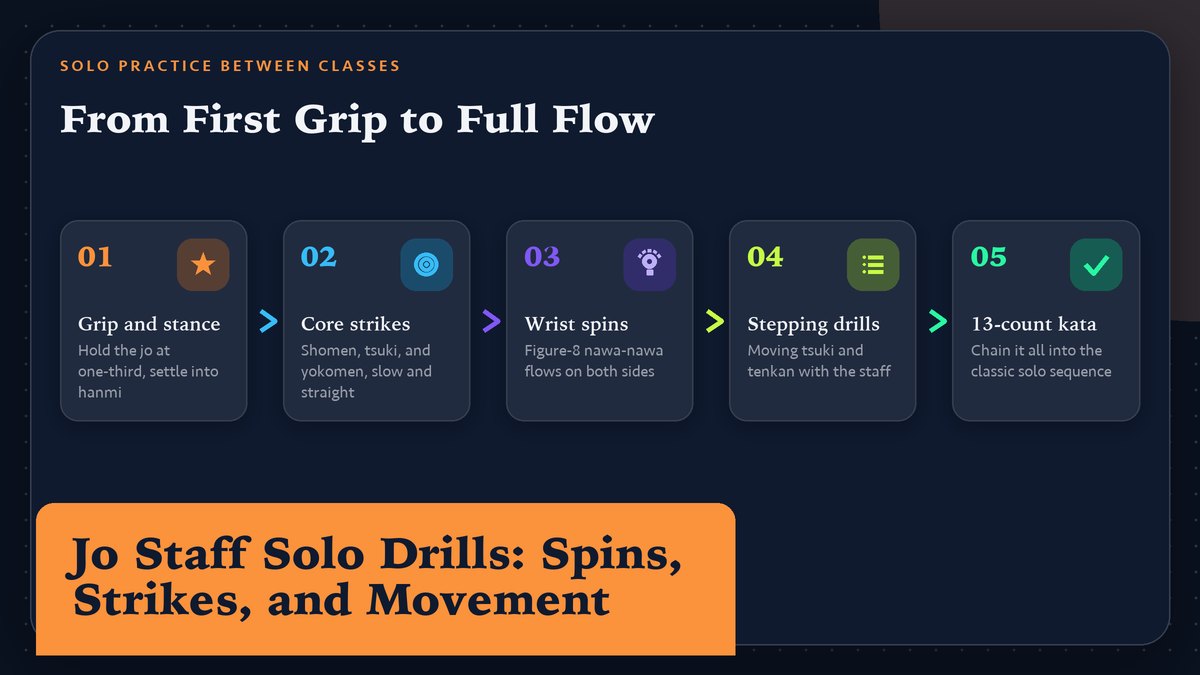
A four-foot oak stick, a strip of empty floor, twenty minutes twice a week, and a bit of stubbornness will do more for your aikido than most people expect. Here are the strikes, the spins, the stepping drills I hand every new student, and the order that keeps them from quitting the staff out of frustration.
The jo showed up in my life as a leftover. My dojo had finished a weapons weekend, and a pile of practice staffs leaned in the corner of the equipment closet like a handful of spilled broom handles. Sensei told everyone to take one home. “Work on it between classes,” he said, “or it’ll take you five years to learn what takes two.” That was the whole lesson plan. I brought mine back to my apartment, moved the coffee table aside, and spent my first evening whacking the ceiling fan on a clumsy overhead cut. The fan survived. The lesson stuck anyway. The jo is portable, cheap compared to a sword, and endlessly patient, and it’s the best solo training partner aikido offers, because everything that makes you better with a stick in your hands (posture, footwork, timing, a quiet grip) makes you better empty-handed too.
If you’ve never touched a jo, or you picked one up once at a seminar and fumbled through a group form with everyone moving in a direction you weren’t expecting, this article is the on-ramp. We’ll cover the three basic strikes, the wrist spins that make the staff feel alive instead of like a piece of lumber, and the stepping patterns that tie hands to feet. I’ll mention the 13-count kata along the way, since that’s where all of this eventually lands in a traditional dojo. For the backstory on the weapon itself, the Wikipedia overview of the jō is a solid place to start, and it covers the stick’s famous duel with Musashi, which I’ll get to in a minute.
What a Jo Is, and Why Aikido Loves It
Four feet of hardwood, roughly the height of your armpit.
The jō is a wooden staff about 128 centimeters long, a touch over four feet, noticeably shorter than a bō but much longer than a sword. Legend credits it to a 17th-century warrior named Muso Gonnosuke, who supposedly developed the weapon and its art, Shintō Musō-ryū, after a famous encounter with the swordsman Miyamoto Musashi. The story says Musashi beat him with a wooden sword. Gonnosuke retired to a shrine, and after a stretch of meditation came back with a shorter staff and a new set of angles that worked against a blade. Historians argue about the details, but the legend explains something real about the weapon’s character. A jo is short enough to move like a sword in your hands, long enough to keep a blade at a distance, and quick enough to change ends mid-fight.
Aikido adopted the jo through its founder, Morihei Ueshiba, who trained in multiple weapon arts before developing aikido and never really separated weapons from empty-hand practice. In most traditional lineages, the jo shows up as solo forms (kata), paired practice where one person has a jo and the other attacks empty-handed or with a wooden sword, and blending exercises where the staff teaches you the same entering and turning movements you’d do with your arms. The long-running magazine Aikido Journal has published decades of interviews and articles on how weapons work fits into modern aikido training, and it’s worth browsing once you’ve got the basic moves under your belt.
Equipment-wise, you don’t need much. A standard white-oak or red-oak jo costs somewhere between thirty and sixty dollars from any martial arts supplier, and honestly a closet pole of the right length works for your first month if you’re careful about splinters. (I’d spend the thirty dollars. The oak version comes balanced and sanded smooth, with no slivers to pick out of your palms.) Measure for your height by standing the staff upright; most people want it somewhere between armpit and chin. Shorter staffs spin faster but lose reach. Longer ones feel authoritative and swing slower.
One safety note before anything else. You are holding a hardwood lever with two weighted ends, and the most common beginner injury is self-inflicted, usually a strike to your own kneecap, elbow, or the ceiling fixture. Give yourself a clear space about the length of the jo in every direction. I knocked a drinking glass off a shelf with a rear spin in my second month, and my spouse instituted a garage-only rule that’s still in effect. Train outside or in the garage if you can swing it.
The Three Strikes Everything Builds On
Aikido’s jo work rests on three core strikes, and they’re the same three you’ll see in the sword work, which is no accident. Ueshiba intended them as one study. Learn these solo first, slowly, in the air.
Shomen-uchi is the overhead cut. The jo rises up along your center line and comes down diagonally in front of you, like chopping wood with an axe, except the power comes from your hips rather than your shoulders. Beginners muscle it. Don’t. The staff should fall under its own weight once you’ve started it moving, your job is steering the fall. A good shomen ends with the jo pointing down and forward at roughly forty-five degrees, your front knee bent, both hands still on the stick. Thirty slow repetitions, and your shoulders will tell you whether you’re muscling it.
Tsuki is the thrust. You drive the end of the jo straight forward at mid-height, like a bayonet or a pool cue, and your rear hip rotates into it so the power starts at the floor. The back hand pushes while the front hand guides, and at full extension the staff should be level with your solar plexus rather than your chin. Beginners push with both arms and lean, which topples them forward and, against a partner, hands the other person their balance. Think of the thrust arriving from behind you, traveling up through your legs and torso, rather than originating at your arms. The legs do the work, in other words.
Yokomen-uchi is the side cut. The jo travels in a rising arc that crests beside your head and then falls diagonally across, aimed at the temple or collarbone line of an imaginary opponent. If shomen is an axe, yokomen is a tennis forehand with a follow-through. It teaches the sideways hip switch that’s the parent of half the turning movements in aikido, the same body mechanics behind tenkan and irimi, which I wrote about in the guide to blending and tenkan movement.
The three strikes share one skeleton. Feet set the range and hips start the motion; the hands only finish what the floor began. When a strike feels off, run the checklist in reverse order. Nine times out of ten the hands are fine and the feet did nothing.
| Grip / Strike | How it looks | What it trains |
|---|---|---|
| Honte grip (forward hand over) | Right hand on top of the shaft, both palms down | Power through structure, the default grip for most strikes |
| Gyakute grip (reverse) | Top hand palm-up, like holding a bicycle handlebar | Wrist mobility and the figure-8 spin transitions |
| Shomen-uchi | Overhead diagonal cut | Whole-body alignment, relaxing the shoulders |
| Tsuki | Straight thrust at mid-height | Hip rotation, extension without leaning |
| Yokomen-uchi | Arcing side cut past the temple | Side-to-side hip switch, tenkan body mechanics |
| Wrist spin (nawa-nawa style) | Continuous figure-8 rolling in front of the body | Independence of the hands, smooth grip changes |
| Hasso stance | Jo held vertical beside the shoulder | Readiness posture, the starting and ending position of most solo forms |
| Hidari orientation | Left foot and hand forward | The non-dominant side, which feels broken for the first month |
A good staff feels heavy on the way down, light on the way back up. If every direction feels like work, your shoulders are doing the job your hips were hired for.
Wrist Spins, or Teaching the Stick to Move Itself
This is the part beginners skip, and it’s the part that transforms the jo from a stick you’re carrying into a stick you’re handling. The goal is simple to describe and humbling to achieve. Keep the staff rolling continuously in front of your body so it traces a horizontal figure-8, with the ends trading the lead as it passes from side to side. Japanese dojo slang for this kind of continuous flowing movement is “nawa-nawa,” a mimetic word for rope-like motion, and you’ll hear instructors use it for anything smooth and unbroken.
Start with both hands at the center of the staff, right hand above left in the gyakute grip. Roll the right hand over the top of the shaft so the staff pivots in your left palm. The far end swings across to your left, and as it crosses, your left hand takes over the roll. That’s half a figure-8. Keep trading hands, and the staff draws a sideways 8 in the air while your wrists do small circles. Sounds easy. The first attempts look like you’re stirring an enormous pot of soup with two broken wrists, and everyone goes through that stage. Give it a week of five minutes a day.
Once the basic roll runs on its own, learn the forward spin and the reverse spin. In a forward spin, the top of the staff rotates away from you as the jo turns over; reverse, it comes toward your face. You’ll use forward spins to flip the striking end from one side to the other mid-movement, and reverse spins to bring the staff back into guard after a committed strike. The paired versions of these appear everywhere in the 13-count jo kata, which most Aikikai-affiliated dojos teach as the first formal solo sequence and which strings the strikes, spins and steps into thirteen continuous movements. Counting varies slightly by lineage; my current dojo counts fourteen, and neither of us is wrong. The pattern matters more than the arithmetic.
But what the spins actually build is hard to see until you do paired practice. When a partner grabs your jo, or their sword beats against yours, a stiff grip freezes the staff and the force travels straight into your shoulders. A person with fluid spins absorbs that same contact through a rolling wrist and the strike keeps going. The spin work is sensitivity training disguised as a party trick. The community at AikiWeb, one of the oldest English-language forums on the art, has threads going back years about how these small solo exercises connect to the much-debated “internal” body skills in aikido, if you want to go down that rabbit hole later.
Stepping Drills: Where the Feet Join the Party
Strikes and spins are hand skills. The moment you add footwork, the exercise becomes aikido, because aikido is mostly about where your feet are when something arrives. Two stepping patterns cover most of what you’ll need solo.
The first is the advance-and-strike, or moving tsuki. Stand in a natural stance with the jo ready, then slide your front foot forward about half a step while the rear foot follows, and immediately thrust. The sequence is foot-foot-stick, in that order, always. Beginners reverse it, stabbing first and stepping after, which in a real exchange means your strike lands nowhere near where your body now stands. Do ten slow crossings of your practice space this way, then ten more leading with the other foot. The non-dominant side will feel like someone else’s body. That’s the point of training it.
Pattern two is the turning step, the solo version of tenkan. From your stance, pivot 180 degrees on the balls of your feet so the jo sweeps around with you at shoulder height, and finish facing the other direction in the same stance you started. No crossing the feet. The jo should describe a big horizontal arc during the turn, which is exactly the distance-management movement you’d use to let an attacker’s momentum sail past you, the same idea I covered in the falling and ukemi basics article from the other side of the contact. Do this slowly. The turn hides a tendency to lean away from the spin, and leaning is the habit you’re training out.
Now chain them. One turn, one strike, one turn, across the room and back. This begins to resemble the spine of the 13-count kata without being the kata, which makes it a friendly gateway if your dojo hasn’t introduced the form yet. Some lineages add a low sweeping movement to the sequence to teach dropping your level. The traditional sources on the weapon’s own art are worth a look if you get curious about where aikido’s staff practice came from, and the Aikikai Foundation, the Tokyo-based organization Ueshiba’s family still heads, offers context on how weapons study sits inside mainstream aikido.
So train slow. Speed hides errors, and I keep a metronome app on my phone at 60 beats per minute when I’m ironing something out, one movement per beat. It feels absurd, like a tai chi DVD, and it finds every foot that drags and every shoulder that creeps up. After a month of slow work, normal speed feels easy, almost suspiciously easy.
How Solo Work Pays Off with a Partner
Everything in this article becomes visible the first time you do jo partner practice. The solo spins turn into recoveries when your partner’s strike slides down your staff and tries to own it. The stepping drills become the entries and exits that keep you at the end of the jo instead of inside it. The three strikes become the attacks your partner practices receiving, and later, the structure underneath your empty-hand technique, because shomen, tsuki and yokomen are the same lines as the grabs and strikes that start every aikido technique.
A concrete example. In a typical paired jo exercise your partner strikes shomen with a wooden sword, you rise to meet it with a diagonal block while your feet step off the line, and the contact lands at a comfortable distance. Done well, it’s the paired version of your solo turn-and-strike chain, where the feet move first and the staff rises because your hips turned, so the contact happens at a comfortable distance. Done poorly (drilled without the solo foundation), it’s a stick collision followed by a wrestling match. I’ve been both people in that exchange, sometimes in the same class. Solo work is what keeps the paired version smooth.
It also fixes your empty hand work in ways that take a while to notice. Carrying a jo makes your posture honest, because a rounded back puts the staff in the wrong place and you feel it immediately. It exposes over-gripping, which is the same habit that makes your empty-hand throws stiff. And it builds the habit of moving from center, since any strike that starts at the arms telegraphs itself a mile off. This is why so many instructors, mine included, hand a jo to a struggling beginner and say “work on this for a month.” The staff is a diagnostic instrument that happens to also be a weapon.
If you’re newer to the art and wondering where this fits among the empty-hand fundamentals, the overview of what aikido actually is lays out how weapons and unarmed practice interlock, and the first technique article on ikkyo shows the same body mechanics from the receiving end.
A Simple 20-Minute Solo Session
The routine I’d hand you on day one fits in a living room corner, a backyard, or a park, and it covers everything above in the order your body learns best. Posture first, then hands, then feet, then flow.
- Open (minutes 0–3) with standing and holding. Hold the jo in hasso position, vertical beside your shoulder, and simply stand. Feel where the weight sits. Relax your grip until the staff is almost slipping. This is posture calibration, and skipping it is why most people’s shoulders stay tense for the whole session.
- Then minutes 3–8, slow strikes. Ten each of shomen, tsuki and yokomen per side, at metronome pace if you have the patience. One movement per breath. When a strike feels off, run the checklist in reverse order. Feet, hips, hands.
- Minutes 8–13 go to spins over the bed. Continuous figure-8 rolls, then forward spins, then reverse spins. Aim for unbroken flow and let speed arrive on its own. When you drop the staff, which you will, just pick it up without the sigh.
- Follow with minutes 13–18 of stepping chains. Turn, strike, turn, across the room and back. Five minutes of this builds more usable aikido than an hour of fast strikes, partly because turning under control is the exact skill that pairs with the etiquette of safe movement around other people on a crowded mat, or see the dojo etiquette guide for the group-practice side.
- Close (minutes 18–20) with a cool-down kata sketch. Walk through the first third of the 13-count form, or, if you haven’t learned it yet, just improvise a smooth chain of two strikes and a spin. End with the jo in hasso, bow to nobody in particular, and put it away, because the bow matters even alone. It marks the practice as practice, a small boundary between the rest of the day and the work you just did.
Twenty minutes twice a week, and within about two months you’ll notice it at your dojo. Strikes arrive on time. Grips adjust instead of freezing. Footwork stops abandoning you the moment a partner moves unpredictably, and that last one is the real prize, because unpredictable partners are the entire sport.
The jo rewards consistency more than talent, which is the best kind of training tool for the average busy adult. Some rainy Tuesday in your third month, the figure-8 will suddenly run itself, the strikes will stop wobbling, and the staff will feel less like an object and more like an extension you’ve been issued. That feeling carries straight onto the mat. Bring it to class, and your partner will feel the difference before you say a word about drills.
More from akac.org — What is aikido? The basics, explained · Ikkyo, the first technique you learn · Blending and tenkan movement · Ukemi, rolling and falling basics · Dojo etiquette for beginners. External sources include Wikipedia’s article on the jō, plus Aikido Journal, AikiWeb and the Aikikai Foundation. This page is reviewed periodically; solo drills described here are standard across most Aikikai-lineage dojos in the US and Canada, though your instructor’s count and terminology should win any disagreement.
Leave a Reply