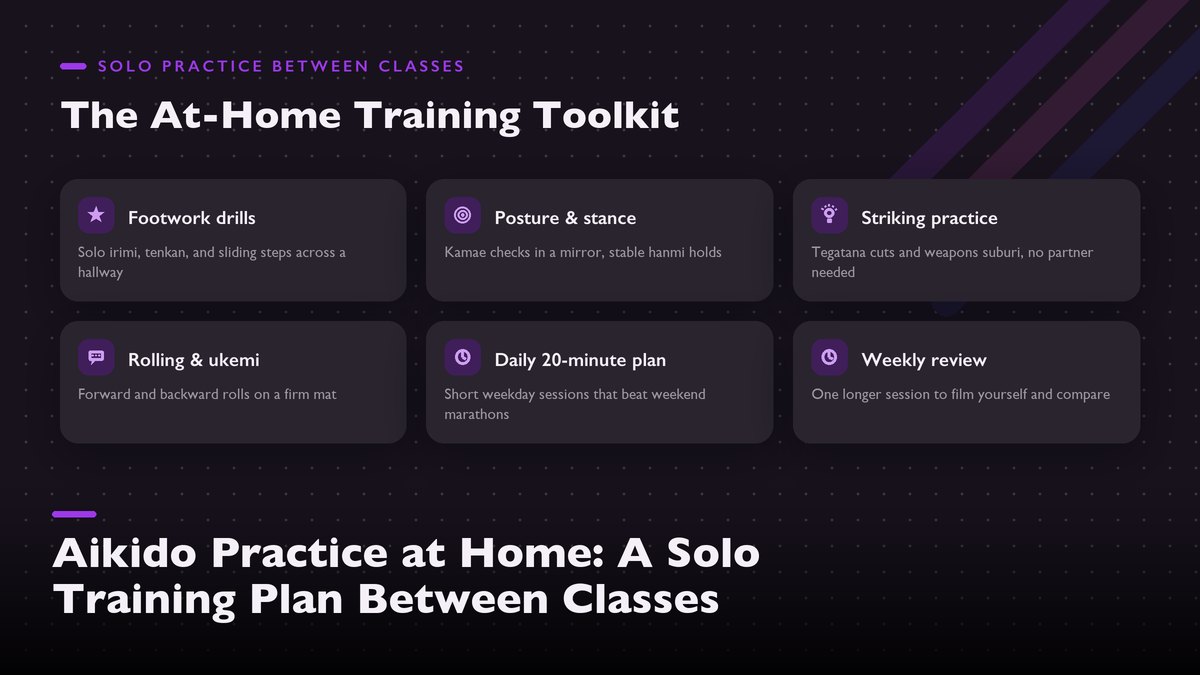
A realistic weekly routine of footwork, posture, striking, and rolling that needs no partner, fits in a living room, and makes your dojo training sharper every single week.
Most aikido students in the US and Canada train twice a week, maybe three times if the schedule and the commute cooperate. That leaves five or six evenings where the only aikido happening is whatever you choose to do about it. I spent my first two years doing nothing about it, and I could feel the difference. Every Monday class started with my body re-learning things it had half-forgotten since Thursday. Then a senior student at my dojo told me the thing nobody puts in the brochure. It stung a little. The people who visibly improve between gradings are almost never the ones with natural talent. They’re the ones who practice at home for twenty minutes and don’t make a big deal of it. This article is the plan I wish someone had handed me on day one, built around one honest idea. You can’t practice aikido alone, but you can practice almost everything that makes aikido work, and you can do it in the space between your couch and your TV.
What Solo Practice Can (and Can’t) Do
Let’s be straight about the limits first, because a plan that lies about its own limits is worthless by week three. Aikido is a paired art. No partner, no aikido. At least not the part that matters most. The throw, the blend, the timing, the feeling of someone’s grab landing on your wrist, all of that needs a partner, and no amount of living-room footwork replaces it. Our overview of what aikido actually is makes the same point from the other direction, describing the art as something that happens between two people rather than inside one.
Solo practice does give you real things, though. It builds the physical foundation the paired work stands on. How your feet move, how your posture holds up when you’re tired, how your hips turn, how safely you fall. All four are solo-trainable. In my experience, the biggest difference between a student who progresses steadily and one who stalls is rarely raw technique. It’s that the steady one shows up with feet that already know where to go. And it keeps the habit alive between classes, so aikido stops being two islands in your week and starts being a thread running through it. A brief history of the art is on Wikipedia’s aikido page if you want the wider context of where this practice tradition comes from.
The catch, if there is one, is that solo practice magnifies whatever you feed it. Drill a movement wrong at home and you’ll arrive at the dojo with a polished mistake. So the plan below sticks to things you can self-check, and it tells you exactly what to check. Also, roughly twenty minutes is the sweet spot. Shorter and it barely registers. Go longer and your attention starts to wander. That’s when the bad reps sneak in.
You can’t practice aikido alone. You can practice almost everything that makes aikido work.
The Four Things You Can Actually Train Alone
Everything in the weekly plan below comes from four pillars. Learn these once and the rest of the article is just scheduling, because each one maps directly onto what your instructor is trying to do on the mat.
Footwork (ashi sabaki)
Aikido lives in the feet before it lives anywhere else. The irimi entry, the tenkan pivot, the shuffle that keeps you off the line of an attack, these are foot patterns, and you can drill them all solo across six feet of carpet. Our article on blending and tenkan movement breaks the pivot down step by step, and everything there can be walked slowly in your living room with no partner in sight.
Start slow. Like, embarrassingly slow. Step through an irimi entry ten times at quarter speed, watching that your feet don’t cross and your weight stays settled instead of bobbing up and down. Then ten tenkan pivots. Check that the back foot swings through a real arc instead of scooting along the floor. Once the pattern is clean you can speed it up, and this is the part that’s actually fun. Put on some music and shadow-step through combinations for three minutes straight. It looks ridiculous. It also fixes your balance in ways that transfer straight to the mat, usually within a couple of weeks.
Posture and centering
Stand the way your instructor keeps telling you to stand: feet about shoulder-width, knees soft, pelvis tucked slightly under so your lower back isn’t arched, crown of the head reaching up. Then hold it. Two minutes feels like nothing on day one and like an argument with your own spine by week two. That tells you how much postural work you actually need. Add slow knee-bends (you’ll hear them called shikko in the dojo, walking on the knees), ten across the floor and ten back, and your legs learn the low, stable stance most standing techniques lean on. Harder than beginners realize, most of them.
Striking practice (tegatana and weapons)
Aikido isn’t about trading punches, but it does start from strikes: the straight punch, the overhead shomen strike, the sideways yokomen. Solo, you train the receiving end of that vocabulary by practicing the strikes themselves. No bag required. Work the tegatana (the “hand blade”) by extending your arm with fingers together and thumb tucked, cutting the air along clean lines. If you own a bokken or a jo, even better, because suburi, the basic repetition cuts, are the classic solo drill of Japanese budo. Twenty of them a day will do more for your shoulders and your timing than most beginners expect. The Aikikai Foundation in Tokyo, the organization that grew out of the founder’s own dojo, still treats weapons work as part of the art’s foundation rather than a side hobby. That should tell you how seriously to take those twenty cuts.
Rolling and falling (ukemi)
Forward rolls, backward rolls, breakfalls on a padded surface, all of it can be rehearsed solo, and this is probably the highest-value solo work you can do. Our guide to ukemi, the art of rolling and falling, covers the mechanics in detail, and every one of those mechanics can be practiced alone. One caveat worth respecting is where you do it. Slow beats brave here. Roll on a firm mat, a thick carpet, or grass outside, and keep a sofa cushion or two nearby. Hardwood floors are unforgiving teachers, and they grade on a curve you don’t want to be on. Ten quiet, careful rolls beat thirty sloppy ones every single time, and your future self, the one who gets projected across a dojo at speed, will be built out of those ten careful ones.
Setting Up Your Living Room Dojo
You need less than you think. A rectangle of floor about six by eight feet is enough for every drill in this article, which means the average living room clears the bar with furniture pushed back a little. Move the coffee table, warn anyone else in the house that you’re about to do something that looks odd, and you’re done. Odd is fine. If you own a tatami or an exercise mat, lay it down; if you don’t, a rug over carpet works fine for footwork and posture, and the rolling work can migrate to grass in the warmer months.
Two small investments pay off disproportionately. The first is a cheap full-length mirror, or even a glass patio door at dusk, so you can watch your own posture and foot angles. Your instructor sees your movement from the outside; a mirror is the closest solo equivalent. Simple, and it works. The second is a jo or a broomstick standing in a corner. Suburi with an ordinary broomstick is ninety percent as good as suburi with a real jo, and it costs nothing, though I’d be lying if I said the real one doesn’t feel better.
One more setup note, and it’s about time rather than space. Attach the practice to something that already happens every day. Right after work, right before a shower, while dinner simmers, any anchor works, but anchored sessions survive busy weeks and unanchored ones die by the third Tuesday. Mine sits between pouring coffee and opening my laptop. Yours can sit anywhere, as long as it sits somewhere definite.
The Weekly Session Plan
The plan below assumes two dojo classes a week. Adjust the days freely if you train more often, because the shape matters more than the exact days. Sessions run twenty to thirty minutes. That’s the whole ask. Sunday evening is rest. Rest is how bodies consolidate. And a plan with no gap in it is a plan you’ll abandon by week five, guaranteed.
| Day | Session focus | What to drill (20–30 min) |
|---|---|---|
| Monday | Footwork | Ten slow irimi entries, ten slow tenkan pivots, then three minutes of shadow-stepping to music, and finish with two minutes of quiet standing for a posture check. |
| Tuesday | Dojo class | Attend class. No solo work after; just note one thing your instructor corrected. |
| Wednesday | Rolling | Warm up neck and shoulders, then ten forward rolls and five backward rolls on a padded surface. Finish with two slow knee-walks across the room. |
| Thursday | Dojo class | Attend class. Afterward, write one line in a notebook about what clicked. |
| Friday | Striking & weapons | Tegatana cuts along eight lines (shomen, yokomen both sides, plus the diagonals), twenty cuts on each line. With a bokken or a broomstick, add twenty shomen suburi. Shoulders stay loose throughout. |
| Saturday | Mix & review | Your choice: repeat the weakest pillar from the week, or shadow-box an entire technique start to finish, stepping through ikkyo, shihonage, or whatever your class is covering. About twenty minutes. |
| Sunday | Rest | No practice. Maybe read an article or watch one demonstration video instead. |
Notice the shape of the week. Footwork opens it, because footwork is the foundation everything else stands on, and rolling lands midweek so your body has time to recover before the weekend. The Saturday review session exists for a practical reason. It forces you to recall what the dojo taught you, and recall is where learning actually cements. Reading about a technique feels like learning it. Walking it through your own living room, badly at first, is closer to the real thing.
If twenty minutes feels like too much, halve everything rather than dropping a pillar entirely. Ten minutes of footwork still beats zero, and a five-minute rolling session still counts. The plan is a floor, not a ceiling; on good weeks I’ll stretch Saturday to forty-five minutes without any guilt, and on bad weeks the whole thing compresses to ten minutes of shikko while the kettle heats. Both weeks count as wins.
Connecting Home Practice Back to the Dojo
A solo plan that floats free of your classes is just exercise, so the trick is letting the dojo drive the content. Whatever technique your instructor spent the most time on this week becomes your Saturday shadow-walk and maybe next Monday’s footwork pattern. Our breakdown of ikkyo, the first technique most students learn, is a good template for how to deconstruct a throw into steppable parts you can rehearse solo.
Ask your instructor what they’d suggest for home practice, too. Most love the question, and the answer you get will be more specific than anything an article can give you, because it targets whatever your movement actually needs right now rather than a generic beginner. Some dojos even keep a short list of approved solo drills for students who ask. It costs you nothing. Others will tell you to just relax and enjoy your evenings, which is also a defensible position, to be fair.
There’s a mindset piece here as well. Leave the ego at home. Between-class practice works best when you treat it as homework rather than as a second dojo. You’re not trying to learn new techniques from videos (please don’t; that’s how polished mistakes get born). You’re reinforcing what a qualified instructor already taught you in person. When in doubt about a detail, leave it alone and ask at the next class. The dojo stays the source of truth; the living room is where the source gets practiced until it sticks.
How to Keep the Habit Alive
Every article like this one ends with the plan, and most readers quit by week three. So let’s talk about the actual hard part, which is showing up in your own living room on a rainy Wednesday when nobody’s watching and there’s no instructor to disappoint. Three things have worked for me and for the students I’ve watched stick with it, and they’re all boring, which is maybe why they work.
- Anchor it to an existing habit. Same time, same trigger, every day. After the coffee, before the shower, while the pasta boils. Vague plans like “sometime this evening” evaporate under any pressure at all.
- Lower the bar on bad days. Decide in advance that five minutes counts. A plan you can do exhausted is a plan you still have on your worst week, and keeping the chain unbroken matters more than any single session’s quality.
- Track it somewhere visible. A wall calendar with a slash mark per session, a note on your phone, anything. Paper works fine. After three weeks the chain itself becomes the reason you roll out the mat, and after two months you’ll notice the difference at the dojo, which is the feedback loop that sustains everything.
One more honest note before the close. Some weeks you’ll skip everything, and that’s fine, it happens to me a couple of times a year around deadlines and family visits. The plan doesn’t need perfect attendance. It needs you back on the mat after the interruption, without the guilt spiral that turns one missed week into three. If you’re reading this in January with a new year resolution fresh in mind, I’d suggest starting with the Monday footwork session only, and letting the rest of the week fill in on its own once that one stops feeling like a chore.
For extra study between sessions, the long-running archives of Aikido Journal carry decades of interviews and essays from senior teachers. AikiWeb hosts one of the oldest ongoing discussion forums in the art, where beginners ask exactly the questions you’ll have by week four, sometimes in threads that run to fifty replies. If you ever want to see how the art organizes itself worldwide, the International Aikido Federation lists member organizations from dozens of countries, a nice reminder that your little living room practice connects to something much larger. None of that replaces mat time, of course. Rest days count too. But on a rest day, reading a good interview beats scrolling. Your dojo etiquette will still be waiting on the mat for you on Tuesday.
Notes and related reads. This plan assumes a typical beginner schedule of two dojo classes per week; adjust days and volume to your own school and body. Related articles on this site: what aikido is, blending and tenkan movement, ukemi basics, and dojo etiquette for beginners. External links were checked and working as of October 2026; always confirm solo drills with your own instructor before drilling them hard.
Leave a Reply