Search for aikido classes in any mid-sized American or Canadian city and you’ll
find a surprising mess of names. Aikikai. Yoshinkan. Ki Aikido. Iwama style. Tomiki.
They all claim the same founder, and they all look more or less alike to a beginner
watching through a window. So what actually differs, and does it matter for your
first two years on the mat?
The first time I shopped for a dojo, I did what most people do. I typed
“aikido near me,” opened six websites, and promptly got confused. One school promised
“traditional Aikikai curriculum.” Another advertised “hard-style Yoshinkan training.”
A third mentioned something called ki development and showed photos of students holding
their arms out while a partner tried to push them down. I assumed these were different
martial arts sharing a name, the way “karate” covers shotokan, goju-ryu, and a dozen
other flavors. They’re closer than that. Every style on this page traces back to one
man, Morihei Ueshiba, who taught aikido in Japan from the 1920s until his death in 1969.
The differences between styles are real, but they’re differences of emphasis and
personality, and most of them only become obvious after you’ve trained for a while.
If you’re brand new, our guide to what aikido actually is
is the better starting point. Come back here once you know you want to start, because
choosing a school is where this stuff suddenly becomes practical.
Why One Art Splintered Into Many
Ueshiba didn’t leave behind a tidy, written curriculum. He taught large groups in
Tokyo at his home dojo, and for decades he also taught smaller circles of dedicated
students at his country property in Iwama, about a hundred kilometers northeast of the
city. Different students heard different things. Some trained mainly in Tokyo and
absorbed his flowing, almost gentle later teaching. Others spent years in Iwama and
came away with a strong weapons emphasis they kept for the rest of their lives. A few senior students left before his death
and built their own organizations with their own names.
After 1969, there was no single authority who could say what “real” aikido was.
Ueshiba’s son Kisshomaru ran the Aikikai, the umbrella organization centered on the
family dojo, and most lineages stayed affiliated with it. The ones that didn’t mostly
left for personal or philosophical reasons rather than technical ones, usually following
a senior teacher with a strong personality. That’s worth remembering when you compare
styles. The splits were about people and priorities, and the technical gaps are smaller
than the marketing suggests.
One historian counted well over a dozen distinct organizations teaching Ueshiba’s art
worldwide. You don’t need to know all of them. Five or six cover the overwhelming
majority of dojos you’ll find in the US and Canada, and they share the same core
techniques with the same Japanese names. Ikkyo is ikkyo everywhere. What changes is
how it’s done, how hard it’s done, and how much bowing, weapons work, and formality
surround it.
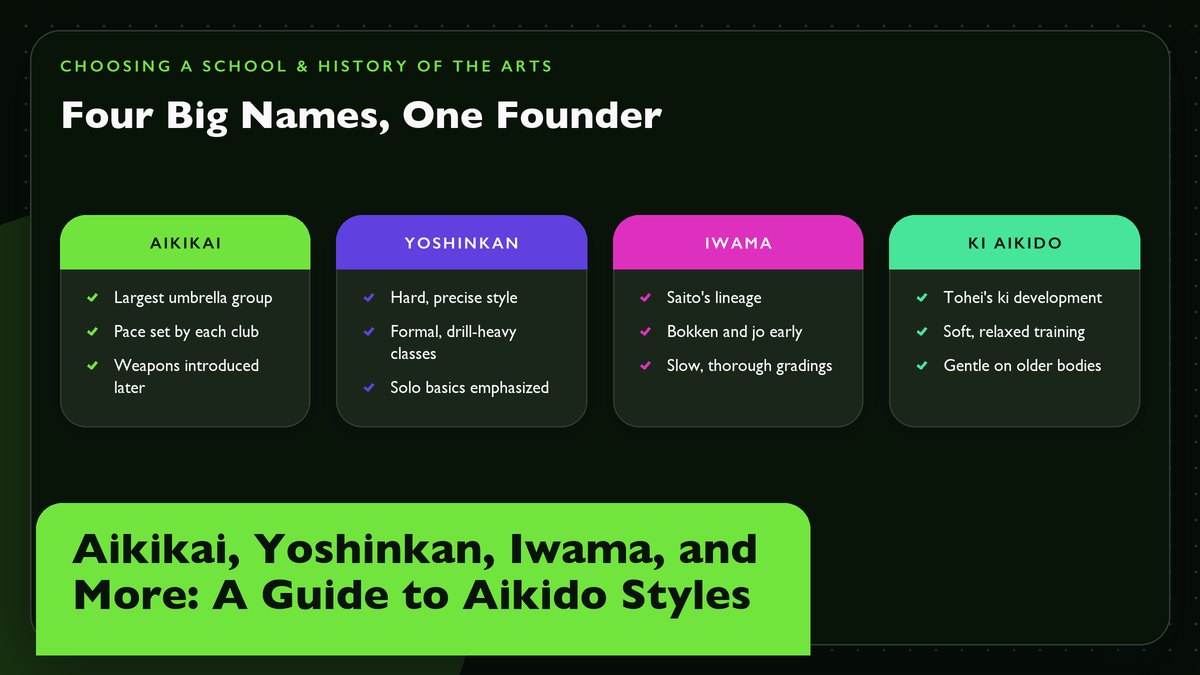
Aikikai: The Mainline
The largest umbrella, and the default most dojos belong to
Aikikai is the organization Ueshiba’s family built, run today from the Hombu Dojo in
Tokyo with a headquarters registered as the Aikikai Foundation. Most aikido clubs on
earth, including the majority in North America, hold rank through it or through one of
its national federations. If a dojo’s website just says “aikido” without a style name,
it’s probably Aikikai-affiliated. You can check any club’s credentials against the
Aikikai Foundation’s official site, which
lists affiliated organizations by country.
So what does that mean on the mat? Honestly, the range inside Aikikai is wider than
the range between some styles. A small university club in Oregon might train loose and
flowing, all blending and big circular movements, while a dojo in Montreal follows a
fairly strict traditional syllabus. The shared baseline is the standard curriculum of
empty-hand techniques plus some weapons work, typically introduced after your first
year. Classes move at moderate pace, ukemi (falling and rolling) gets taught patiently,
and testing follows the familiar kyu-and-dan ladder we cover in our
aikido belt ranks guide.
For a beginner, Aikikai’s main advantage is simple reach. Because it’s the biggest
network, it’s the easiest to find, the easiest to verify, and the most likely to have
multiple clubs if you move cities. Rank earned under one Aikikai federation is usually
recognized by the others without drama. The downside, if there is one, is that quality
varies more between individual teachers than between organizations, and the Aikikai
name alone tells you almost nothing about a specific dojo’s flavor, so you still have
to watch a class.
Yoshinkan: The Hard Style
Precision, conditioning, and the most formal etiquette you’ll meet
Yoshinkan was founded by Gozo Shioda, one of Ueshiba’s pre-war students, who opened
his own Tokyo dojo in 1955. Shioda’s aikido kept the crisp, direct quality of the
founder’s earlier teaching, and Yoshikan (as newcomers sometimes mishear it) became
known as the “hard style.” The basic movements are broken into numbered, repeatable
drills called kihon dosa, and beginners practice them solo for months before partner
work opens up. The posture is strict. The pins come on with real pressure, and the etiquette
runs more formal than most Aikikai clubs bother with.
None of this is accidental. Shioda’s dojo trained the Tokyo Metropolitan Police, and
the style still carries that paramilitary flavor. If you want structure, Yoshinkan
delivers it in industrial quantities. I have friends who found that exact quality
restful after chaotic jobs, because the dojo told them where to stand, when to bow,
and how to hold their hands, down to the angle of the wrist. The style’s international
organization maintains the official Yoshinkan
honbu site, and its North American branches grade through a clear, demanding
syllabus. For a sense of how testing works across styles, our article on
aikido grading exams
walks through a typical test day.
What should you expect physically? Conditioning is a step up from the average
Aikikai club. Wrists and forearms take a beating in the beginning, and the warmups
assume you can handle some discomfort. Beginners who thrive in Yoshinkan tend to be
people who like clear right answers. The trade-off is flexibility. Yoshinkan aikido
looks precise from day one, but some practitioners find it takes longer to loosen up
and flow. I’ve watched a five-year Yoshinkan student visit an Aikikai dojo and get
gently teased for moving “like a robot with excellent posture.” He took it well.
Iwama and Takemusu: Where the Weapons Live
Morihiro Saito spent roughly twenty years training under Ueshiba at the Iwama
dojo, and after the founder’s death he stayed there as chief instructor until his own
passing in 2002. His students now practice under several banners, most of them
containing the words Iwama, Takemusu, or both, and a summary of his teaching sits on
the English Wikipedia entry
for Morihiro Saito. What unified Iwama-line dojos is the pairing of empty-hand
technique with heavy weapons training. Saito taught that the sword and staff weren’t
extras but the place where the body mechanics of aikido actually lived.
In an Iwama-style class, expect the bokken and jo from your first month, and expect
them often. Suburi, the solo striking practice, shows up in every session, and the
footwork drills with a weapon in hand come before the fancy empty-hand applications.
This is catnip for a certain kind of student. If you’ve ever wanted the feel of
old-school Japanese training, wooden sword included, an Iwama-line dojo will hand you
that within weeks. We break down the basics in our
suburi practice guide.
The daily experience sits somewhere between Aikikai and Yoshinkan in pace. Precise
without being militaristic. The grading pace, though, tends to be slower, partly
because rank tests include weapons material and partly because many Iwama-line
organizations simply keep longer minimum-time requirements. If you’re impatient for
your black belt, factor that in. On the other hand, students from these dojos often
develop unusually clean posture and strong arms. Their empty-hand technique tends to
look grounded in a way that’s hard to fake, years later, when you watch them work
with a newer partner who hasn’t put in the same hours with a bokken.
Ki Aikido: Mind and Body First
Koichi Tohei was the Aikikai’s chief instructor through the 1960s and the man most
responsible for bringing aikido to Hawaii and the mainland US. In 1974 he split from
the Aikikai and founded the Ki Society, teaching what became known as Ki Aikido or
Shin Shin Toitsu Aikido. The split was philosophical. Tohei believed ki development,
his system of tests and exercises for calmness and coordination, should sit at the
center of training, and the Aikikai disagreed about the emphasis. The
Ki Society’s official site explains the
approach better than any summary I could give you in a paragraph.
On the mat, Ki Aikido classes usually open with ki exercises. Extending your arm
while a partner pushes on it, then switching roles so you can feel the difference
between a tense arm and a settled one. Sitting in seiza and testing whether you can
be moved.
Relaxation drills that look odd from the doorway and feel stranger the first time
you try them, because the whole point is learning what an un-tense arm actually
feels like. The techniques themselves follow the standard aikido syllabus, executed
with a strong preference for softness. If you’ve read our piece on
blending and tenkan,
Ki Aikido pushes that idea further than most styles do.
Who does this suit? People who come to martial arts through the mind-body door,
frankly. Older beginners, yoga converts, anyone whose back twinges at the phrase
“hard style.” The training is gentle on joints and serious about posture. The honest
criticism you’ll hear from other stylists is that softness without structure can turn
cooperative, with uke falling out of politeness rather than technique. That risk
exists in every style, to be fair, but it’s worth watching for in any club where
nobody ever looks mildly uncomfortable.
Tomiki and Shodokan: The Competitive Branch
Kenji Tomiki was another senior student of Ueshiba, and a judo black belt under
Jigoro Kano before that. His heresy was competition. Tomiki believed aikido needed a
form of live, resisting practice to stay honest, so he designed a randori system where
one partner attacks with a foam or rubber knife and the other scores with throws and
pins. His organization is now commonly called Shodokan, with its headquarters in
Osaka, and the Shodokan honbu site lays out
the competition rules and the kyu syllabus.
Every other style on this page rejects competition as a matter of principle. Aikido
is cooperative, they say, and adding scoring corrupts the blending ideal. Tomiki
people reply that cooperative training can hide sloppy technique behind good manners,
and that a resisting partner exposes what actually works. Both camps have a point, and
the argument has run for seventy years without resolution.
For a beginner, the practical difference is that Tomiki/Shodokan classes include
sport-like elements you’ll find nowhere else in aikido. Timed matches, referees,
tournaments. Some students love it, especially teenagers and anyone coming from
judo, wrestling, or BJJ who finds pure cooperation unsatisfying. Others find the
pressure counterproductive for learning ukemi safely. My honest take: if you know
you’re a competitor, seek out a Shodokan club, because the alternative is years of
pretending you don’t want to spar. If you’re drawn to aikido partly because it has
no sparring, avoid it and you’ll never miss it.
Side by Side: The Styles at a Glance
Everything above, compressed into the kind of table I wish someone had handed me
before my first dojo visit. Read the cells as tendencies more than laws, since
individual teachers bend every one of them without thinking.
| Style | Founded by | Pace & tone | Weapons | Competition |
|---|---|---|---|---|
| Aikikai | Ueshiba family, post-1969 | Moderate; varies most by club | Some, usually after the first year | None |
| Yoshinkan | Gozo Shioda, 1955 | Formal, precise, conditioning-heavy | Limited, kata-style | None |
| Iwama / Takemusu | Morihiro Saito lineage | Steady, weapons-led | Heavy, from month one | None |
| Ki Aikido | Koichi Tohei, 1974 | Soft, ki exercises every class | Minimal | None |
| Tomiki / Shodokan | Kenji Tomiki lineage | Structured, includes randori | Some | Yes, with tanto (knife) |
Five styles, one founder, and a beginner would be hard pressed to tell
them apart during the first month of training.
What Actually Differs in Day-to-Day Practice
So forget the lineage charts for a moment. When you train two or three times a week,
style shows up in a handful of concrete habits, and these are the ones you’ll notice.
Pacing and repetitions
Aikikai classes typically move through a technique at conversation speed, with the
instructor demonstrating a few times and partners switching roles freely. Yoshinkan goes the other
way. Solo drills first, slow and exact, then the same paired shape dozens of times in
a row. Iwama-line classes split the hour between weapons and empty hand,
so you cover less repertoire per session but repeat it relentlessly, and none of it is
inherently better. What varies is whether you learn by variety or by repetition.
Formality and etiquette
The bowing load differs more than you’d think. A Yoshinkan dojo bows at the door,
at the edge of the mat, to the shrine or portrait, to the instructor, and to each
partner, in that order, and students answer instructions in unison. Most Aikikai
clubs keep the opening and closing ceremony and drop the rest. If formality makes you
nervous, know that it fades into habit within a month or so. Our
dojo etiquette for beginners
guide covers the standard version you’ll see everywhere.
How hard uke falls
Your body will have opinions about this one. So pay attention on your visit.
Hard-style clubs throw with committed pressure and expect committed falls. Soft-style
clubs sometimes barely throw at all. A good club teaches ukemi progressively and never
asks a white belt to fly. If you watch a beginner class and see new people slamming
the mat in week two, keep looking.
Grading speed
Time-to-black-belt varies by organization and by country. Six to ten years is the
honest range across all the styles for someone training two or three times a week,
with Yoshinkan and Iwama-line organizations often at the longer end. Promises of
shorter timelines are a flag worth taking seriously. You can read the normal
progression in our belt ranks
explained article.
anything, even if the first one feels perfect. Style differences that sound trivial
in an article feel enormous at 7:30 on a Tuesday when you’re tired and someone’s
throwing you. Most dojos offer a free trial class or a cheap intro month. Take
advantage of it.
Why the Instructor Beats the Style Every Time
The style wars miss something. Ask a hundred experienced aikidoka what made
their training good, and almost none of them will name an organization. They’ll name
a teacher. The difference between a careful, patient instructor and a careless one
dwarfs every variable in the table above, and I’ve seen it cut both ways within the
same style. The best Aikikai class I ever visited and the worst both belonged to the
Aikikai.
Within your first two years, you’ll absorb roughly the same core whatever the
banner says. The front roll, the back fall, ikkyo through yonkyo, shihonage, the basic
stances, how to take a wrist pin without wincing. After those two years, styles start
to matter more, because that’s when their specific habits get baked into your
reflexes. Switching from Ki Aikido to Yoshinkan at year five is a real adjustment.
Switching at month five barely registers, which is why the beginner’s choice should
hinge on logistics and teaching quality. Brand loyalty can wait until you know enough
to have one.
So what does good instruction look like when you’re watching a class? A few things
you can actually observe:
- Beginners get real attention. The instructor or a senior student
checks the new person’s falls in the first ten minutes, not just during warmups. - Techniques are explained, not just shown. You’ll hear reasons.
“Step here because uke’s balance is already broken.” Silence followed by “watch
again” is a yellow flag. - Uke’s safety is treated as routine. Nobody applauds a
white belt for taking a hard fall. Sloppy ukemi gets corrected kindly. - Senior students help juniors without being asked. In a healthy
dojo, the brown belts drift toward the struggling white belts on their own. That
habit comes from the top. - The instructor trains too. Not just demonstrates. Actually takes
falls, rolls, sweats, the whole undignified business, week after week. Teachers who
never take ukemi from their students are telling you something about the room. Loudly.
None of these depend on style. You’ll find them in a cramped Ki Aikido basement
and a polished Yoshinkan honbu branch alike, and their absence is a worse sign than
any style mismatch. And if a dojo fails most of the list but the schedule is perfect,
go anyway for a month. Schedules keep people training longer than ideals do.
Two dojos of the same style can feel like different sports, while a
good teacher makes any style work for a beginner.
Choosing With Your Actual Life in Mind
Practical constraints beat philosophy for most people, in my experience. The dojo
you’ll attend for six years is the one twenty minutes from your house with a class
schedule that fits your job, rather than the theoretically perfect lineage ninety
minutes away. Training twice a week at an average club beats training monthly at a
famous one, and it isn’t close. Add up the real schedule before the visit: evening
classes for office workers, weekend mornings for parents, lunchtime options if you
work nearby.
Age and body matter as well, and it’s fine to say so. A twenty-four-year-old
wrestler can walk into Yoshinkan and enjoy the first rough month. A fifty-year-old
with a desk back might be happier in Ki Aikido or a gentle Aikikai club, and that
choice has nothing to do with commitment. If you have old injuries, mention them
before your trial class and watch how the instructor responds. A good one modifies
without making a show of it.
And trust the awkward first visit for what it tells you. You’ll bow wrong. You’ll
put your left foot in the wrong place. Everyone does, and every dojo on this page was
once full of people doing exactly that, probably on the very mat you’re standing on.
What you’re really there to observe is how the room treats the person who’s currently
worst at everything in it, because in two months that person is you, and in two years
it’s someone else. A dojo that handles that gracefully will handle everything else
you need.
Related reading: start with what to expect at your first aikido class, then our guides to ukemi and falling safely and dojo etiquette. Organization links above go to each style’s official body (Aikikai Foundation, Yoshinkan honbu, Ki Society, Shodokan honbu) plus Wikipedia for historical figures. We last reviewed every external link in October 2026.
Leave a Reply