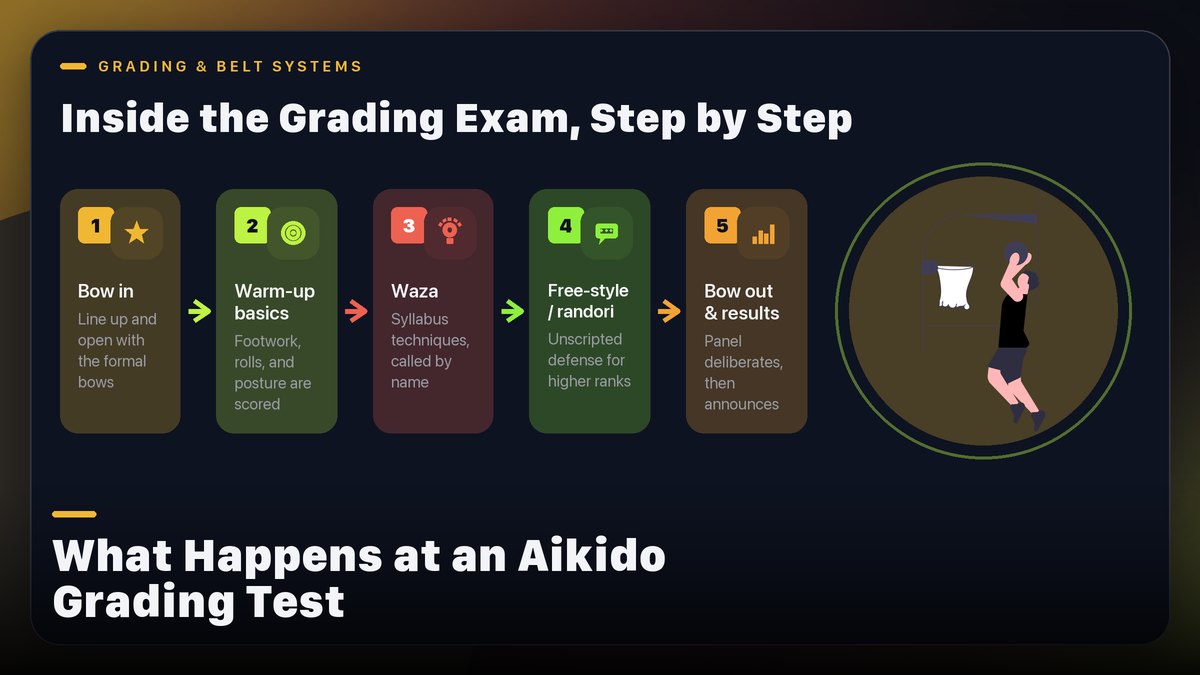
From the first bow to the moment your name is read out loud, here’s what actually happens inside an aikido grading exam, what the examiners are scribbling on their clipboards, and why most people pass.
Somewhere in the weeks before my first grading, I developed a theory that the exam would be the hard part. Ten years and several ranks later, I can report that the hardest part was the waiting, and the second hardest part was parking. The test itself turned out to be the most familiar hour of my aikido life so far, because I’d spent months rehearsing almost every minute of it without realizing. That’s the secret nobody tells nervous candidates. A grading exam in aikido is less an audition and more a demonstration of what you already do three nights a week, performed in front of people with clipboards. If you’re about to test, this article walks you through the whole thing, from the warm-up you already know to the bow you’ll take at the end.
One caveat before we start. Aikido has no single world federation that runs every exam. The big umbrella organizations, like the Aikikai Foundation in Tokyo, set broad expectations, and almost everyone shares the kyu-and-dan rank system borrowed from older Japanese arts, but your instructor runs your exam your way, and details vary from dojo to dojo, sometimes from year to year. What follows is the common shape of a grading in a typical North American dojo. If your sensei tells you something different, your sensei wins.
The Weeks Before the Test
Nobody springs a grading on you. There’s a ritual to getting permission.
In most traditional dojos, you don’t just sign up for a test. Your instructor invites you, or you ask formally and they consider it, and that consideration is the first filter. The teacher has watched you train for months, sometimes years, and they’re asking themselves a practical question, roughly: “Can this person demonstrate their rank, safely, in front of a panel, without embarrassing themselves or hurting a partner?” If the answer is yes, you get a yes. If the answer is “almost,” you get a “not yet,” which stings for an evening and then turns out to be the correct call more often than not.
Once you’re approved, expect the next month or two of classes to change character. Your instructor will quietly steer the whole room toward your syllabus, calling the techniques you’ll be tested on, drilling the ukemi you hate, and correcting the small habits that have survived this long because nobody had a reason to fix them. Partners you barely spoke to last month start giving you unsolicited advice, which is how you know the dojo has decided you’re testing whether you like it or not. I think of this period as the exam arriving early. The actual test date is just the part with an audience.
Logistics are simple but worth listing, because stress makes people forgetful:
- Know your syllabus. Write down the techniques for your rank, in the order your dojo teaches them, and drill the list until you can recite it cold. Exams get failed on forgotten syllabus items more often than on bad technique.
- Gather your gear the night before. A clean gi, your belt, and if your dojo uses name tags, your zekken. Some exams include weapons, so ask whether your bokken and jo should come along.
- Sort out fees and paperwork early. Rank certificates usually involve a registration fee that flows up through your national organization to the Aikikai, and since groups like the United States Aikido Federation process rank registration for their member dojos, it takes time, which is why certificates often arrive weeks after the test.
- Sleep, eat, hydrate. Boring advice, but an exam is an hour of continuous movement, and showing up depleted is the one avoidable mistake on this list.
The Day of the Test
Show up early. I mean twenty to thirty minutes early, not the breezy five-minute version you get away with on a regular Tuesday. Exams run on a schedule, candidates are often grouped by rank, and the chief examiner will want to confirm who’s testing, in what order, with which partners. Being present and squared away when those decisions get made is the first impression, and it’s made before any bow is called. So use the extra minutes to warm up your ankles and slow down your head, in that order.
There’s usually a check of your gi, too. A clean, white, reasonably fitted uniform is the unspoken expectation, belt tied properly, no torn sleeves flapping around your elbows. Some examiners have strong opinions about zekken, the white name tag worn on the chest in many traditional dojos, and whether yours is present and legible. It seems fussy until you remember that the panel may include a visiting teacher who has never seen you before and will be identifying you by that tag for the next hour.
If the schedule lets earlier groups go first, watch them. Not to psych yourself out, but because the mat you’ll test on has a personality. The corners are closer than they look, the floor may be slick near the door, and seeing how the first candidates handle the space settles something in your own movement. Anyway, the waiting room before a grading is one of the friendliest places in the martial arts world. Everyone is nervous, everyone is pretending not to be. And the black belts telling calm stories are all remembering their own shaky first exams.
Bow In, Then Warm Up
The exam usually starts the way every class starts, which is deliberate. You’ll line up, the senior student will call the bows, and the room will bow to the front, to the examiners, and to each other. The examiners, by the way, are often senior teachers from other dojos. Bringing in outside eyes is standard practice, because it keeps standards honest and stops any one school from drifting into its own grading habits. The opening bows are the same ones from any class, just performed a little more carefully than usual.
Then comes the warm-up, and it counts. Most candidates miss that. It won’t be announced. Nobody will say “the exam has begun.” The senior examiner simply calls the first exercise, usually something basic like stretches, footwork, or rolling practice, and the panel starts watching. Your posture during stretches, whether you’re focused or chatting, how cleanly you take your falls, all of it goes in the notes before a single named technique is called.
Basics at this stage typically mean the things you do every single class. Tai no henko, the blending pivot. Forward and backward ukemi, maybe breakfalls if your rank expects them. Suburi, the basic sword cuts, in schools that fold weapons into warm-up. None of it is exotic. Which is the point. The panel wants to see the floor of your ability, the stuff that should be automatic by now.
Examiners start grading the moment you step on the mat. There is no “just the warm-up.”
The Demonstrated Techniques
After basics, the examiners begin calling techniques, and the format is simple. A name is called, you bow to your partner, and you demonstrate, usually with the partner assigned to you from your own dojo. Depending on the rank, you might do each technique once or several times, from one attack or several, and at some point the panel will swap your roles and watch you take ukemi for the same techniques. Sometimes a technique you did early in the hour comes back near the end, called again without warning, just to see whether the second version improved on the first while you were busy thinking about everything else.
What are they looking for? Not perfection, mostly. I want to be honest about that, because candidates torture themselves trying to perform the “correct” version of ikkyo. What the panel actually watches is whether the shape of the technique is recognizable and safe: did you get off the line of attack, did you control the partner’s balance before moving them, did you finish with posture instead of leaning, did your partner land somewhere predictable. If you train regularly, those things are already in your hands. If you’re newer to aikido, our walkthrough of ikkyo, the first technique everyone learns, covers the shape examiners expect from the very first rank upward.
Expect the unexpected to be called. Most panels deliberately throw in a technique you weren’t anticipating, or ask for a variation from the side instead of the front. This isn’t a trap. It’s how they check that you own the material instead of having memorized a sequence, because a sequence breaks the first thing a real attacker does something unscripted. When an odd call comes, pause, bow to your partner, and take your time setting up. A composed three-second setup reads far better on a clipboard than a hurried technique that half-works.
The examiners may also stop you mid-technique to ask for a correction or a repeat. Don’t argue, don’t apologize, just nod and do the version they asked for. Some of the friendliest examiners correct the most, because they’re engaged enough to bother. A panel that has gone quiet and stopped offering notes is usually a worse sign than a chatty one.
Partners matter here more than people expect. A good uke for a test is not a passive rag doll and not a tank. They attack honestly at an agreed speed, they give you their balance so the technique has something to work with, and they protect themselves if something goes wrong. In return, you owe them the same when the roles swap. Most candidates test with a partner they’ve trained with for months, which is why those last few pre-test classes matter: you’re really rehearsing the pair of you, not just yourself.
Ukemi, Randori, and the Higher-Rank Extras
At every rank, part of the exam is dedicated to ukemi on its own, rolling and falling as a skill rather than a byproduct. For early kyu ranks that might mean a line of forward rolls across the mat and a few backward breakfalls. Higher ranks get thrown harder and faster, sometimes by the examiners themselves. If ukemi is the shaky part of your game, our ukemi basics guide is worth a slow read before test day, because nothing else in the exam reveals nerves quite like a stiff fall.
From roughly third kyu upward in most schools, expect jiyu waza, free-style defense against a single attacker who can choose their grabs and strikes, and at dan level, randori against multiple attackers. This is the part of the exam that looks chaotic to a beginner watching from the sideline and is actually the most honest part of the whole day. Without a script, the panel sees how you move when nobody tells you what comes next. That’s the real test. Keeping your feet under you, staying aware of the whole mat, and not panicking into muscle are the actual criteria, in my opinion.
Aikikai-style schools often add weapons kata as well, the thirteen-count bokken and thirty-one-count jo patterns, for the middle and upper kyu ranks. These are demonstrations of solo form, so they show something the partner work can’t: whether your posture, distance, and movement hold up with no one else on the mat to react to. Organizations descended from the founder’s teaching, which you can read about on the Wikipedia overview of aikido, treat these kata as the connective tissue between empty-hand technique and weapons work.
The extras vary enough that a table is the honest way to show it:
| Rank level | What’s typically tested | What the panel adds |
|---|---|---|
| Beginner kyu (5th-6th) | Basic ukemi, a short list of techniques from set grabs, etiquette throughout | Focus and safety; whether the candidate is coachable in the moment |
| Middle kyu (3rd-4th) | Longer syllabus, multiple attacks, both roles (nage and uke), solo weapons kata | Timing, posture under pressure, smooth transitions between techniques |
| Advanced kyu (1st-2nd) | Full syllabus from any attack, jiyu waza against one attacker | Consistent control, spacing, calm when a technique fails and needs redoing |
| Dan grades (black belt) | Everything above plus randori against multiple attackers, teaching demonstration at some schools | Authority on the mat, economy of movement, whether lower ranks could learn from watching this person |
Notice the last column drifting away from technique as the ranks climb. That’s the whole story of aikido gradings in one table, honestly.
What Examiners Are Actually Scoring
Candidates obsess over this part, and almost nobody explains it. There are no points. Most aikido exams don’t use a numerical scorecard. The panel holds a mental model of what your rank should look like, watches you for an hour, and then votes. Pass or fail, with a discussion in between.
That mental model has four buckets, and it helps to know them before you’re inside one:
| What they watch | Passing looks like | Failing looks like |
|---|---|---|
| Basics | Footwork and falls are automatic; stance stays upright even when tired | Stumbling through warm-up rolls, posture collapsing halfway through |
| Techniques | Recognizable shape, off-the-line entry, partner controlled and safe, finishes with balance | Arm-wrestling the partner, forcing throws, lost techniques followed by visible panic |
| Ukemi | Falls are relaxed and quiet, partner trusts you with speed and power | Stiff, noisy falls; protecting yourself so hard the technique can’t happen |
| Attitude | Calm bow in and out, takes correction without argument, keeps going after a mistake | Arguing with examiners, sighing at errors, treating partners roughly |
A few things in that table deserve unpacking. Attitude genuinely counts, and it counts from the warm-up, because rank in a traditional art is a statement about character as much as skill. The founder’s framing of aikido as a discipline of the person, not just the body, is old news to anyone who has read a biography of Morihei Ueshiba, and examiners who grew up in that tradition grade what they see of the person.
Also, mistakes are allowed. A failed technique that you notice, redo calmly, and complete correctly reads better to a panel than a shaky one you rushed through. Examiners watch what happens after the mistake more closely than the mistake itself, so the one skill worth rehearsing above all others is the recovery. I’ve seen nervous candidates melt down over one wobbling ikkyo and calm ones turn the same wobble into their best throw of the day, and the difference was rarely the technique.
How Passing and Failing Actually Work
When the last technique is done, you’ll line up and bow out, and the panel will ask you to step off the mat while they talk. This conversation can take two minutes or twenty, depending on the rank and the politics of the panel. Sometimes the decision is obvious to everyone, sometimes a candidate splits the examiners down the middle, and the chief examiner’s opinion carries the weight. Use the break to breathe.
If you pass, you’ll be called back in, the result is announced, you bow, and everyone claps. Certificates usually come later, because rank has to be registered up the organizational chain, which in Aikikai-affiliated schools runs from your dojo through the national organization to Hombu Dojo in Tokyo. Your new rank is real the moment it’s announced, even if the paper takes two months to arrive in the mail.
Should you fail, the news arrives kindly and privately, with reasons. Retesting waits some months, often six. Take it from someone who’s watched several friends go through it: failing a kyu exam is a bruise, not a break, and almost everyone who fails once passes the next time, because they’ve now seen exactly what the exam feels like from the inside. The candidate who failed and kept training is, in the long run, indistinguishable from the one who passed on the first try.
The Part Nobody Warns You About
The strangest part of grading day isn’t the exam. It’s the day after. You trained for months toward one morning, the morning is over, and there’s a hollow feeling where the goal used to be. Old-timers have a standard answer for this, which is that the rank you just earned is now the floor of what’s expected from you, and the next rank started the moment you bowed out. It sounds like a motivational poster. It also happens to be true, and most people who stick with aikido long enough end up nodding along with it.
There’s a lighter side too. Grading days are usually followed by food. Dojos celebrate at a nearby restaurant, the new ranks get toasted, and the people who just tested you turn back into the people you train with every week, sometimes for the first time you can remember. If your first exam is coming up, I’d say go in expecting exactly what you’ve been practicing, give your partners clean attacks and safe falls, and save some appetite for afterward.
Sources and notes. Practice described here reflects common exam formats in Aikikai-affiliated and independent dojos in the US and Canada; your own dojo’s syllabus and customs always take precedence. If you’re new to aikido altogether, start with what to expect at your first aikido class, then the etiquette and ukemi guides linked above. External links were checked and working as of October 2026.
Leave a Reply