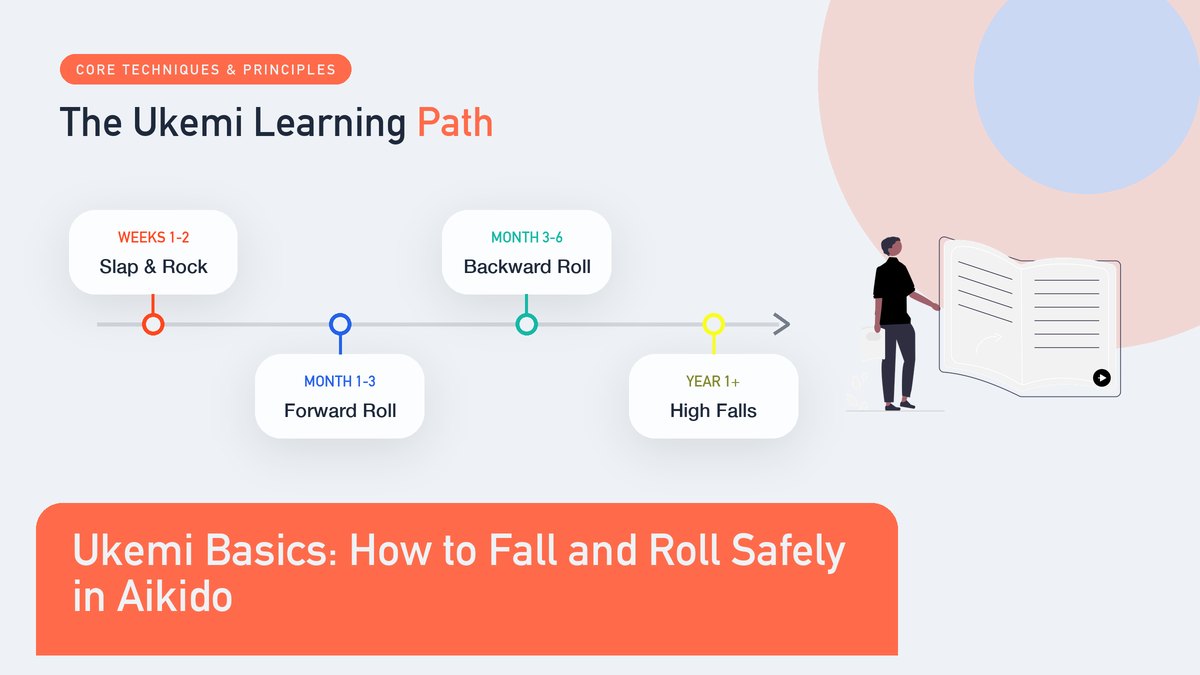
Most people walk into an aikido dojo dreaming of the throws. Within a week they’re spending half of every class on the mat learning to fall, and a surprising number of them decide that’s the best part. No exaggeration. Good ukemi is learnable, it follows a clear progression, and it changes how every technique feels on both sides of the partnership.
My first forward roll felt like a cartwheel gone wrong. I’d watched the senior students fold themselves over one shoulder and pop back up like it was nothing, so when my turn came I charged at the mat, tucked my head, and came down flat on my hip with a noise I can still hear. My partner, a patient brown belt named Denise, just said “again, slower” and walked me through it piece by piece. Ten minutes later I rolled, stood up, and grinned like an idiot. That arc, from clumsy to workable in a single class, is completely normal. Falling is a motor skill like any other, and nobody is born knowing how to do it.
Ukemi is the Japanese word for the whole family of skills around receiving a technique, and the “receiving” part deserves a moment of respect. The word comes from uke, the partner who takes the fall, paired with mi, the body, so ukemi lands somewhere near “receiving with the body” in plain English. That framing explains almost everything about how an aikido class runs, because the uke is doing real work from the first minute of the first class. They attack with commitment, they move on the entry, they feel where the technique is going, and they follow it early enough to land in one piece and jump back in. None of that is passive. Experienced students will tell you ukemi takes years to get good at, and they’re right, though I’d argue the learning curve is front-loaded. The basics that keep you safe arrive fast, and everything after that is polish.
The organization most aikido schools trace their lineage back to is the Aikikai Foundation, which runs the Hombu Dojo in Tokyo, where the art’s founder taught until 1969. You don’t need to care about lineage to learn a roll, honestly. But it explains why a dojo in Ohio and a dojo in Osaka use the same words for every part of this, and that shared vocabulary is genuinely useful when you visit a new school for a seminar weekend.
Why Aikido Teaches Falling Before Anything Else
If you are afraid of hitting the ground, you will stiffen up every time a technique starts to work, and stiff is exactly what you cannot afford to be on the mat. Simple as that. Aikido moves a partner through space in arcs and spirals, often off balance well before they ever leave their feet, so the first thing a beginner has to prove to their own nervous system is that going down is safe. Once that sinks in, techniques start making sense within weeks instead of months, because your attention stops being spent on bracing for impact and becomes free to notice what your partner is actually doing.
There’s a training reason too, and it’s blunt. In aikido you take turns: attack for your partner, receive for them, switch. Roughly half your time on the mat is spent being thrown, so a student who only practices the throwing side is training at half speed for their entire first year. Half the art, right there. The fastest learners in any beginner class are rarely the athletic ones. They’re the people who relax into the fall early and pay attention while it’s happening, because the fall is where you feel the technique from the inside, and feeling it from the inside is the fastest way to learn how it works.
For the historical picture, meaning where aikido came from and how it grew out of the older jujutsu schools of Japan in the early twentieth century, the Wikipedia article on aikido is a solid, well-sourced starting point. Back on the mat, the practical point stands on its own. You cannot receive a technique you are terrified of, so the curriculum removes the terror first.
The Slap Is Not Optional
Watch any judo or aikido class for five minutes and you’ll see it constantly. Just before the body lands, an arm sweeps out and the forearm and hand meet the mat with a sharp slap that echoes off the walls. It looks theatrical from the hallway. It is actually the single most useful habit a beginner will build, because the slap spreads the landing across a bigger patch of mat and gives your whole body a timed signal to go loose at the exact instant contact happens. Loose absorbs. Stiff bounces.
The details matter more than people expect. You slap with the full length of the forearm plus an open hand, fingers spread, arm swinging from the shoulder so the contact lands a fraction of a second before your back or side touches down. Slap late and you’ve missed the entire point of the exercise. Slap with a floppy wrist and it stings without helping. Timing beats force every single time, so don’t muscle it. Let the arm swing and trust the mat to take the energy you’re offering it.
The Forward Roll, Step by Step
The forward roll, mae ukemi in most dojo, is the first ukemi you’ll learn and the one you’ll perform ten thousand times over the years. The shape is simple once you’ve seen it. You fold at the waist, place one arm across your body, and roll over the shoulder so the back of it touches first, then the opposite hip, and then your feet come back under you and you’re standing again. The head never touches. If your head is touching the mat, something has already gone wrong, so stop, reset, and find the shoulder again.
From a squat
Start from a squat, and expect to stay there for a while. This is standard practice in most dojo for the first weeks, because a low roll keeps the drop small while your body memorizes the shape. From a deep squat with your feet together:
- Kneel onto one knee, and tuck your chin until your eyes rest on your own belt knot.
- Reach the opposite arm across your body, hand flat on the mat, fingers pointing away from the knee that’s down.
- Tip forward from the hips, aiming the back of your shoulder at the floor rather than the top of your head.
- Roll diagonally across that shoulder to the opposite hip, and let your legs unfold underneath you as you travel.
- Finish on your feet, or at least sitting upright, then turn around and go again.
Two things will feel wrong at first, and both are fine. The chin tuck feels like you’re staring at your stomach, and the diagonal line of the roll feels like you’re falling off to one side instead of straight ahead. That diagonal is the whole trick. Rolling straight over the spine is how people bang their heads, while rolling across the shoulder puts the sturdy parts of your back in charge of the trip. Give it twenty reps a side over a week or two and the shape stops being a puzzle and becomes a thing your body simply does.
From standing
Only when the squat roll feels boring should you take it from standing, and “boring” is the right milestone here, because boredom means your body trusts the shape enough to stop monitoring it. From there it’s the same squat roll with a run-up. Step forward into a lunge, sink through the same low position you already own, pass through it, and let the momentum carry you up onto your feet at the other end. Dojo that skip the squat version end up with students who fling themselves at the mat and call it rolling. Go slow. By month two or three the speed shows up on its own, more or less uninvited.
The Backward Roll
Backward rolls look easier than forward rolls and are sneakily harder, because the part of your body that lands first is the part you can’t see. Sit on the mat with your legs tucked, rock back, bring your knees toward your chest, and aim one shoulder at the floor as your hips travel up and over. Slap with the trailing arm the moment your back meets the mat, roll across the shoulder instead of straight over the spine, and let the momentum hand you back up to sitting. Most beginners spend their first month thumping onto the tailbone, and that thump almost always means the hips never made it over the shoulder. Timid rolls land on the seat. Committed ones land soft.
Standing backward rolls
The standing backward roll is a different animal, and it’s fine to leave it alone for your first year. It demands that you sit deeply, drop your hips below your knees, and tip backward without pushing off with your hands, all in one continuous motion that feels wrong until the day it abruptly doesn’t. A good readiness test is ten seated backward rolls in a row, soft landings, finishing in the same spot you started each time. When you can do that, ask your instructor about the standing version. Until then, more reps of the seated roll will do more for you than any amount of standing practice, and I say that as someone who tried to skip ahead and paid for it in bruises.
The High Fall, and Why You Shouldn’t Rush It
A backward breakfall is the high fall you see in demonstrations, the one where a technique lifts you into the air and you come down flat on your back with both arms slapping at once. It is also the one beginners want most and should get last. Nothing about it is mystical. Your body just needs hundreds of low, comfortable falls first so the slap, the exhale, and the loose landing all happen on autopilot, because at real height there is no time to think your way through any of them. Most dojo won’t ask for high falls until you’ve put in a year of consistent training, which strikes me as about right, maybe even a little generous toward the student.
When your dojo does start teaching it, the progression is kind if you let it be. Your partner first lowers you almost to the mat while you rehearse the shape of the landing, then raises the entry a few inches at a time over the following weeks, and only then throws at full commitment. Never let an eager partner talk you into a full high fall you haven’t built up to. The mat forgives a lot, but it isn’t a trampoline, and confidence built out of order has a habit of cracking at the worst possible moment, usually in front of the people you were trying to impress.
Being the Partner You’d Want
A good uke makes the technique honest. A lazy one makes it a lie.
Ukemi is a two-person skill, and your partners decide half of your progress whether you like it or not. On the receiving side, that means attacking for real, with committed grabs and strikes that actually travel to their target, because a technique performed against a dead attack teaches nobody anything. It also means relaxing once the technique has you rather than wrestling it to the last inch. Honest resistance early in the exchange is valuable. Sandbagging a beginner is just being difficult, and the difference between the two is visible from across the room. Your partners notice everything.
On the throwing side, match your partner’s level every single rep. No exceptions. With a brand-new student, throw slowly and land them softly, full stop. With an experienced uke you can add speed, and they’ll turn your power into a beautiful fall, which is honestly one of the small private pleasures of this art. What you never do is surprise a beginner with a fast throw to test them. That’s how flinching gets trained into people, and flinching takes months to undo. The late George Ledyard made the case at length in an Aikido Journal interview on the role of ukemi, arguing that receiving skill shapes the entire practice, and after a few years on the mat I’d say he was right.
Solo Drills That Build Comfort
Class time is where the corrections happen, but the comfort gets built between classes. Nothing exotic, either. None of these need equipment, a partner, or much space, and fifteen quiet minutes twice a week does more for your ukemi than one heroic Sunday session ever will. Roughly twenty reps per side is a good default for each drill, give or take depending on how your shoulders feel that day.
- The rocking drill. Sit with knees tucked, rock backward onto your shoulder blades, slap the mat, then come back to sitting; it teaches the exhale and the slap without any falling at all.
- Seated forward folds. From the same tucked seat, fold forward over each knee in turn and place the back of the shoulder toward the mat, no roll. You’re rehearsing the entry line.
- Kneeling shoulder rolls. The squat roll from the checklist above, done slowly at home on a carpeted floor or at the dojo before class.
- Wrist and shoulder circles. A minute or two in each direction, every session, because ukemi asks a lot of both joints and cold joints complain.
- Standing roll reps. Once the standing roll is yours, do a short set on each side as a warm-up and stop while they still feel crisp. Fatigued reps rehearse sloppiness.
If you want to eavesdrop on how regular students talk through this stuff, the AikiWeb forums have hosted that conversation since the 1990s, and the ukemi threads there are full of exactly the questions you’ll have in your first year, answered by people who remember being where you are. Francis Takahashi’s classic essay “Ukemi: An Aiki Perspective” is the deeper read I’d recommend once the basics feel solid, because it treats receiving as a partner’s craft rather than a survival skill, and that reframe tends to land right around the one-year mark.
The Faults Everyone Hits First
Every beginner faults the same handful of ways, which is oddly comforting, because it means the problems are standard and so are the fixes. The table below maps the usual progression; expect to live in each row for a few months before the next one fits.
| Level | What your ukemi looks like | What to practice |
|---|---|---|
| First few weeks | Squat rolls with a thud, backward rolls onto the seat, breath held through every landing | Squat roll reps, the rocking drill, sharp exhale timing |
| Around six months | Standing rolls most of the time, backward rolls usually clean, occasional tailbone landings when tired | Standing roll from a lunge, seated backward roll finishing back on your feet |
| First year | Rolls flow straight back to your feet, first low breakfalls start feeling routine | Partner-lowered high falls, even reps on both sides |
| Intermediate | Falls look rounded and unhurried from any height, both directions, at speed | Falling for faster techniques, guiding newer students through their first rolls |
The chin fault comes first for most people. Somewhere around rep five, beginners get curious about where they’re going and lift their head to look, which plants the top of the skull in the roll path. The cue that fixed it for me was “look at your belt knot,” and I’d pass that along unchanged. It works. It keeps the neck long and the head out of the way without any tensing up.
Tailbone landings in the backward roll are the hips’ fault, almost always. The shoulders go back but the hips stay home, and physics does the rest. Fix it by exaggerating the knee tuck on purpose for a session or two, so the hips are forced to travel with the shoulders. And the stiff-arm fault, where a beginner plants a straight hand on the mat to catch themselves, deserves a firm word from your instructor early, because a locked elbow in a fall is a lever working against you. Soft arms, always.
Where This All Leads
Nobody does aikido for ten years because they love falling. They stay because the falling stopped being an interruption and became part of the technique, something that happens in the flow of an exchange rather than at the end of it. Good ukemi feels like that from the inside too. You stop bracing, start reading your partner earlier, and one day a fast throw stops registering as danger at all. It registers as information. If you get hurt, stop training and tell your instructor, full stop. Beyond that plain rule, the path is just reps, honest partners, and patience with a skill that rewards both.
Related reading on this site: What Is Aikido? The Basics Explained, our guide to ikkyo, the first technique most dojo teach, and blending and tenkan movement. External sources cited above are the Aikikai Foundation, Wikipedia, Aikido Journal, and AikiWeb, all checked as of October 2026. We revise articles as our own practice grows.
Leave a Reply