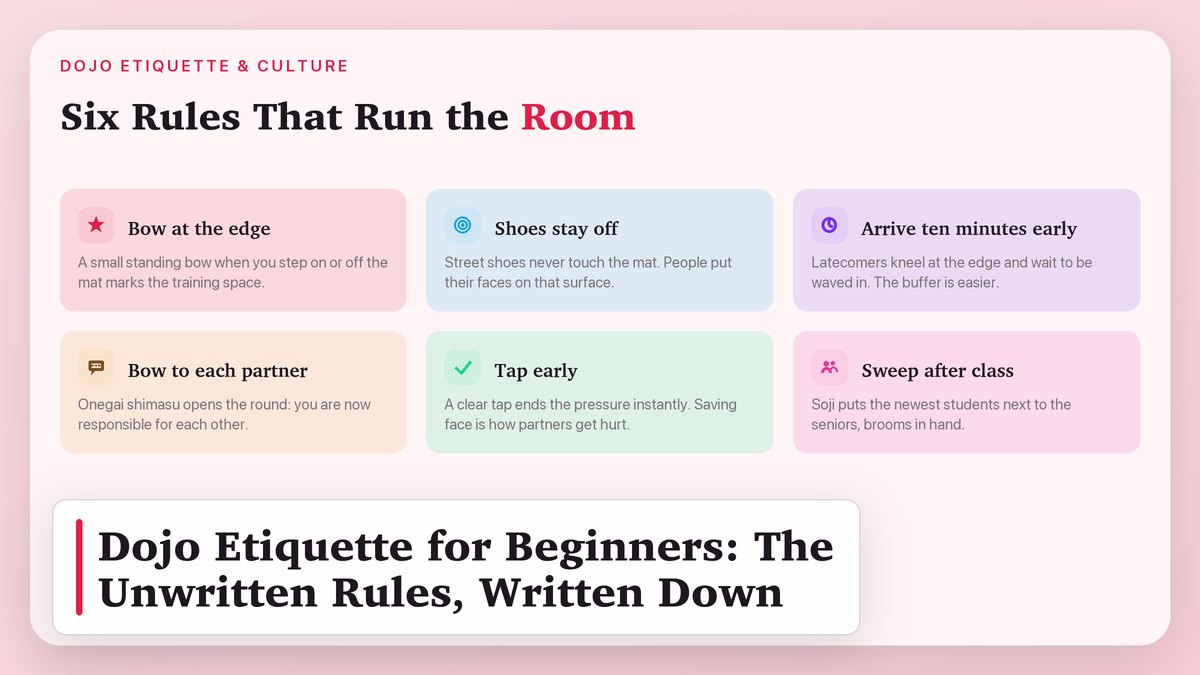
Every dojo runs on customs nobody hands you on a printed sheet. The bow at the door, the way you address the instructor, the reason beginners are handed the broom after class. This guide covers what those customs mean, and why following them makes you a better training partner.
My first week in an aikido dojo, I made a small mistake that still makes me smile. Class had ended, everyone bowed, and while I stood there wondering where the exits were, the senior students walked to a closet, pulled out brooms, and started sweeping the mat. I watched for a polite moment, then left, assuming they’d handle it. Nobody scolded me. But as I laced up my shoes at the door, one of the black belts called over, kindly, “Next week, you sweep too.” Not because the mat needed my particular sweeping skills. Because the broom is where the etiquette starts making sense.
If you’re brand new to a traditional martial arts dojo in the US or Canada, some of what you see will feel ceremonial, maybe even stiff. Bows at the threshold. A Japanese word for everything. Students sitting on their heels facing the front wall while the instructor demonstrates. It can look like a wall of rules designed to catch you out. Almost none of it is. The customs exist for a handful of practical reasons that made sense centuries ago and still make sense tonight, and once you know the why, the what stops feeling like a test. This guide walks through the etiquette from the moment you walk in the door to the moment you pick up that broom.
Why Etiquette Exists at All
Start with the obvious question, because it’s the one I should have asked in week one. Why does a martial art, of all things, come wrapped in formality? A dojo is a room where people grab each other, throw each other, and swing wooden weapons at each other’s heads, safely, dozens of times a night. That only works if everyone in the room shares a tight set of habits. How close to stand. How to signal that something hurts. Whose lead to follow when instructions change mid-drill. Etiquette is that shared set of habits, and you can think of it as the traffic system of the room.
There’s a second reason, and it’s older. Traditional Japanese arts, from swordsmanship to tea ceremony, developed in a culture where the way you bowed, sat, and spoke communicated your sincerity before you’d demonstrated any skill. Much of that lives on in the Japanese concept of rei, which covers both the physical bow and the attitude of respect behind it. You don’t have to adopt another culture wholesale to train well. But once you understand the bow as a signal between training partners, it feels different to do it. A respectful training environment also sits at the center of the code of conduct that organizations like the Aikikai Foundation in Tokyo, the headquarters body of the art, expect affiliated dojos to maintain.
The bows, the sitting, the sweeping. None of it is ceremony for ceremony’s sake. It’s how twenty strangers practice throwing each other without anyone getting hurt.
Before You Step on the Mat
The threshold matters more than most beginners expect.
Your first etiquette moment happens at the edge of the mat, and it costs you about three seconds. When you approach the mat for the first time, or return to it after stepping off, you pause and give a small standing bow toward the front of the room, where the picture of the founder hangs. Then you step on. Same thing when you step off. This is the one custom you’ll see observed without a single exception, class after class, and the practical reason is simple. The bow marks a mental boundary between the regular world and the training world. For that hour, your phone and your work email stay off the mat with your shoes.
Which brings up the shoes. Never, under any circumstances, wear street shoes or step on the mat in socks you walked in with. In Japan the line between outside dirt and inside space runs through every home and dojo, and the mat is treated like a clean floor surface, not gym equipment. People train on it barefoot and sometimes face-down. A gravel fragment tracked in from the parking lot is a real hazard when someone rolls across it. Leave your shoes neatly at the edge, soles against the wall if the dojo does it that way. You’ll already look like a local.
A few smaller customs that cluster in the “before class” window:
- Arrive ten minutes early. Latecomers create a small disruption, and in most dojos the fix is formal. You kneel at the edge of the mat and wait for the instructor to wave you in, which is more attention than most beginners want. Give yourself the buffer.
- Remove rings, watches, and dangly jewelry. They scratch partners and they break. I lost a watch band to this rule in month two.
- Trim your nails. Long fingernails leave marks on wrists and faces, and partners remember.
- Bring a clean gi. If your uniform is damp from yesterday’s class, the person grabbing your lapel will know. Air it out between sessions.
- Ask before stepping onto a mat area where a class is running. If you arrive during someone else’s session, wait at the edge and catch a senior student’s eye.
The Bow: What It Means and Who Bows to Whom
Called rei in most dojos, the standing bow is simple. Feet together, a hinge at the waist, eyes roughly on the person or direction you’re bowing toward, held for about a beat. That’s the whole movement. The subtler part is knowing when. In a typical aikido class you’ll bow at the start of class, toward the front of the dojo and sometimes toward the instructor; at the end of class; when stepping on or off the mat; and to each partner when practice begins and ends. In Japan, formal greetings and bows follow their own logic, and the customs around bowing in Japanese daily life are a good background read if you want the cultural context.
The partner bow is the one worth understanding deeply, because it contains the whole safety system in miniature. Before you and a partner start working together, you face each other, bow, and in most dojos say onegai shimasu, a phrase that means roughly “please train with me, I ask your cooperation.” When the round ends, you bow again and say arigato gozaimashita, thanking them for the practice. What matters is what the exchange establishes in those few seconds. You and your partner are on the same side, and you’re both responsible for each other’s safety during the next ten minutes. That frame is what lets two near-strangers practice joint locks at full commitment. Dojos affiliated with national organizations, like the United States Aikido Federation, pass etiquette expectations on to member schools for exactly this reason. The bow is how a room full of mixed ranks keeps everyone honest.
One beginner worry I hear is whether to bow to the instructor separately. In most traditional dojos, yes, once at the opening of class. It’s a mutual acknowledgment, and many instructors return the bow in kind. If you’re ever unsure what a specific dojo does, watch the senior students and copy them. That’s not cheating. That’s the etiquette working as designed.
How to Address Instructors and Senior Students
The title you’ll hear most is sensei, which attaches to the teacher of the class. It means something like “one who has gone before,” and it’s a description of the person’s role in the room. Some things worth knowing about it. First, you don’t need to call out “Sensei!” to get attention; raising a hand works fine. Second, in the US and Canada many instructors are relaxed about the title and will tell you to use their first name off the mat. The safe default is sensei on the mat, whatever they prefer off it.
Two other words describe the hierarchy without any titles at all. Senpai are students senior to you, meaning they’ve trained longer, and kohai are junior. The senpai carry a real job. When the instructor is busy with another pair, they’re the ones correcting your footwork, and they’re the example you’re meant to follow when something ambiguous happens. If a senpai gives you a correction during practice, the etiquette is to say thank you and try it immediately, even if you were doing it the other way on purpose. I promise they corrected someone else the same way last week.
The head instructor of the dojo is the dojo cho. You may never need the word, but knowing it helps you follow who’s who in a new school. And if you visit another dojo, as students often do, guest etiquette follows you. You behave as a guest, introduce yourself to the dojo cho before class, and let them run their room their way.
Sitting, Watching, and the Etiquette of Attention
When the instructor demonstrates a technique, something happens that surprises most newcomers. The whole class kneels and sits in neat rows to watch. The position is usually seiza, kneeling on the heels with a tall spine, though plenty of Western dojos allow sitting cross-legged, and any instructor will tell you to switch positions or stand if your knees object. Persistent sitting in seiza is a learned skill with real history behind the posture in Japanese culture, and most beginners’ ankles lodge a formal protest for the first month.
What the room is buying with the kneeling is attention. In a class of twenty, if even four students keep chatting or half-heartedly going through motions while the instructor demonstrates, the demonstration gets repeated, time burns, and nobody’s footwork improves. Sitting facing the front, still and watching, is how a room signals “we are ready to receive the next thing.” It’s the classroom equivalent of everyone quieting when the conductor lifts the baton, and it works the same way.
A few related customs cluster around this:
- Don’t practice the technique while it’s being shown. Sit still and watch. You’ll get your repetitions; the demo is for your eyes rather than your arms.
- Face the front when seated. Turning your back to the kamiza, the honor position at the front of the room, is considered poor form in traditional dojos.
- When sensei walks over to correct your pair, stop and listen. Nod, try the correction immediately, and resist the urge to demonstrate what you were doing before.
- Keep talking to practice talk. Mat conversation should be about the drill. If you need to discuss last night’s game, the lobby exists for that.
Partner Etiquette While Training
Bow said, drill running, now what? The customs inside live practice matter most of all, because this is where people actually get hurt or stay safe. The first is pacing. You match your partner’s speed and intensity, and the junior partner sets that dial. When a 4th kyu works with a brand-new white belt, the senior partner practices softly and cleanly so the junior can actually see the shape of the technique. It looks like going easy. It’s how the art transfers. The seniors were once the flailing white belt receiving exactly that patience.
The second custom is the tap. If a joint lock or pin hurts beyond comfortable training pressure, you tap, early and clearly, on the mat or on your partner’s body, and your partner releases instantly. Then you reset and go again. Talking through pain to save face is the one piece of etiquette worth actively unlearning, because it converts a safe room into an injury report. Say “tap” out loud if your hands are trapped. A good partner thanks you for the information.
Third, keep your ukemi honest. If you’re the person being thrown, your job is to attack with commitment and fall safely, never to anticipate the technique and leap into the throw. Anticipating feels like cooperation and does the reverse. It robs your partner of real practice and teaches you to fall for throws that never happened.
Finally, hygiene is etiquette, full stop. A clean gi, trimmed nails, no strong cologne. All of it is a message to the person in grabbing range. The long-running publication Aikido Journal has spent decades documenting dojo culture across styles, and partner-care customs like these show up in nearly every tradition they cover.
Soji: Why Beginners Sweep
Now the broom. After the final bow in many traditional dojos, the mat gets cleaned, and everyone, especially the newest students, takes part. This practice is called soji, and it’s worth explaining carefully because it’s the custom most often misread by newcomers as hazing or busywork.
The mat is the dojo’s single shared asset, the one thing everyone touches, and cleaning it together does three jobs at once. Practically, it keeps a surface that people put their faces on sanitary and free of the debris that shoes track in. Symbolically, caring for the space is caring for the school, and doing it as the newest person states plainly that you don’t consider yourself above the shared work. On the social side, it’s ten unhurried minutes where the newest students stand next to the most senior black belts, talking about the class they just shared. Some of the best advice I ever got in a dojo came mid-sweep from a sandan who’d said maybe four words to me before that evening.
So when the brooms come out, take one. Sweep conscientiously, don’t race, and treat it as part of class, because in every way that matters, it is.
Nobody will ever test you on the Japanese words. They will absolutely notice whether you grabbed a broom.
Rank, Testing, and Watching Your Ego
Most aikido dojos use the kyu and dan ranking system, where colored or white belts cover the kyu grades and the black-belt dan grades follow. Rank brings etiquette with it. You line up by rank at the start and end of class, seniors toward the front. You don’t argue about rank, yours or anyone else’s. And when a visiting student of higher rank joins class, they’re typically given appropriate courtesy, sometimes seated accordingly.
The deeper etiquette here is internal. A dojo is one of the few rooms left where humility gets practiced as a skill. Beginners apologize constantly for mistakes, then gradually learn that nobody expects apology, only honest effort. The senior students aren’t watching your mistakes. They’re watching whether you keep training through them. One of the most quoted ideas in the art, tracing back to the founder, is that aikido has no competition and no matches, a principle covered in any good overview of aikido as an art. If you arrive with a tournament mentality, checking who’s winning each exchange, the mat will sand that down over time. It’s one of the more useful things the etiquette does for you personally.
A Field Guide for Your First Weeks
The table below covers the customs you’re most likely to meet in your first few weeks, and what to do with each.
| Situation | What to do | The why behind it |
|---|---|---|
| Stepping on or off the mat | Small standing bow toward the front of the room | Marks the boundary between ordinary life and focused training |
| Start and end of class | Line up by rank, sit, bow when the instructor bows | Opens and closes the shared hour with a common signal |
| Starting with a partner | Face each other, bow, say onegai shimasu | Establishes cooperation and shared responsibility for safety |
| Instructor demonstrates | Sit facing the front, watch without practicing | Gives twenty pairs one clean demonstration instead of three tired ones |
| Something hurts | Tap early and clearly, say “tap” if needed | Keeps a joint lock a drill and out of urgent care |
| After the final bow | Grab a broom and help clean the mat | Cares for the shared space and puts you next to the seniors |
| You’re unsure | Watch the senior students and copy them | Etiquette varies slightly by dojo; imitation is expected and encouraged |
The Unwritten Rules, Now Written
After a few months, most of this stops being etiquette and becomes just how the room works. You bow at the edge of the mat without deciding to. You sit facing front because it would feel strange not to. You sweep because the class isn’t over until the mat is clean. The customs stop policing you and start carrying you.
One last reassurance I’d have wanted in week one. Nobody in a healthy dojo is keeping score on your mistakes. Every senior student in that room once bowed to the wrong direction, called the instructor by the wrong name, and walked off the mat without their broom. What the etiquette actually measures is simpler and kinder. Do you show up, do you pay attention, do you take care of your partners, and do you grab the broom. Get those four things roughly right, and everything else will teach itself to you, one bow at a time.
Sources and notes. Customs described reflect common practice in Aikikai-affiliated and independent dojos across the US and Canada; individual schools vary, and when in doubt, follow the senior students. External links checked as of October 2026. Related reads on this site: What Is Aikido? The Art and Its Basics Explained, Ukemi: Rolling and Falling Basics, Blending and Tenkan Movement, and Ikkyo: The First Technique Most Students Learn.
Leave a Reply