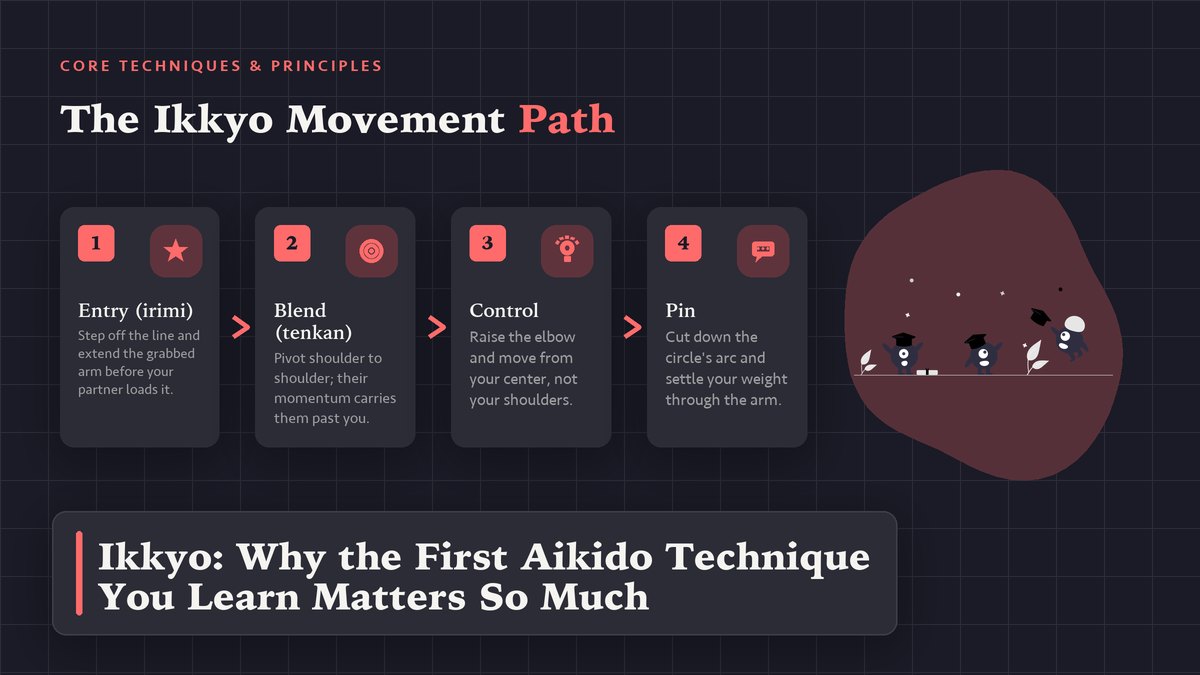
Every aikido student meets ikkyo in their first month on the mat, and most of them underestimate it for the next ten years. A step-by-step look at what the “first teaching” is actually teaching you.
Ask a room full of aikido students what they worked on in their very first class, and you’ll hear the same answer almost every time: somebody grabbed my wrist, my teacher put a hand on my elbow, and suddenly I was looking at the ceiling. That’s ikkyo. It looks like nothing from across the room, a gentle folding of an arm that a bigger, stronger person could surely resist with raw muscle. Except they can’t, or at least they can’t once you stop doing it with your arms. The technique is the first one taught in the traditional curriculum for a reason that has very little to do with the wrist grab and everything to do with the shape underneath it, because that shape reappears in almost everything that comes after.
I remember watching a fifth-degree black belt run a class on ikkyo, and honestly, a few of us were annoyed about it because we wanted the flashy throws. Then he took one of the largest students in the dojo, moved him around the mat for a full three minutes without ever looking like he was trying, and told us afterward that he still practices this one technique every single morning. I stopped being annoyed.
What Ikkyo Is, and Where It Comes From
Ikkyo means, more or less, “first teaching.” The name is a shortened version of ikkajo, the heading under which the founder Morihei Ueshiba organized the earliest material he inherited from Takeda Sokaku’s Daito-ryu aiki-jujutsu. In that older catalog, ikkajo headed a whole group of responses to specific attacks rather than naming one move. Ueshiba spent years boiling that catalog down, and what survived as ikkyo was the response to a very common situation: someone has hold of your wrist and intends to keep hold of it. You can read the broader story of how Ueshiba reshaped Daito-ryu into aikido in the overview of aikido, and his own winding path from a small town in Wakayama to a famous Tokyo dojo in any biography of Ueshiba.
The standard version most dojos teach first works from a cross-hand wrist grab called gyaku hanmi katate-dori. Your partner reaches across to take the wrist on the opposite side. Simple to describe. Hard to do. The response has a beginning, a middle, and an end. You enter in, you turn, you cut your partner down to the mat and pin the arm beside their head, ideally before they’ve decided what to do about any of it.
What makes the technique worth studying for years is that every stage of it is a miniature of a larger principle. The entry is irimi, the entering step. The turn is tenkan, the pivoting movement. The cut down is the same shape as several throws. The pin is where you learn what it means to control someone with your whole body weight instead of your grip. Strip the wrist grab away and you still have the skeleton of half the art. Most styles recognize this today, which is why the largest aikido organization in the world, the Aikikai Foundation in Tokyo, treats ikkyo as a core examination requirement at essentially every rank.
The Four Parts, Broken Down
The shape you learn in week one is the shape you’ll be refining in year ten.
Watch a slow demonstration and ikkyo appears to happen all at once. It doesn’t. Break it into its four stages and each one has a job, a common failure mode, and a reason your teacher keeps stopping the class to talk about it.
The entry: take the space and break the balance
The grab itself isn’t the problem. A held wrist only matters because your partner intends to use it as a handle, so the entry starts before that handle gets loaded. You step slightly off the line of the grab, usually at an angle that puts your body beside your partner rather than in front of them, and you extend the grabbed arm forward as if you’re handing them something they can’t quite reach. Done at the right moment, this puts them just far enough onto their front foot that pushing back at you becomes their whole plan. That off-balancing is called kuzushi, and the concept of kuzushi runs through every Japanese grappling art worth the name; aikido just tends to arrive at it earlier in the encounter than most.
On day one, the almost universal mistake is pulling the grabbed arm back toward your own chest, which gives the grabber exactly what they wanted. The arm goes forward. It’s a strange feeling the first few dozen times.
The blend: the turn that isn’t a retreat
From the entry you pivot, and this is the moment people describe as blending. Your free hand rises to contact the underside of your partner’s elbow while your feet turn you to face roughly the same direction they do, like two people standing shoulder to shoulder looking at the same view. You are no longer in front of them where they can push you. Their own forward energy, the momentum they committed to the grab, is now carrying them past the place where they expected you to be. I think this pivot, tenkan, is the single most copied movement in all of aikido, because it shows up in some form in almost everything you’ll learn in your first few years.
The elbow and the center line
The elbow is the steering wheel. Your upper hand drives it up and across in an arc that traces the outside of a big circle, and because the shoulder has to follow the elbow, the rest of your partner comes along for the ride. Done well, you’re not pulling or pushing with that hand at all. You’re moving your own center, your hips and torso, and the arm connected to your partner is just the delivery mechanism. A strong person can resist your arm muscles for a long time. Nobody in the dojo is strong enough to stop your whole body from rotating when their balance is already broken.
One more thing about the elbow: keep your own arms in front of your body. But the moment either arm drifts out to the side, you’re feeding your partner a lever they can use to turn the whole thing around on you.
The pin: the part everyone rushes
The cut down happens as you both reach the end of the turn. Your partner’s arm extends, their balance drops, and they end up on the mat with you beside them, ideally one knee near their head and both hands controlling the arm at the elbow and the wrist. The finish matters. You’re pressing the arm toward the mat in line with the shoulder, never twisting it up behind the back, and your weight settles down through your posture rather than pushing across with your shoulders. I said the pin comes at the end, but on a bad day it actually comes at the beginning, because if your entry never broke their balance, you’re just kneeling on the floor wrestling an arm while your partner stands up.
As a training checklist, the whole sequence looks something like this:
- Enter early. Step off the line and extend the grabbed arm before your partner loads it up.
- Turn together. Pivot so you end up shoulder to shoulder, facing their back rather than their front.
- Raise the elbow. Drive the underside of their elbow up and across with your free hand, moving from your center rather than your shoulder.
- Cut and follow. Let the arc drop them as your knees lower, staying connected all the way down.
- Finish the pin with structure. Weight settles, arm is straight and in line with the shoulder, and you keep your own posture tall.
The wrist is the handle and the elbow is the lever, but your hips are the part doing the work.
Why Your Teacher Will Drill It for Years
It can feel insulting, honestly. You’ve been training for two years, you can fall reasonably well, you’ve seen a dozen techniques, and there you are again in suwari-waza, both partners kneeling, doing ikkyo up and down the mat until your knees ache. There’s a reason for it that goes beyond tradition for tradition’s sake.
Ikkyo is where aikido’s timing lives. The technique only works comfortably if the entry happens during the half-second when your partner’s weight is committed to the grab, which means you can’t run it on autopilot and you can’t run it on strength. Every repetition forces you to feel where your partner’s balance is, right now, this time, with this person. Say a heavier training partner grabs you a little lower and pulls instead of pushes. The arm does the same shape, but the moment you enter shifts by a beat. You don’t learn that from a book or a video, you learn it from roughly the ten-thousandth repetition when something clicks and the person twice your size folds like a deck chair.
There’s also a teaching-tradition reason. Because ikkyo is forgiving, partners can attack each other sincerely without much risk, so it carries a double load in most dojos. It’s the first technique a newcomer learns as nage, the one doing the technique, and usually the first position they learn to fall out of as uke, the one receiving it. One movement trains both sides of the exchange. My own practice has been built around it for years, and I still find pieces of it I’d swear weren’t there last month.
The Mistakes Nearly Every Beginner Makes
Watch any intro class and you’ll see the same three or four errors cycle through the room, because they’re what untrained instincts tell you to do. Your instincts are wrong about this art almost everywhere, which is sort of the point of training.
- Pushing with arm strength. The most common one by far. The arms do hold on, but the force comes from your center, and muscling it only teaches your partner to muscle back. You’ll know you’re guilty when your shoulders burn after three repetitions.
- Crossing your feet during the turn. Feet cross, balance goes, and the person who was supposed to fall is suddenly holding you up. Walk the pivot without a partner a few times at home; it fixes itself faster than you’d expect.
- Looking down at the arm. Your eyes drop, your posture folds forward, and you hand your partner your balance along with your full attention, which is exactly backwards from what the entry is supposed to do to them. Look at your partner’s center rather than their hand. Their face works too, though some teachers will tell you that’s impolite in a different way.
- Gripping the wrist like a handle. The pin controls the elbow and the line of the arm; the wrist hand mostly guides. White-knuckling the wrist tenses your whole frame and telegraphs every move you’re about to make.
One more, quieter mistake: rushing to the ground. Beginners often yank the arm down as soon as the turn completes, which lets an experienced uke simply ride the pull and stand back up. The cut down is the end of the circle your center drew, so if the circle was never drawn, the ending has nothing to ride on. Slow is correct, and correct eventually becomes fast on its own.
Where Ikkyo Keeps Showing Up
The sneaky thing about ikkyo is that it never really leaves. Learn its shape properly and you’ll start recognizing it inside techniques that look nothing like it on the surface. This is why old-timers sometimes describe aikido as one technique with several hundred costumes (a bit grand, maybe, but you see what they mean).
| What ikkyo teaches | Where you meet it again |
|---|---|
| Off-balancing at first contact (kuzushi) | Every throw and every pin in the syllabus; if the entry doesn’t break balance, nothing downstream works |
| Entering off the line (irimi) | Iriminage, the “entering throw,” and the entry to shihonage |
| Turning with the attack (tenkan) | All the pivoting entries, plus kokyunage where the blend is the whole throw |
| Controlling the elbow and center line | Nikyo, sankyo, and yonkyo, which start from almost the same grip |
| Extension through the partner’s arm | Kaiten-nage and most of the projection throws, which are ikkyo’s circle drawn larger |
| Falling safely as uke | Every technique, every class, from day one until you hang up your belt |
In the other pins
Nikyo and sankyo begin from positions nearly identical to ikkyo’s. The difference arrives after the blend: instead of cutting your partner down, you keep the elbow raised and rotate the wrist to spiral them down instead. When a sankyo feels impossible, it’s usually because the ikkyo underneath it, the entry, the turn, the raised elbow, was skipped or rushed. Fix the ikkyo and the nikyo often appears by itself.
In the throws
Kaiten-nage is the clearest relative. Same wrist grab, same entry, same turning blend. The difference comes at the top of the circle: you send your partner forward and roll them out along the extension of their own arm instead of pinning it to the mat. Shihonage similarly takes the raised elbow and turns it over your partner’s head into a spiral throw. And honestly, I don’t think it’s an exaggeration to say that if your ikkyo is honest, these later throws take weeks to learn instead of months.
On the weapons rack
Pick up a bokken, a wooden practice sword, and the family resemblance gets hard to miss. The overhead cuts of basic suburi trace the same line the elbow follows in ikkyo, and many dojos teach a paired exercise where the two partners cross weapons exactly the way two arms cross in the technique. The connection runs both directions, too: practicing the sword cut cleans up the empty-handed version, because the sword is unforgiving about whether your power comes from your arms or your hips. Long-running publications like Aikido Journal have published decades of essays and interviews on exactly this overlap between weapons work and empty-hand technique, if you want to go down that particular rabbit hole.
A Word About Being the Uke
Half of your ikkyo training is taking the fall, and it’s worth saying plainly that this part is a skill too. Following the technique as uke, keeping your own balance alive until the moment it genuinely breaks, and falling out of the pin without tensing up are all learned behaviors. Good ukemi lets your partner train honestly and keeps your own shoulder out of trouble, which matters a lot more than it sounds. Some nights the whole lesson is in the receiving half of the exchange, especially early on when the person throwing you is still finding the shape.
So the next time class opens with yet another round of ikkyo, maybe treat it as a measuring stick instead of a warm-up. Film yourself occasionally, or just notice whether the person on the other end folded without you having to convince them. Either tells you plenty. That feeling, the one where a committed grab turns into nothing and a heavy partner arrives gently on the mat, is the whole art arriving through its front door.
This guide reflects common teaching practice in Aikikai-affiliated and independent dojos across the US and Canada; details vary by style and teacher, so treat your own instructor’s version as the final word. If you’re newer to the mat, you might also like our introductions to what aikido is and how a first class usually runs and to ukemi, the art of falling well. We last reviewed this article in October 2026.
Leave a Reply