Category: Dojo Etiquette & Culture

  • Rei: The Meaning and Practice of Bowing in Japanese Martial Arts

    Rei: The Meaning and Practice of Bowing in Japanese Martial Arts

    Dojo Etiquette & Culture

    Why Japanese martial artists bow to a wall, to each other, and to a wooden stick — what the gesture actually means, and how the rules change the moment you switch dojos.

    Updated October 2026 · 13 min read

    I still remember my first bow. I’d driven forty minutes to a dojo I’d found on a flyer, signed a waiver I didn’t fully read, and put on a white judo-style gi that smelled like someone else’s laundry. Then the whole class turned toward the front wall and bowed, and I had about two seconds to decide what to do with my body. I bent at the waist somewhere between a nod and a stretch, kept my eyes up like an idiot, and nearly tipped over. Nobody said anything. That’s the thing about dojo etiquette. The mistakes get absorbed quietly, and you’re expected to pick the correct version up by watching, the way you learned which relatives to hug and which to shake hands with.

    If you’ve just started aikido, judo, karate, or kendo in the US or Canada, the bowing will be the first culture shock and, honestly, the last thing you’ll fully get comfortable with. This article is the guide I wish I’d had. It covers what rei actually means, the different bows you’ll be expected to perform, where the whole custom comes from, and why the rules look different in every dojo you’ll ever visit. That’s the promise, anyway.

    What Rei Actually Means

    It’s not worship, and it’s not the Japanese word for hello.

    Rei (礼) is usually translated as “etiquette” or “courtesy,” and that’s true but a little flat. The character combines the radical for a sacrificial vessel or altar with the part that means “to display,” and scholars of the language connect it to an older idea: showing respect through correct, visible form. In a martial-arts context, rei is the entire system of gestures and procedures that tells everyone on the mat that they are in a shared, serious space. The bow is just the most visible piece of it. You’ll also meet the word in reigi, the term for formal etiquette, at the shrine gate of any traditional dojo. A good overview of how the custom fits into Japanese daily life, far beyond the dojo, is the Wikipedia entry on bowing in Japan.

    The distinction that took me years to notice is a simple one. In the West, respect is mostly a feeling we’re expected to carry around internally, and showing it too formally can seem stiff or even insincere, which is a strange inversion once you notice it. Japanese rei runs the other direction. The form comes first, and the feeling follows it. You bow not because you’ve successfully manufactured reverence on command, but because performing the form, correctly and at the right moment, is itself the respect. Actors know this trick. Smile on stage for long enough and the audience’s mood changes yours. Bow the same way.

    One more layer. Morihei Ueshiba, the founder of aikido, talked about rei constantly, sometimes saying that aikido begins and ends with it. That’s easy to file under platitude until you notice what he paired it with. In his view, a technique done with respect and the same technique done carelessly were not the same technique at all, because the person doing it had changed. Any account of Ueshiba’s life will tell you he kept training long past the age when most people retire, and students describe an old man whose bow somehow conveyed more alertness than most people’s attacks.

    Where the Custom Comes From

    Bowing in Japan didn’t start in martial arts, and it isn’t one single tradition wearing one costume. Three streams fed into it. The oldest is Shinto, the native Japanese religion, where a standing bow and a pair of hand claps at the shrine gate mark the moment you cross from ordinary ground into sacred space. The second is Confucian, imported from China and Korea, which treated correct ritual form as the glue holding a hierarchical society together; the word li (礼) is the same character as Japanese rei, and it covered everything from court ceremony to how a son addressed his father. The third stream is Zen Buddhism, which arrived with serious force during the samurai centuries and turned precise, repeated form into a training method in its own right. Sweep the courtyard the same way every morning for ten years and the sweeping starts doing something to you.

    By the time the samurai class formalized its martial training in the Edo period, roughly 1603 to 1868, the bow was already loaded with all three meanings. The form was ancient. A swordsman bowed to the shrine before practice the way you’d bow at a shrine anywhere, bowed to his teacher as a student acknowledging a debt, and performed endless formal repetitions as Zen-influenced discipline. The dojo itself, as a concept, grew up inside this world; the word’s literal roots mean “place of the way,” borrowed from Buddhist temple terminology, and you can trace the full history in the article on the dojo.

    Modern budo, the “martial ways” like judo and kendo that emerged after Japan opened to the West, deliberately kept the bows when they dropped most of the battlefield content. That was a deliberate choice, and worth remembering as one. The bows stayed. The founders wanted the new arts taught in schools and to ordinary citizens, and the etiquette was the part that made a rough physical practice into something you could hand to a fourteen-year-old. Two men bow to each other on a mat, and for the length of that bow, the stronger one agrees to throttle himself down and the weaker one agrees to attack honestly. Most of what keeps partner training safe is negotiated in that two-second gesture.

    The Main Bows You’ll Learn

    There are really only a handful of bows in any Japanese martial art, and you’ll perform all of them in your first month. The terminology shifts a little between aikido, judo, and karate dojos, but the shapes are universal.

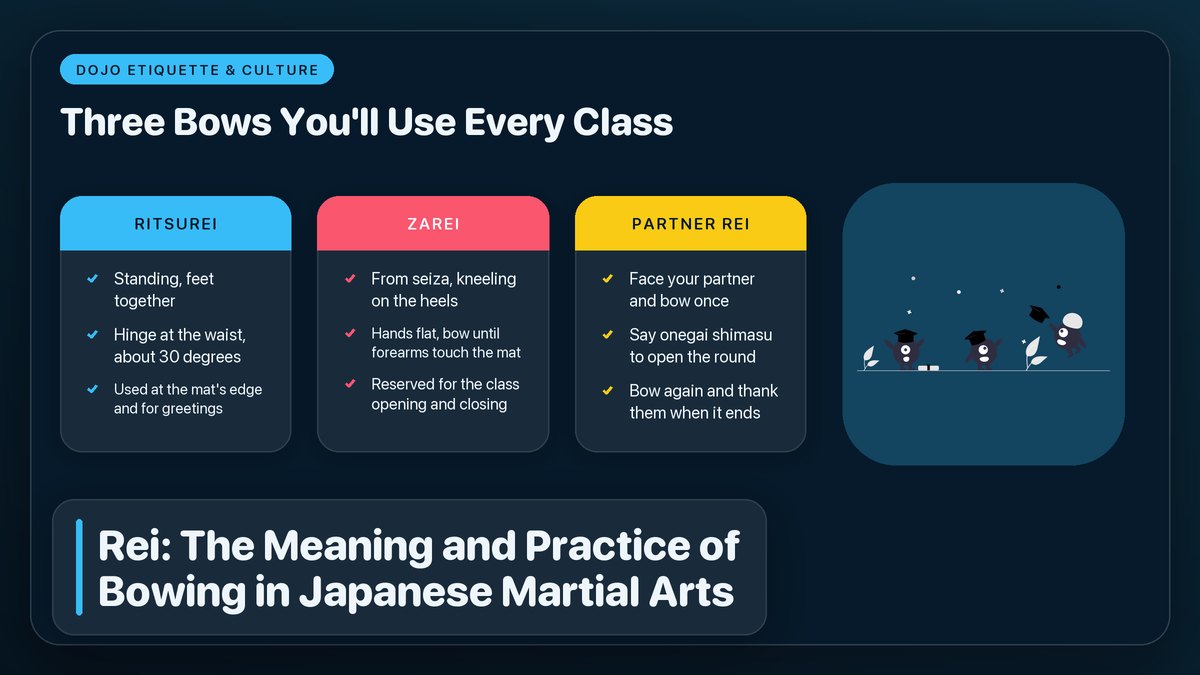
    The Standing Bow (ritsu-rei)

    Ritsu-rei is the workhorse. Feet together, body straight, hinge from the hips, hands sliding down the fronts of your thighs, eyes cast down, and hold for a beat at about thirty degrees before rising. In most dojos the depth encodes the relationship. A casual fifteen degrees says “hello, thanks, we’re starting.” A full thirty degrees or a touch more is reserved for the formal opening and closing bows toward the front of the dojo. The whole thing should take two to three seconds. Bow too fast and it reads as dismissive; hold it too long and you’re making your partner wait on ceremony.

    Two details beginners fumble. The hands slide down the legs rather than clasping at your sides. That keeps the gesture soft instead of military. And the eyes go down, not forward. Staring at your partner while bent over is, weirdly, one of the more aggressive things you can do on a mat, because the shape says submission while the eyes say challenge. Old habit, probably from an era when a bent-over swordsman really did need to watch for a blade.

    The Seated Bow (zarei)

    Zarei is performed from seiza: kneeling on the floor, tops of the feet flat, spine tall. You place both hands on the mat in front of you, fingertips touching or overlapping to form a small triangle, and lower your forehead toward that triangle without lifting your hips. Thirty degrees of forehead travel is plenty; this is not a yoga stretch. The hands sliding forward is the important part. When the founder’s photo is at the front of the room, the forward slide of the hands acknowledges a debt toward the source of the teaching. The same bow between partners trades the gesture more evenly. Kneeling changes the geometry of respect, dropping the whole exchange to floor level where nobody can hide behind height, which is probably half the point of requiring it.

    One practical warning. Seiza itself is the hard part. If your ankles and knees aren’t used to it, a formal opening ceremony can be more physically demanding than the warm-up that follows it. Most American and Canadian dojos won’t force it. Bow from a standing position when you need to. Twenty years of training won’t make everyone’s knees compatible with the floor, and any instructor who pretends otherwise is prioritizing form over function. Your knees get a vote.

    The main bows, side by side:

    Bow Japanese name When you’ll do it Depth
    Standing bow Ritsu-rei Entering the mat, greeting a partner, thanking the instructor. 15-30 degrees, a two-count
    Seated bow Zarei Formal class opening and closing when kneeling Forehead lowered, hands slid forward
    Bow to the front Shomen ni rei Start and end of class, toward the front wall or kamiza. Deepest standing or seated bow of the hour
    Bow to the teacher Sensei ni rei Called by the senior student, after the front bow Same depth, directed at the instructor
    Bow to each other Otagai ni rei Before and after every partner exchange. Quickest and lightest of the day

    Notice the pattern. The deepest bows go toward things that outrank you in time, the tradition first and the teacher right behind it, because both of those were standing on the mat long before you were. The lightest bow is the one you do most, aimed at the person standing right in front of you, about to grab your wrist.

    The Three Bows of Every Class

    Walk into a traditional aikido class anywhere in North America and the opening ceremony takes about ninety seconds. Everyone lines up facing the front of the dojo, usually in rank order; the school and the state of everyone’s knees decide whether that’s kneeling or standing. A senior student calls “shomen ni rei,” and the room bows toward the front, where the founder’s portrait hangs and sometimes a small shrine or a scroll. Then “sensei ni rei,” a bow to the instructor, who returns it. Then the class begins, and a third kind of bow quietly takes over the whole hour.

    Shomen ni rei: bowing to the front

    What exactly is everyone bowing at? It varies. In some dojos it’s the kamiza, the “upper seat,” a small shrine with a Shinto flavor. In others it’s purely the portrait of O-Sensei, aikido’s founder, and the bow is directed at a person rather than a deity. A few secular dojos have just a scroll with the word aikido on it, or nothing visible at all, and the bow addresses the art itself. The headquarters view of what the front of the dojo represents lives on the Aikikai Foundation’s official site, the organization Ueshiba’s family still leads in Tokyo.

    If you have a religious background, this moment can feel loaded. It shouldn’t. I’ve trained in dojos where the front held a shrine, and in dojos where it held a photograph, and the feeling of the bow was identical: gratitude toward whoever made the practice possible and toward everyone who’s ever bowed in that room before you. Bowing to a photograph of a dead teacher is structurally the same gesture as standing at a veteran’s memorial for a war you didn’t fight, an acknowledgment aimed at an absence. Nobody thinks the stone is listening, the bow just gives the feeling somewhere to go.

    Sensei ni rei: bowing to the instructor

    This one translates most easily for Western students, because we already understand the student-teacher bow’s shape: I acknowledge that you know things I don’t, and I’ll take correction from you for the next hour. Watch the exchange closely in any good dojo and you can read the entire culture of the place in those two seconds, right down to how the teacher treats the newest white belt. What surprises people is that the instructor bows back. Every time. Mutual doesn’t mean equal, and the depth of the returned bow is exactly the point. The student bows deeper and holds longer. The teacher’s return bow is slightly shallower and slightly shorter, which acknowledges the relationship and keeps it from becoming servile. Watch the exchange closely in a good dojo and you can read the whole culture in those two seconds.

    Otagai ni rei: bowing to your partner

    The bow that matters most happens dozens of times per class. You find a partner for the next drill. You face each other and bow, saying onegai shimasu, which means something like “please work with me.” You train for ten minutes and trade the roles of attacker and defender. Then you bow again, this time saying arigato gozaimashita to thank your partner for the practice they just gave you. It adds up fast. That pair of exchanges brackets every single partnership on the mat for the whole hour, which is the etiquette doing its most important work.

    Because the bow with a partner isn’t really about courtesy. It’s a safety agreement. Bow, and you’ve just told each other that you’ll attack at an agreed speed, tap when something hurts, stop when the other person taps, and let go the moment either of you asks. Remove the bow and the same physical exchange becomes a fight with unclear rules. The writers at Aikido Journal have returned to this idea for decades, usually pointing out that the bow is where uke’s honest attack and nage’s controlled technique are both negotiated before anyone moves. The AikiWeb forums host the ongoing student debate about how formal that negotiation should be, and it’s never once been settled, which is itself a kind of answer.

    The bow isn’t the class saying goodbye to you. It’s the class saying: we all showed up, and that deserves marking.

    Quick tipIf you only learn three phrases for your first month, make them these. “Onegai shimasu” at the start of a partnership, “arigato gozaimashita” at the end of it, and “hai” — yes, I understood — whenever a teacher gives you correction. Those three, said clearly and at the right moment, cover ninety percent of dojo communication, and senior students notice who’s making the effort.

    How Etiquette Differs Between Dojos

    Everything above is the common core. The actual rules, though, get invented locally, and two dojos in the same city can run completely different etiquette. After a decade of visiting schools across the US and Canada, I’d say the variation falls into a few predictable patterns.

    How traditional is the dojo?

    At the formal end, expect strict rank ordering in every line, zarei at the opening rather than standing bows, plus Japanese counting and a senior student whose whole job is calling the etiquette. Instructors may be addressed as sensei or by surname plus sensei, and questions to the teacher go through the senior student rather than directly. At the relaxed end, common in university clubs and many community dojos, you’ll get a quick standing bow at the start, first names everywhere, and maybe a single Japanese word all evening. Neither is wrong. The formal dojo is keeping a training method intact; the relaxed one is betting that the training survives without the packaging. Both bets win often enough that both styles persist.

    Which lineage and style?

    Lineage matters too. Aikikai-affiliated schools worldwide share a broad baseline, with national organizations like the United States Aikido Federation setting expectations for their member dojos. Iwama-style schools, which trace to the founder’s rural dojo, tend to keep the most conservative etiquette and the most weapons formality. Tomiki or Shodokan aikido includes competition, which changes the bowing rhythm entirely, since some exchanges now end with a judge’s call rather than a mutual reset. Karate and judo dojos bring their own house rules on top. Visit three different arts and you’ll bow with different hands, at different depths, in different orders. The variation is normal. Taking it personally is the only real mistake.

    Weapons classes

    If you ever train with a wooden sword (bokken) or staff (jo), the etiquette multiplies. Weapons are bowed to. You bow to the weapon rack when taking and returning one, some schools bow to the weapon itself before and after partner drills, and the reasons are practical as much as ceremonial. A heavy wooden sword swung carelessly ends careers. So the bow to the weapon doubles as a three-second pause in which you confirm you’re actually ready, grip settled, space clear, attention on your partner. I used to find this fussy. Then I watched a beginner swing a bokken into his own forehead during a rushed warm-up and decided the fuss was cheap insurance.

    How to Bow Well

    Form-wise, a good bow is simpler than it looks. The checklist I’d give a new student in my own dojo:

    • Match the room’s depth and speed by watching the two most senior students and copying them exactly, then matching the instructor’s return bow when it’s aimed at you. Etiquette is calibrated locally.
    • Feet together before you bend. Hinging from a staggered stance looks like you’re dodging something. Set your feet first.
    • Eyes down, briefly. A downward gaze for the length of the bow. It reads as respect in every dojo on earth.
    • Hands slide, they don’t swing. Down the front of the thighs for ritsu-rei; onto the mat, fingertips forming a triangle, for zarei.
    • Don’t talk through a bow. The phrases onegai shimasu and arigato gozaimashita belong on either side of the bend. Bowing and chatting at the same time is the most common beginner tell.
    • Bow back. If anyone bows to you, partner or senior student, return it. An unreturned bow in either direction is the one real etiquette error on this list.

    And that last point deserves its own paragraph, since it’s the one rule with no local variation. Every bow in a dojo is a proposal, and the correct answer is always another bow, which is why a whole room bowing in unison never quite gets old.

    What Bowing Is Not

    Three misconceptions show up in almost every beginner’s head, and it saves everyone time to clear them now. First, the bows are not worship. The shomen bow addresses a tradition, a portrait, or an idea, and practitioners of every religion and none train side by side in North American dojos without conflict. The details differ. The feeling doesn’t. If a specific dojo’s front-of-room practice bothers you, ask the instructor privately. The answer is usually more interesting than you expect, and I’ve never seen the question taken badly.

    Second is subtler. The bows are not a dominance ritual, at least not in any healthy dojo. The instructor’s return bow is the whole system in miniature. When a senior student’s bow goes unreturned, or when bowing starts being demanded rather than modeled, that’s a yellow flag about the school, and it belongs in the same category as a coach who screams. The seniors tell you everything. Watch how the most senior people treat the least senior ones, and the bows will fill in the rest.

    Third, and this one took me years: the bow is not empty. It’s a real action with real effects. Two people who bow to each other before practicing violence, however cooperative, are actively training something. They’re practicing noticing each other and entering a shared agreement before force is involved. Done a few thousand times, that sequence doesn’t stay on the mat. You find yourself pausing before difficult conversations, actually looking at the person you’re about to disagree with. Depending on which of my teachers you ask, that’s either a lovely side effect or the entire point.

    What to Take From All This

    Start simple. Bow when the room bows and match your depth to the senior students. Say the two partnership phrases until they’re automatic. Return every bow that’s offered to you. Then let the form do what it was designed to do, which is to take the question “am I showing enough respect?” off your plate so you can pay attention to the person in front of you instead.

    The rest of the etiquette will accumulate on its own, the same way you learned the unwritten rules of your first job. Nobody sat you down for a seminar on office culture. You watched, you absorbed a correction or two, and within a year you were the one new people were watching. Dojo etiquette works exactly like that, except the stakes are friendlier and everyone is secretly glad you’re making the effort.

    Sources and notes. This guide reflects common practice in Aikikai-affiliated and independent dojos across the US and Canada; exact etiquette varies with the school and the instructor, so always follow your own dojo’s customs first. If you’re brand new, our guides on dojo etiquette for beginners and what to expect at your first aikido class pair well with this one, and the basics of aikido itself gives the technique context the etiquette serves. External links were checked and working as of October 2026.
  • Your First Aikido Class: A Complete What-to-Expect Guide

    Your First Aikido Class: A Complete What-to-Expect Guide

    Dojo Etiquette & Culture

    What to wear, what to bring, how the bowing works, and what actually happens for the hour you’re on the mat, told straight so you can stop worrying and just show up.

    Updated October 2026 · 13 min read

    The scariest part of a first aikido class happens before the class starts. You’re standing at the door of a room you’ve never been in, holding clothes you maybe bought yesterday, about to walk onto a mat where everyone seems to already know the rules. I want to take that part away. A beginner class is one of the friendliest hours in martial arts, and the people inside that room remember their own first night better than you think. If you show up fifteen minutes early with a water bottle and an open mind, you’ve already done most of the hard part. This guide walks you through the rest, in the order it will actually happen.

    What to Wear (And Whether You Need a Uniform Yet)

    Aikido’s traditional training uniform is the keikogi, usually just called a gi: two heavy cotton pieces, a jacket and drawstring pants, plus a belt called the obi that holds the jacket closed. White is the standard color for beginners nearly everywhere in the US and Canada, and a full set costs somewhere in the $60 to $120 range depending on the weight of the cotton. If you want background on how the uniform evolved across Japanese martial arts, the overview of the keikogi is a good ten-minute read.

    And you don’t need to buy any of it before your first class. That’s the part that matters most. Almost every dojo keeps a box of loaner gis in various sizes, and a trial class is exactly what the loaner box exists for. If the dojo has no spare uniform, wear something you can move in. Think sweatpants without zippers and a plain t-shirt. Avoid shorts, because kneeling on mat burn is real; avoid anything with buttons or jewelry that can catch a partner’s sleeve; skip the baggy shirt that rides up the first time someone grabs your wrist.

    Feet stay bare on the mat, always. You’ll take your shoes off at the edge before stepping on, so clean socks or bare feet, and trim your toenails. One of those details nobody mentions until it matters, it always eventually matters.

    Nobody at the dojo will remember what you wore. They’ll remember whether you were willing to fall down and get back up.

    What to Bring vs. What the Dojo Provides

    The short version: bring almost nothing. Aikido dojos are low-gear compared to, say, starting hockey. Most training halls already have everything the practice needs on the walls or in the closet.

    Item You bring The dojo provides
    Uniform (gi) Only after you decide to keep training; ask about loaners first Loaner gis for trial classes at most dojos
    Belt (obi) Comes with the gi, or the dojo lends one Someone will happily show you how it ties (there’s an art to it)
    Water A bottle you can keep at the edge of the mat A drinking fountain at many community dojos
    Mat space Nothing, just be on time The tatami itself, swept before and after every class
    Weapons Nothing on day one Wooden swords (bokken) and staffs (jo) for later classes
    First aid Any tape or supports your body already needs A small kit somewhere near the office, usually

    If there’s one thing I’d add beyond that table, it’s a small towel. An hour of aikido involves more close contact with other people’s sleeves than newcomers expect, and you’ll be glad for it by the halfway point.

    Before you goEmail or call the dojo a day ahead. Ask what a trial class costs (many are free or a few dollars), whether they have a loaner gi in your size, and whether you should arrive early to fill out a waiver. Five minutes of email removes ninety percent of first-night awkwardness.

    Arriving: The Fifteen Minutes That Set the Tone

    Show up about fifteen minutes before the posted start time. This is normal dojo culture, not over-eagerness, since it gives the instructor time to greet you and find a loaner gi in your size before pairing you with a patient senior student. Walk in, take your shoes off at the door or mat edge, and say hello to the first person who makes eye contact. That’s the whole entrance exam.

    Right away, a few things will catch your eye. The mat area, the tatami, is treated as a clean space, so street shoes never touch it and you’ll step on and off at the same spot. At the front of most dojos hangs a framed photograph, usually of Morihei Ueshiba, the founder, and there’s often a small shelf or altar beneath it (some dojos keep flowers or a stick of incense there, some keep nothing at all). You don’t have to do anything about that yet. Bowing toward it, and toward the instructor, is something the regulars do. You’ll pick it up by watching in about four minutes flat.

    Someone will hand you a waiver and probably a loaner uniform, then point you toward a changing area. Waiver first, gi second. If the gi feels stiff and strange, that’s because it is, for everyone, for roughly their first month. Also, leave your phone in your bag. Classes run phone-free on the mat almost everywhere, and the quiet is half the point.

    Bowing In: What the Ritual Actually Means

    Classes in most traditional dojos open with a short formal sequence, and knowing what’s coming makes it feel like a ceremony instead of a pop quiz. Students line up seated, usually in rows with the most senior students at the right end near the instructor. A senior student calls the class to attention with a phrase like “ki o tsuke,” everyone bows toward the front of the dojo together (that’s shomen ni rei), then bows toward the instructor (sensei ni rei), who bows back. Partner practice later begins and ends with a small bow to your own partner, plus a spoken phrase or two.

    The bow itself, in Japanese contexts generally, is called ojigi, and it’s worth understanding that a bow in a Japanese martial art is closer to a handshake than to worship. The entry on ojigi covers how the gesture works in daily Japanese life, where bowing shows up at funerals, job interviews, even convenience stores, and the dojo version sits in that same lineage of mutual respect. You’re acknowledging the space, the teacher, the person about to grab your wrist. Nothing more is being asked of you.

    One reassurance for anyone worried about the quasi-religious look of the front-of-room shrine (the kamiza): practices vary. Some dojos lean traditional, some barely nod to it. Both are common across North America. You bow as a sign of respect to the tradition rather than a statement of belief. In the years I’ve been around dojos, I’ve trained alongside devout members of half a dozen religions and a comfortable number of atheists, and nobody has ever been asked to profess anything.

    Warm-Ups: Rolling Before You’re Ready to Roll

    After the bows, the instructor leads warm-ups, and this is where aikido differs from most martial arts in one important respect. Expect some stretching, wrist and shoulder circles, loosening exercises, and then the surprise. Falling practice. From your very first class you’ll work on ukemi, the art of receiving a technique safely, starting with rocking drills and forward slides, maybe a gentle somersault over one shoulder with a slap of the mat. There’s a reason, and it’s a good one. Falling well is the skill that keeps partner practice safe for decades, so it’s trained from minute one rather than left until you need it.

    Go slowly here, and I mean that as practical advice rather than politeness. The temptation in a first class is to copy the shape of what the advanced students are doing, but a senior student’s forward roll is the product of a few thousand repetitions, and your version on night one should be small, slow, and boring. Knees, then shoulder, then slap. The mat is more forgiving than your pride assumes, but only if you keep your chin tucked.

    By the end of warm-ups, roughly ten or fifteen minutes have passed and the nervousness most beginners arrive with has usually burned off. Which is exactly the design. Something about being busy with your body leaves no room left over for anxiety.

    Partner Practice: The Heart of the Hour

    You’ll spend most of class taking turns throwing and being thrown.

    The middle of class is partner work, and the first thing that will happen is a senior student or the instructor will walk you through the partner bow and the phrase onegai shimasu, which means something like “please train with me.” You’ll say it to your partner at the start of each round and arigato gozaimashita at the end. They sound like a mouthful. By the third time, they aren’t, and I think most people end up liking the ritual more than they’d expect, because it turns every round into a small handshake instead of a contest.

    What nage does

    Your partner will attack in a pre-agreed way, a wrist grab or a slow strike, and you’ll practice the response the instructor just demonstrated, maybe three or four repetitions before switching. The teacher walks the mat correcting details. Your shoulders are up. Your feet are crossed. You’re muscling it. Expect a lot of small, kind corrections. Expect the technique to feel completely impossible for the first half hour, then suddenly click for one repetition out of nowhere. That single click is the feeling people come back for.

    What uke does, and why it’s half the art

    Being the attacker, the uke, is a role, not a loss. Uke gives a real, committed attack at a speed both partners can handle, then follows the technique into a safe fall. Doing that well is a skill with its own years of depth, which is why Aikido Journal has published essay after essay on what makes good ukemi. As a beginner, your job is simpler: attack honestly at a slow pace, fall where you’re guided, tap the mat or your partner the instant anything hurts, then get up smiling if you can manage it. Your partner in that first class was once on the ground in a borrowed gi doing exactly the same thing.

    Something I’d warn you about: the hands-on closeness. Aikido practice involves wrist grabs and elbow contact, with occasional moments where your partner’s sleeve is your only handle on the situation. It can feel intimate for the first few classes if you’re not used to contact sports, and that fades fast. Dojos are good at this. If a grip or a position ever feels wrong, say so, immediately, to your partner and then to the instructor if needed. Every serious dojo treats that as normal communication, and any partner who doesn’t isn’t someone you’ll be paired with twice.

    The Japanese Words You’ll Hear (Don’t Memorize, Just Recognize)

    Nobody hands you a vocabulary sheet. Japanese terms just float around the room, and after a few classes they stop being foreign. Sensei means teacher. Tatami is the mat. Uke and nage, you’ve met. Ma-ai is the distance between partners, the gap that decides whether an attack can even land. Rei is the bow itself. And the headquarters style practiced at most dojos traces back to the Aikikai Foundation in Tokyo, which is why a class in Ohio and a class in Osaka can share the same vocabulary.

    Two phrases earn themselves a little study before class one, though. The opening request is onegai shimasu. The closing thanks is arigato gozaimashita. Write them on your palm if it helps. Nobody will laugh at your pronunciation, because roughly half the room was mumbling them nervously a year ago. I still mumble a little, if I’m being honest.

    The bow and the words do real work. They turn a room of strangers into people who have agreed, out loud, to take care of each other for the next hour.

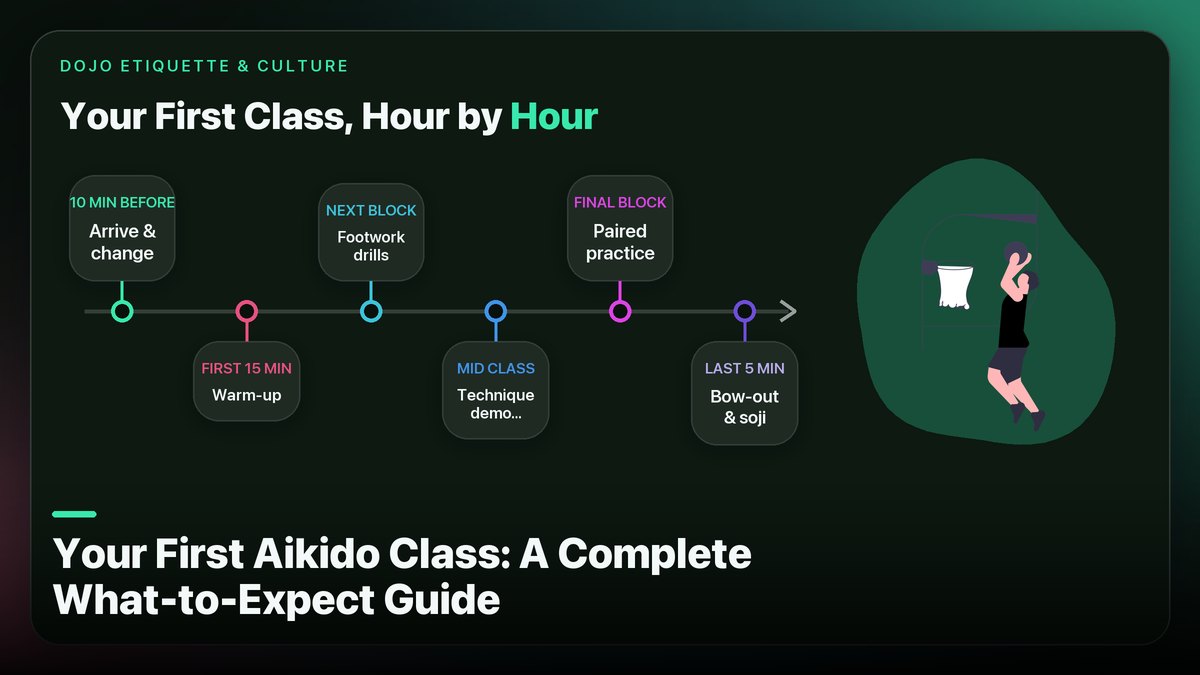
    The Hour at a Glance

    Every dojo runs its own rhythm, but a beginner class in the US or Canada tends to look something like this:

    • Bow in. Line up, seated bow to the front of the dojo and to the instructor, about two minutes.
    • Warm-ups. Stretching plus wrist and shoulder loosening, then basic falling practice, ten to fifteen minutes.
    • Footwork solo drills. Walking irimi and tenkan steps up and down the mat until the pivot stops feeling like dance choreography, five to ten minutes.
    • Partner techniques. The instructor demonstrates, pairs work a grab or strike response, everyone switches roles each round, thirty minutes or so.
    • Bow out. The line forms again, bows are exchanged, class ends. Senior students stay to sweep and stack the mats.

    Notice what isn’t on that list: sparring, competition, anything resembling a fight for points. Most styles of aikido don’t have matches at all, which is either a feature or a bug depending on what you’re looking for, and for a nervous first-timer it’s almost always a feature. You will never be asked to “win” anything on your first night. Or ever, honestly.

    The Worries Everyone Has (Answered Straight)

    “I’m not in shape for this.” Neither was anyone else on their first night, and aikido is kinder to the unfit than it looks. You can do the whole class at your own pace, sit out any drill by stepping to the edge of the mat, and no one will say a word beyond “feel better.” The conditioning builds on its own schedule, about fifteen classes in, when you realize the warm-up stopped feeling like a workout.

    “Too stiff, too old, too uncoordinated.” The average beginner class in North America skews adult, with plenty of students starting in their thirties and forties, some well past retirement age. Stiffness is close to the norm, and uncoordination is why there are mirrors and patient seniors. I’ve watched a sixty-year-old accountant with two left feet become one of the most reliable ukes in his dojo over about two years, mostly by just showing up Tuesdays and Thursdays.

    “I’ll be the only beginner.” Possibly, and briefly, but it matters less than you’d fear. Dojos assign seniors to newcomers on purpose, because teaching a beginner is considered good training for the teacher, which means your confusion is literally useful to somebody. A little flattery that happens to be true.

    “What if I bow wrong or say something dumb?” You’ll bow slightly off, mispronounce something, and step on the mat with your left foot when the room used the right. Nobody cares. Etiquette in a beginner context is graded on obvious effort, and effort is the one thing fully in your control. I said fifteen minutes earlier that you should arrive early; on reflection I’d say the real rule is just don’t arrive late, because late arrivals walk onto a mat full of seated people mid-bow, which is the one entrance nobody enjoys making.

    “Is it dangerous?” It’s a full-contact martial art with throws and joint locks, so a sprained wrist is a real possibility over the long run, about on par with recreational basketball. Injuries in beginner classes are rare, mostly because beginners move slowly and fall from low heights under close supervision. Tap early. Tap clearly. Speak up. The risk drops a lot after that.

    Training noteTell the instructor before class about any injury, recent surgery, or ongoing condition that affects how you can move or fall. A good teacher will adjust what they ask of you for the entire hour. Hiding a bad knee and limping through ukemi drills helps nobody, least of all your knee.

    After Class: The Part Nobody Tells You About

    Class ends with the bow-out, and then something nice usually happens. People linger. Good sign, usually. The senior student who worked with you will ask how it went, someone will mention when the next beginner class meets, and you’ll probably be handed a schedule and a rate sheet. This is a fine moment to ask the questions you saved up: what a month of classes costs, whether there’s a beginner-only series, what the testing path looks like, and how the AikiWeb community and dojo directories can help if you ever move cities and need a new mat to call home.

    Physically, expect two things the next morning. Muscles you forgot you had, mostly forearms and hips, plus the tops of your feet, and a vague sense that the world moved a little slower yesterday than it usually does. Both pass in a day or two. The part that doesn’t pass is the question you’ll catch yourself asking by Wednesday: whether you could make the Thursday class. If you’re asking it, the answer is yes, and the borrowed gi will be hanging on a hook with your name on it by next week.

    Sources and notes. Class structure and etiquette described here reflect common practice at Aikikai-affiliated and independent dojos across the US and Canada; individual dojos vary, and your instructor’s word beats any article. External links were checked and working as of October 2026. For more on this site, start with what aikido actually is, then the companion guides on dojo etiquette for beginners, tying your belt (obi), and ukemi, the rolling and falling basics you’ll meet in your first warm-up. This is training guidance for a supervised martial-arts class, not medical advice; for any injury or health concern, see a qualified professional.
  • How to Tie Your Obi: A Step-by-Step Belt-Tying Guide

    How to Tie Your Obi: A Step-by-Step Belt-Tying Guide

    Dojo Etiquette & Culture

    The obi is the first thing you put on before class and the last thing you take off, and yet most beginners tie it badly for years. This is the proper wrap and knot, the mistakes that leave belts loose or lopsided, and how to fix them without holding up the line.

    Updated October 2026 · 12 min read

    I tied my belt wrong for the better part of four months before anyone corrected me, and the only reason they finally did was that my knot migrated around to my spine every single class and landed directly under me every time I took ukemi. Rolling across your own belt knot is a small, stupid discomfort. It won’t injure you, but it makes every fall a little worse, and nobody mentions it because everyone assumes someone else already told you. This guide is the correction I wish I’d gotten on day one. It’s written for new aikido students in the US and Canada, it assumes zero experience, and it walks through the whole job from finding the center of the belt to tying the flat square knot that aikido shares with karate, plus the handful of mistakes that leave a belt loose or sitting crooked. If your first class is coming up, you can practice at home in front of a mirror. By the time you bow in, you’ll tie it the way the senior students do, which is to say without thinking about it at all.

    What Your Obi Actually Is

    Before the how, thirty seconds of what. Obi is simply the Japanese word for a sash, and it’s far older than any martial art. The obi as a sash has been part of Japanese dress for centuries, and martial artists borrowed it because a wide wrapped band does an excellent job of keeping a training jacket closed while marking rank. In aikido dojos you’ll usually get a white belt to start, then progress through the kyu grades toward black. The grading structure that uses these colors is standard across most Japanese martial arts, and the dan and kyu ranking system behind it was systematized in the 19th century before being adopted by the art’s early organizations, including what became today’s Aikikai Foundation in Tokyo, headquarters body for the largest aikido lineage.

    A few practical differences from other arts matter once you start tying. An aikido obi is wide, typically about 4 inches, and it’s meant to be wrapped around the waist twice. It’s softer than a judo belt, which is built to be gripped and yanked. And unlike a karate belt, which many styles fold and stitch stiffeners into, an aikido belt is usually plain dyed cotton. That last point sneaks up on you. A new belt is stiff and flat and cooperative. After a few dozen sweaty classes it turns soft and starts willing to twist, which is when most of the mistakes below get invented. The methods in this guide work at every stage, but expect a brand-new obi to fight you slightly until it breaks in.

    Whatever rank color you’re wearing, the belt changes nothing about safety on the mat. And if this is your first month of training, our overview of aikido basics for new students is a good companion read for the terminology used here.

    Getting Oriented Before You Wrap

    Ninety percent of lopsided belts are decided in the first three seconds.

    Every wrap starts the same way, and doing that part deliberately is the difference between a belt that sits straight all class and one you adjust after every technique. Hold the belt in both hands and find the exact center point. Most aikido and karate belts have a seam or a small stitched label marking the middle, and if yours doesn’t, fold it in half and pinch the fold. That midpoint anchors the whole operation. Nearly every crooked belt I’ve seen started exactly there. Start at one end, skip the center, and the whole wrap is doomed from the first pass around your waist.

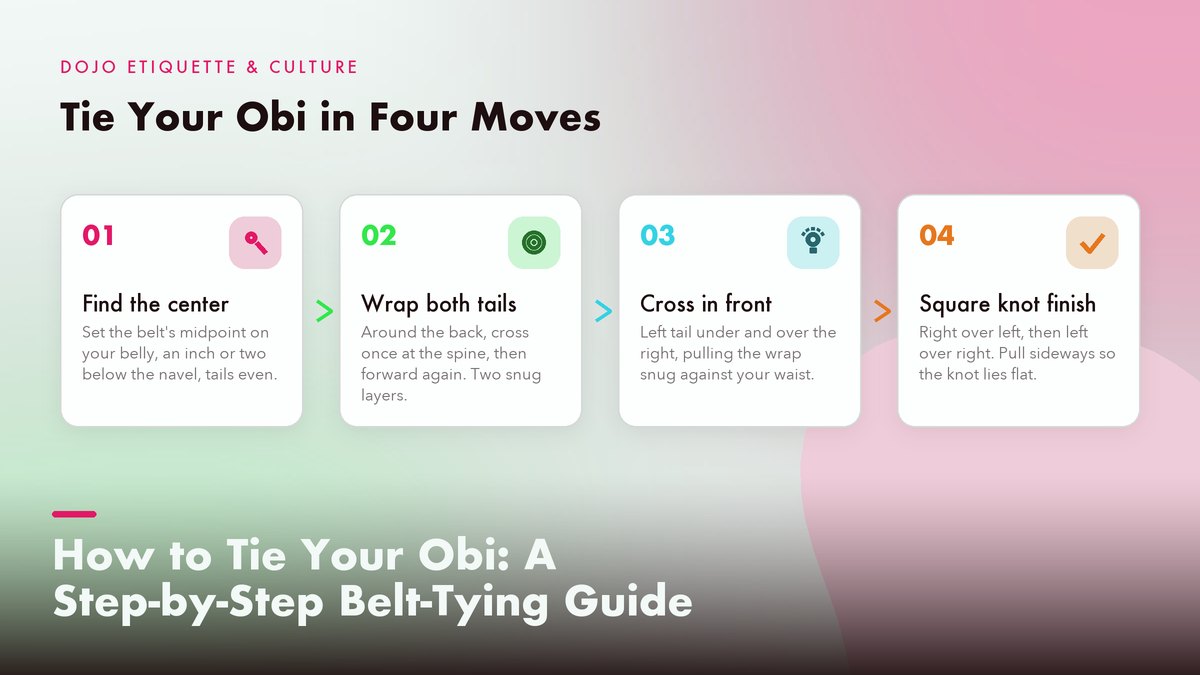
    Set the center of the belt flat against your stomach, a couple of inches below your navel, with the stitched label (if there is one) facing out against your body. Both tails hang down in front, roughly even. Five seconds, once it’s a habit.

    One choice deserves a moment of thought, because your dojo has an opinion about it even if nobody has mentioned it yet. When the tails cross in front, most aikido and karate dojos expect the right tail to cross over the left. Mechanically it makes no difference at all. What matters is consistency, because a wrap that always crosses the same way produces a flat square knot every time, while swapping the order at random produces the twisted granny knot that every beginner eventually complains about. Pick the convention on day one and never improvise again.

    Quick tipRun the whole sequence once at home in front of a mirror, slowly, before your first class. Do it three times in a row. You’ll feel self-conscious for about thirty seconds. Then you’ll walk into the dojo already looking like you’ve done this for months, and that changes how the first hour feels more than you’d expect.

    The Standard Wrap, Step by Step

    This is the sequence used in the overwhelming majority of aikido dojos. Some styles teach minor variations in where the belt sits or how the tails cross, so if your instructor shows something different, do it their way and treat this as the default you’ll come back to.

    • Start at the center, low on the belly. Set the midpoint of the obi flat against your stomach a couple of inches below the navel, both tails hanging even in front of you.
    • Send both tails behind you. The right one goes around your right side, the left around your left. Keep the wrap snug rather than tight. You should be able to breathe and squat without the belt biting.
    • Cross once at your spine. Where the tails meet in back, let them pass over each other, right over left, so each one continues toward the opposite side of your waist.
    • Bring them home to the front. The right tail now rounds your left side and the left tail rounds your right, and both hang in front of you again. Two layers, anchored against your body. That anchored feeling is the whole point of the double wrap, and you should feel it well before you ever touch the knot.
    • Even the tails. Slide the belt around until the hanging ends match. If one end reaches your knee while the other barely exists, your center point drifted during the wrap. Undo it, re-center, start over. Fifteen seconds.

    Wrapping too loosely is the most common failure at this stage, by a wide margin. A belt wrapped with slack between its two layers rotates around your waist the moment you pivot hard or take a fall, and a rotated belt drags everything sitting on top of it along for the ride. Snug means the belt moves when your body moves, not when your jacket moves. My rough test, which I stole from watching a fourth-dan, is two flat fingers under the wrap. If they slide in comfortably, the tension is right.

    Tying the Knot So It Lies Flat

    What you’re after is a square knot, the same one sailors use to join two lines that need to hold under load, and it has one quality that matters enormously on the mat. It lies flat. A flat knot doesn’t dig into your stomach when you bow, and it doesn’t form a hard pebble under your spine when you’re thrown. Keep the same right-over-left convention from the wrap and work through it slowly.

    • Lay the right tail over the left, then tuck it up under both strands. Pull it through toward you and snug it down.
    • Swap for the second pass. Whichever tail ended up on top after the first pass now crosses over the other, tucks under, and comes through. Two half-knots, opposite directions.
    • Set it sideways. Pull both tails outward, horizontally, instead of straight down. Pulling down rolls the knot into a cylinder. Pulling across seats it flat against the wrap.
    • Check the ears. A finished square knot shows two short, roughly even tails pointing off to the sides like a flat little bow. They should rest on top of the wrap itself and read as a small horizontal rectangle sitting on your stomach.

    Why does this knot stay put when the beginner’s knot doesn’t? The answer lives in which tail crosses on top. A square knot is really two half-knots stacked in opposite directions, and the opposing tensions lock each other in place. Cross the same way twice and you get a granny knot, which looks nearly identical for about ten minutes before it twists sideways, loosens, and unties itself in the middle of class. If your knot has ever rotated so the ears point up and down instead of side to side, or if you’ve found your belt trailing on the mat after a hard fall, you were tying a granny knot. The fix is embarrassingly simple. Alternate which tail crosses on top, every time, without exception.

    A belt that comes untied in class is almost never a knot problem. It’s a wrap problem. Tie a tidy square knot on a loose, twisted wrap and you’ve built something neat on a moving foundation.

    Common Mistakes and How to Fix Them

    These are the failures I see most in beginner classes, listed roughly in the order they annoy you by the end of an hour. If your belt never quite feels right, one row of this table is probably your culprit.

    What it looks like Why it happens The fix
    Your belt rotates around your waist all class Wrapped too loosely, or one layer twisted so the belt can slide over itself Rewrap snugly and run a hand around your back to flatten both layers before you tie
    Knot twists sideways and works itself loose Crossing the same tail over the top twice, which is a granny knot Alternate the crossing tail. If the finished knot’s ears point up-down, redo it
    One tail hangs to your knee, the other barely exists Started wrapping from one end instead of finding the belt’s center first Start over at the center point. Uneven tails can’t be fudged by the knot
    It migrates over your spine Tails crossed unevenly at the back, so the front junction slides around to the rear Cross the tails crisply at the spine and keep even tension on both as you bring them forward
    Knot digs into your stomach when you bow or roll Tied too low over your stomach, or cinched downward instead of sideways Set the knot a touch higher and seat it with sideways pulls so it stays flat
    Belt twists into a rope down your back A layer flipped over itself during the wrap, common with stiff new belts Smooth each layer flat as you wrap. A twisted layer is a loose layer
    Belt edges roll and curl after washing Machine-washed and dried, which shrinks and torques the cotton Hand wash cold, air dry flat, and fold it neatly instead of cramming it in a bag

    Notice how few of those fixes involve the knot itself. That’s the real lesson of belt-tying, and it’s the one that transfers. Most things that look like finishing problems are setup problems wearing a disguise.

    The granny knot, diagnosed properly

    Since it causes more grief than everything else combined, the granny knot earns its own paragraph. The tell sits in the shape of what you’ve just tied. After your first pass, pause and look at the tails. In a correct sequence, whichever tail ends up on top is the one you cross over for the second pass. Catch yourself reaching for the same tail twice and stop. Swap. There’s a second diagnostic too, and it’s nearly foolproof. A square knot lies flat with two horizontal ears, while a granny knot always curls, because both passes torque the same direction and the knot has no opposing tension to rest against. Spot the curl once and you’ll catch yourself mid-tie within a week. After a month you won’t think about it at all.

    Tying Someone Else’s Belt

    Helping a partner with their belt comes up constantly in beginner classes, and there’s a courteous way to do it. Stand facing them, take the two tails they’ve brought around, and tie the knot as if it were your own, keeping the same right-over-left convention. Two rules apply. Don’t yank the tails to cinch it, because their snug is your snug, and a belt tied too tight is miserable for the next hour. Tie on their front, centered, unless your dojo has a specific custom about placement, since a knot tied off to one side is usually a mistake rather than a style statement. A quick mutual bow afterward, and you’re done.

    Kneeling shifts the geometry. When you tie for someone while both of you are in seiza, the belt sits higher on their torso relative to your hands, and it’s easy to set the knot too low so it slides down the moment they stand. Compensate by placing it a finger’s width higher than feels natural. Belts settle downward as the fabric relaxes, and a knot that’s correct for standing is slightly loose for kneeling.

    Folding Your Obi After Class

    Now we leave mechanics and enter culture, briefly. In traditional dojos the belt counts as more than equipment, and how you handle it off the mat is part of the etiquette you’ll absorb whether anyone spells it out or not. The standard after-class routine goes like this. Untie the knot, find the center, fold the belt in half lengthwise, then fold or roll it from the center outward into a compact bundle. Some students just drape theirs over the hanger with the gi jacket, which is equally respectable. What gets frowned on is wadding it into a ball and stuffing it in your bag. Partly that’s about the creases. Partly it just looks careless, and carelessness with your own gear reads as carelessness with the dojo’s customs.

    A handful of dojos take this further and ask that you never wash a black belt at all, treating the accumulated wear as a record of your training. That’s a custom, a preference, and it varies widely between organizations and lineages. A white or colored belt will need the occasional wash, and the method matters more than the frequency. Hand wash in cool water with a small amount of mild detergent, rinse thoroughly, and air dry flat away from direct sun. A machine dryer shrinks the belt unevenly, torques the seam at the center mark, and sets wrinkles that never fully come out. However you fold or wash it, the principle underneath is the same one that runs through everything else in the dojo, from how you bow to how you treat the mat. The small repeated acts are the practice.

    Worth reading about from people who’ve spent decades inside that culture. Aikido Journal has published for years on the history and customs underneath techniques like this one, and the long-running community at AikiWeb has forum threads going back to the earliest days of the web in which students trade exactly these small practical details. If you want to know whether your dojo’s belt-washing custom is common or odd, that’s the place to ask.

    A Short Pre-Class Checklist

    Everything above compresses into about twenty seconds of actual work. Run through it in your head facing the mirror in the changing room.

    • Center the belt first. Midpoint against the belly, a couple of inches below the navel, tails even.
    • Wrap twice, snug but breathing. Cross crisply at the spine, then bring both tails back around to the front.
    • Match the tails. No knee-length ends, no stubs. Fix this now rather than after the knot.
    • Tie right over left, then left over right. Alternate every pass so the knot can never become a granny.
    • Seat it sideways. Pull horizontal so the knot lies flat, ears pointing side to side.
    • Hand check. Run a palm around your back. Both layers flat? Then bow in.

    Do that every class for a month and you’ll stop doing it consciously, which is the actual goal of almost everything in a dojo. The belt is a small, ordinary object. Learning to handle it well is a small, ordinary skill. But small ordinary skills done without thought are what the whole thing is made of, from your first white belt to whatever rank is decades down the line.

    Sources and notes. Wrapping and knot methods here follow common practice in Aikikai-affiliated and independent aikido dojos across the US and Canada; individual schools vary in details like knot placement, so follow your instructor’s version when it differs. External links were checked and working as of October 2026. Related reading on this site: What Is Aikido? The Art and Its Basics Explained for New Students, What to Expect at Your First Aikido Class, and Dojo Etiquette for Beginners.

  • Dojo Etiquette for Beginners: The Unwritten Rules, Written Down

    Dojo Etiquette for Beginners: The Unwritten Rules, Written Down

    Dojo Etiquette & Culture

    Every dojo runs on customs nobody hands you on a printed sheet. The bow at the door, the way you address the instructor, the reason beginners are handed the broom after class. This guide covers what those customs mean, and why following them makes you a better training partner.

    Updated October 2026 · 13 min read

    My first week in an aikido dojo, I made a small mistake that still makes me smile. Class had ended, everyone bowed, and while I stood there wondering where the exits were, the senior students walked to a closet, pulled out brooms, and started sweeping the mat. I watched for a polite moment, then left, assuming they’d handle it. Nobody scolded me. But as I laced up my shoes at the door, one of the black belts called over, kindly, “Next week, you sweep too.” Not because the mat needed my particular sweeping skills. Because the broom is where the etiquette starts making sense.

    If you’re brand new to a traditional martial arts dojo in the US or Canada, some of what you see will feel ceremonial, maybe even stiff. Bows at the threshold. A Japanese word for everything. Students sitting on their heels facing the front wall while the instructor demonstrates. It can look like a wall of rules designed to catch you out. Almost none of it is. The customs exist for a handful of practical reasons that made sense centuries ago and still make sense tonight, and once you know the why, the what stops feeling like a test. This guide walks through the etiquette from the moment you walk in the door to the moment you pick up that broom.

    Why Etiquette Exists at All

    Start with the obvious question, because it’s the one I should have asked in week one. Why does a martial art, of all things, come wrapped in formality? A dojo is a room where people grab each other, throw each other, and swing wooden weapons at each other’s heads, safely, dozens of times a night. That only works if everyone in the room shares a tight set of habits. How close to stand. How to signal that something hurts. Whose lead to follow when instructions change mid-drill. Etiquette is that shared set of habits, and you can think of it as the traffic system of the room.

    There’s a second reason, and it’s older. Traditional Japanese arts, from swordsmanship to tea ceremony, developed in a culture where the way you bowed, sat, and spoke communicated your sincerity before you’d demonstrated any skill. Much of that lives on in the Japanese concept of rei, which covers both the physical bow and the attitude of respect behind it. You don’t have to adopt another culture wholesale to train well. But once you understand the bow as a signal between training partners, it feels different to do it. A respectful training environment also sits at the center of the code of conduct that organizations like the Aikikai Foundation in Tokyo, the headquarters body of the art, expect affiliated dojos to maintain.

    The bows, the sitting, the sweeping. None of it is ceremony for ceremony’s sake. It’s how twenty strangers practice throwing each other without anyone getting hurt.

    Before You Step on the Mat

    The threshold matters more than most beginners expect.

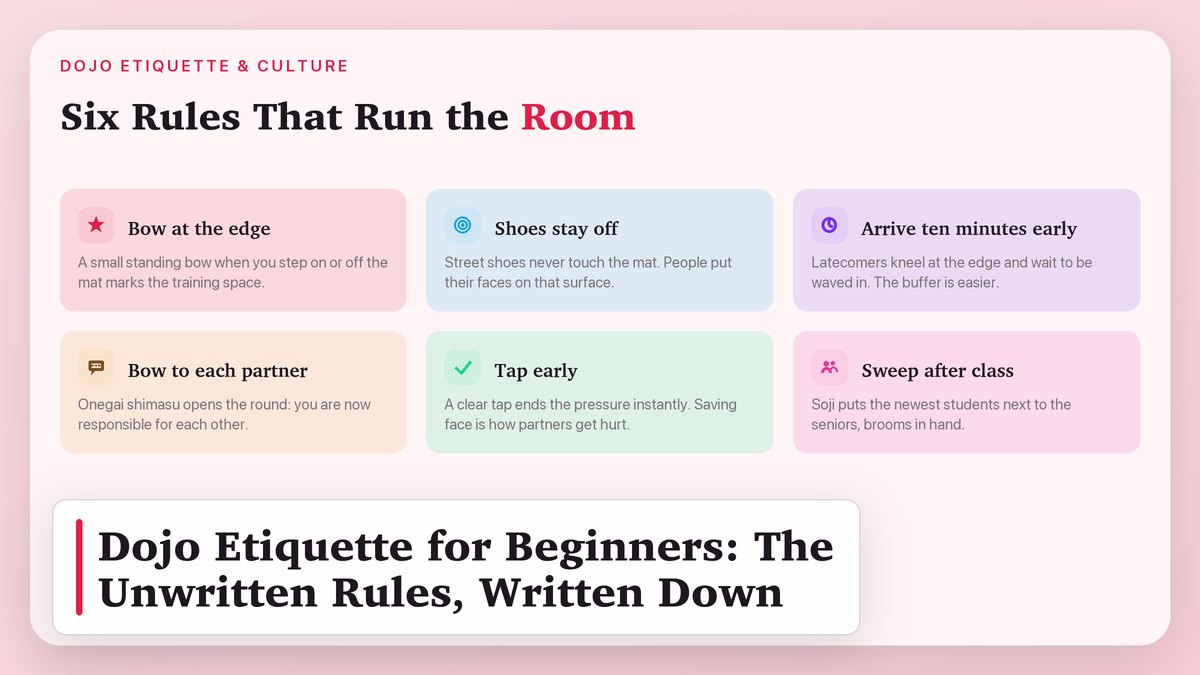
    Your first etiquette moment happens at the edge of the mat, and it costs you about three seconds. When you approach the mat for the first time, or return to it after stepping off, you pause and give a small standing bow toward the front of the room, where the picture of the founder hangs. Then you step on. Same thing when you step off. This is the one custom you’ll see observed without a single exception, class after class, and the practical reason is simple. The bow marks a mental boundary between the regular world and the training world. For that hour, your phone and your work email stay off the mat with your shoes.

    Which brings up the shoes. Never, under any circumstances, wear street shoes or step on the mat in socks you walked in with. In Japan the line between outside dirt and inside space runs through every home and dojo, and the mat is treated like a clean floor surface, not gym equipment. People train on it barefoot and sometimes face-down. A gravel fragment tracked in from the parking lot is a real hazard when someone rolls across it. Leave your shoes neatly at the edge, soles against the wall if the dojo does it that way. You’ll already look like a local.

    A few smaller customs that cluster in the “before class” window:

    • Arrive ten minutes early. Latecomers create a small disruption, and in most dojos the fix is formal. You kneel at the edge of the mat and wait for the instructor to wave you in, which is more attention than most beginners want. Give yourself the buffer.
    • Remove rings, watches, and dangly jewelry. They scratch partners and they break. I lost a watch band to this rule in month two.
    • Trim your nails. Long fingernails leave marks on wrists and faces, and partners remember.
    • Bring a clean gi. If your uniform is damp from yesterday’s class, the person grabbing your lapel will know. Air it out between sessions.
    • Ask before stepping onto a mat area where a class is running. If you arrive during someone else’s session, wait at the edge and catch a senior student’s eye.

    The Bow: What It Means and Who Bows to Whom

    Called rei in most dojos, the standing bow is simple. Feet together, a hinge at the waist, eyes roughly on the person or direction you’re bowing toward, held for about a beat. That’s the whole movement. The subtler part is knowing when. In a typical aikido class you’ll bow at the start of class, toward the front of the dojo and sometimes toward the instructor; at the end of class; when stepping on or off the mat; and to each partner when practice begins and ends. In Japan, formal greetings and bows follow their own logic, and the customs around bowing in Japanese daily life are a good background read if you want the cultural context.

    The partner bow is the one worth understanding deeply, because it contains the whole safety system in miniature. Before you and a partner start working together, you face each other, bow, and in most dojos say onegai shimasu, a phrase that means roughly “please train with me, I ask your cooperation.” When the round ends, you bow again and say arigato gozaimashita, thanking them for the practice. What matters is what the exchange establishes in those few seconds. You and your partner are on the same side, and you’re both responsible for each other’s safety during the next ten minutes. That frame is what lets two near-strangers practice joint locks at full commitment. Dojos affiliated with national organizations, like the United States Aikido Federation, pass etiquette expectations on to member schools for exactly this reason. The bow is how a room full of mixed ranks keeps everyone honest.

    One beginner worry I hear is whether to bow to the instructor separately. In most traditional dojos, yes, once at the opening of class. It’s a mutual acknowledgment, and many instructors return the bow in kind. If you’re ever unsure what a specific dojo does, watch the senior students and copy them. That’s not cheating. That’s the etiquette working as designed.

    How to Address Instructors and Senior Students

    The title you’ll hear most is sensei, which attaches to the teacher of the class. It means something like “one who has gone before,” and it’s a description of the person’s role in the room. Some things worth knowing about it. First, you don’t need to call out “Sensei!” to get attention; raising a hand works fine. Second, in the US and Canada many instructors are relaxed about the title and will tell you to use their first name off the mat. The safe default is sensei on the mat, whatever they prefer off it.

    Two other words describe the hierarchy without any titles at all. Senpai are students senior to you, meaning they’ve trained longer, and kohai are junior. The senpai carry a real job. When the instructor is busy with another pair, they’re the ones correcting your footwork, and they’re the example you’re meant to follow when something ambiguous happens. If a senpai gives you a correction during practice, the etiquette is to say thank you and try it immediately, even if you were doing it the other way on purpose. I promise they corrected someone else the same way last week.

    The head instructor of the dojo is the dojo cho. You may never need the word, but knowing it helps you follow who’s who in a new school. And if you visit another dojo, as students often do, guest etiquette follows you. You behave as a guest, introduce yourself to the dojo cho before class, and let them run their room their way.

    If you remember nothing elseThe bow before partnering up is the load-bearing custom. It’s the moment practice shifts from “two people near each other” to “two people responsible for each other.” Everything else in this article is refinement on top of that.

    Sitting, Watching, and the Etiquette of Attention

    When the instructor demonstrates a technique, something happens that surprises most newcomers. The whole class kneels and sits in neat rows to watch. The position is usually seiza, kneeling on the heels with a tall spine, though plenty of Western dojos allow sitting cross-legged, and any instructor will tell you to switch positions or stand if your knees object. Persistent sitting in seiza is a learned skill with real history behind the posture in Japanese culture, and most beginners’ ankles lodge a formal protest for the first month.

    What the room is buying with the kneeling is attention. In a class of twenty, if even four students keep chatting or half-heartedly going through motions while the instructor demonstrates, the demonstration gets repeated, time burns, and nobody’s footwork improves. Sitting facing the front, still and watching, is how a room signals “we are ready to receive the next thing.” It’s the classroom equivalent of everyone quieting when the conductor lifts the baton, and it works the same way.

    A few related customs cluster around this:

    • Don’t practice the technique while it’s being shown. Sit still and watch. You’ll get your repetitions; the demo is for your eyes rather than your arms.
    • Face the front when seated. Turning your back to the kamiza, the honor position at the front of the room, is considered poor form in traditional dojos.
    • When sensei walks over to correct your pair, stop and listen. Nod, try the correction immediately, and resist the urge to demonstrate what you were doing before.
    • Keep talking to practice talk. Mat conversation should be about the drill. If you need to discuss last night’s game, the lobby exists for that.

    Partner Etiquette While Training

    Bow said, drill running, now what? The customs inside live practice matter most of all, because this is where people actually get hurt or stay safe. The first is pacing. You match your partner’s speed and intensity, and the junior partner sets that dial. When a 4th kyu works with a brand-new white belt, the senior partner practices softly and cleanly so the junior can actually see the shape of the technique. It looks like going easy. It’s how the art transfers. The seniors were once the flailing white belt receiving exactly that patience.

    The second custom is the tap. If a joint lock or pin hurts beyond comfortable training pressure, you tap, early and clearly, on the mat or on your partner’s body, and your partner releases instantly. Then you reset and go again. Talking through pain to save face is the one piece of etiquette worth actively unlearning, because it converts a safe room into an injury report. Say “tap” out loud if your hands are trapped. A good partner thanks you for the information.

    Third, keep your ukemi honest. If you’re the person being thrown, your job is to attack with commitment and fall safely, never to anticipate the technique and leap into the throw. Anticipating feels like cooperation and does the reverse. It robs your partner of real practice and teaches you to fall for throws that never happened.

    Finally, hygiene is etiquette, full stop. A clean gi, trimmed nails, no strong cologne. All of it is a message to the person in grabbing range. The long-running publication Aikido Journal has spent decades documenting dojo culture across styles, and partner-care customs like these show up in nearly every tradition they cover.

    Soji: Why Beginners Sweep

    Now the broom. After the final bow in many traditional dojos, the mat gets cleaned, and everyone, especially the newest students, takes part. This practice is called soji, and it’s worth explaining carefully because it’s the custom most often misread by newcomers as hazing or busywork.

    The mat is the dojo’s single shared asset, the one thing everyone touches, and cleaning it together does three jobs at once. Practically, it keeps a surface that people put their faces on sanitary and free of the debris that shoes track in. Symbolically, caring for the space is caring for the school, and doing it as the newest person states plainly that you don’t consider yourself above the shared work. On the social side, it’s ten unhurried minutes where the newest students stand next to the most senior black belts, talking about the class they just shared. Some of the best advice I ever got in a dojo came mid-sweep from a sandan who’d said maybe four words to me before that evening.

    So when the brooms come out, take one. Sweep conscientiously, don’t race, and treat it as part of class, because in every way that matters, it is.

    Nobody will ever test you on the Japanese words. They will absolutely notice whether you grabbed a broom.

    Rank, Testing, and Watching Your Ego

    Most aikido dojos use the kyu and dan ranking system, where colored or white belts cover the kyu grades and the black-belt dan grades follow. Rank brings etiquette with it. You line up by rank at the start and end of class, seniors toward the front. You don’t argue about rank, yours or anyone else’s. And when a visiting student of higher rank joins class, they’re typically given appropriate courtesy, sometimes seated accordingly.

    The deeper etiquette here is internal. A dojo is one of the few rooms left where humility gets practiced as a skill. Beginners apologize constantly for mistakes, then gradually learn that nobody expects apology, only honest effort. The senior students aren’t watching your mistakes. They’re watching whether you keep training through them. One of the most quoted ideas in the art, tracing back to the founder, is that aikido has no competition and no matches, a principle covered in any good overview of aikido as an art. If you arrive with a tournament mentality, checking who’s winning each exchange, the mat will sand that down over time. It’s one of the more useful things the etiquette does for you personally.

    A Field Guide for Your First Weeks

    The table below covers the customs you’re most likely to meet in your first few weeks, and what to do with each.

    Situation What to do The why behind it
    Stepping on or off the mat Small standing bow toward the front of the room Marks the boundary between ordinary life and focused training
    Start and end of class Line up by rank, sit, bow when the instructor bows Opens and closes the shared hour with a common signal
    Starting with a partner Face each other, bow, say onegai shimasu Establishes cooperation and shared responsibility for safety
    Instructor demonstrates Sit facing the front, watch without practicing Gives twenty pairs one clean demonstration instead of three tired ones
    Something hurts Tap early and clearly, say “tap” if needed Keeps a joint lock a drill and out of urgent care
    After the final bow Grab a broom and help clean the mat Cares for the shared space and puts you next to the seniors
    You’re unsure Watch the senior students and copy them Etiquette varies slightly by dojo; imitation is expected and encouraged

    The Unwritten Rules, Now Written

    After a few months, most of this stops being etiquette and becomes just how the room works. You bow at the edge of the mat without deciding to. You sit facing front because it would feel strange not to. You sweep because the class isn’t over until the mat is clean. The customs stop policing you and start carrying you.

    One last reassurance I’d have wanted in week one. Nobody in a healthy dojo is keeping score on your mistakes. Every senior student in that room once bowed to the wrong direction, called the instructor by the wrong name, and walked off the mat without their broom. What the etiquette actually measures is simpler and kinder. Do you show up, do you pay attention, do you take care of your partners, and do you grab the broom. Get those four things roughly right, and everything else will teach itself to you, one bow at a time.

    Sources and notes. Customs described reflect common practice in Aikikai-affiliated and independent dojos across the US and Canada; individual schools vary, and when in doubt, follow the senior students. External links checked as of October 2026. Related reads on this site: What Is Aikido? The Art and Its Basics Explained, Ukemi: Rolling and Falling Basics, Blending and Tenkan Movement, and Ikkyo: The First Technique Most Students Learn.