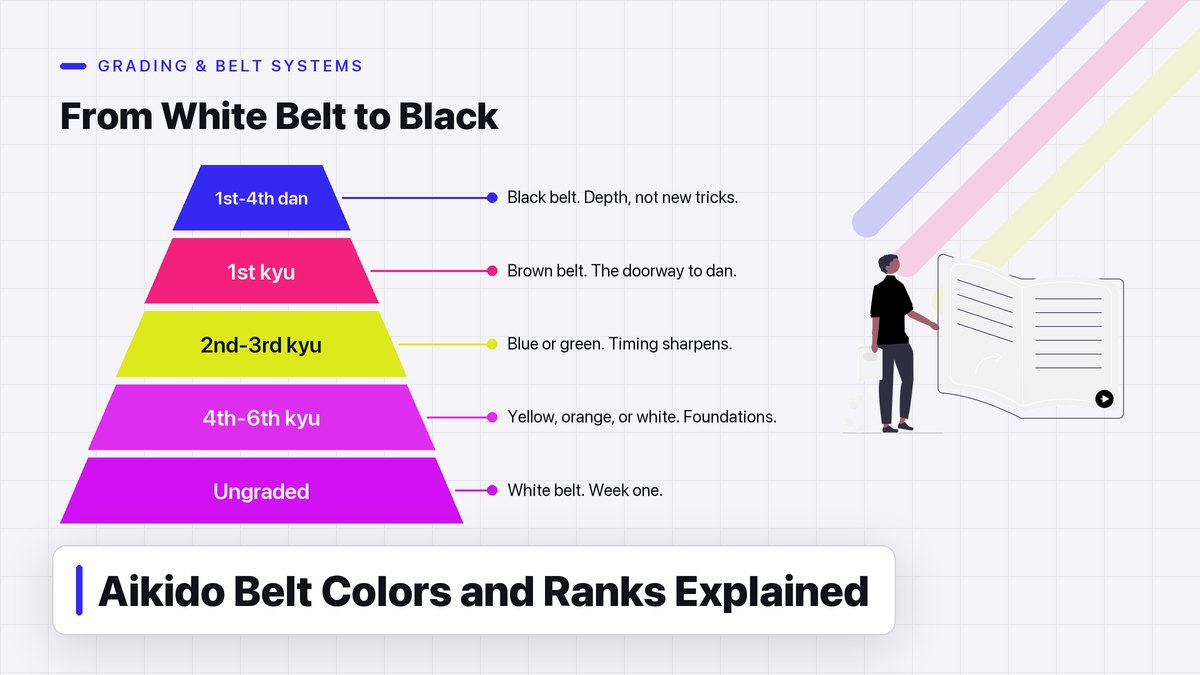
Six kyu grades, ten dan ranks, and a rainbow of belt colors that changes every time you switch organizations. This article walks the whole ladder, from your first test to the far side of black, and answers honestly what your belt will and won’t tell anyone about you.
At my first grading, I was so nervous I tied my belt backwards. Sixth kyu, the lowest rung on the ladder, a test that basically asks “can you fall down and get back up without hurting yourself,” and there I was in front of two examiners with the knot pointing off to one side like a wilted flower. My partner for the test, a quiet accountant named Dennis who outranked me by exactly one belt, whispered “leave it” as we bowed in. He was right. Nobody was grading my laundry skills, and by the end of the morning I’d learned the most useful early lesson this system has to teach: the belt is a marker. The progress itself lives somewhere off the rack.
That’s a hard lesson to hold onto, because everything about martial arts marketing pushes the other way. A belt feels like a verdict. If you’ve just started aikido, or you’re comparing schools and trying to decode what “we test up to fourth dan” even means, this article walks the whole ladder. The kyu grades beginners climb, the dan ranks on the far side of the black belt, why your white-belt cousin in karate wears a different color than your aikido training partner at the same experience level, and an honest answer to what any of it actually proves.
The Shape of the Whole System
Two ladders stitched together at the bottom rung of the tall one.
Aikido uses the kyu-dan ranking structure shared by most modern Japanese budo, the same bones you’ll find under judo, kendo, and karate. The system has two halves. Kyu grades (級, the word for “class” or “grade”) are the student ranks, and in aikido they typically count down, from 6th kyu at the bottom to 1st kyu at the top. Dan ranks (段, “step” or “stage”) count up from there, 1st dan through 10th, and 1st dan is where the black belt starts. This countdown-then-countup arrangement confuses nearly everyone their first year. You’re six months in, proudly announcing you’re now a “fifth” something, while the person beside you is a “second” something who’s been training three times as long.
The countdown has logic, though. A lower kyu number means you’re closer to the door of the dan ranks, so kyu numbers shrink as you improve, while dan numbers grow as you keep going. Think of kyu as distance remaining and dan as distance traveled and the whole thing untangles. Judo adopted a version of this structure in the 1880s, and the grading-culture site overview of the kyū system traces how it spread through Japanese martial arts and into nearly every art practiced in the West.
10th dan, by the way, is mostly historical furniture. A handful of people in the art’s entire history have held it. In most organizations you’ll never meet anyone above eighth, and the practical ceiling for a dedicated lifetime of training sits around fifth or sixth. That’s fine. The ladder isn’t meant to be finished.
One more oddity that surprises people coming from other arts. Aikido has no official record book, no central registry you can query to see who holds what. The certificates are issued by organizations and signed by senior teachers, and their authenticity rests on the organization’s standing, which is one reason lineage matters so much when people compare credentials. Two framed certificates with identical kanji can carry completely different weight depending on whose signature is at the bottom, a fact that seems scandalous until you remember most martial-arts history was passed down exactly this way long before anyone kept databases.
The Kyu Grades: Where Everyone Starts
Unranked beginners walk in the door, and within three to six months most dojos hold their first kyu test. The exact number of kyu grades varies a little by organization, but six is the common North American structure, and the skills tested at each level build in a deliberate order. Roughly speaking:
- 6th kyu. Falling safely (ukemi), basic footwork, your first technique. The exam proves you can train without hurting yourself or your partner.
- 5th kyu. A working handful of entries and controls, plus the first time you’re asked to move with a partner rather than at them.
- 4th kyu. Flow between techniques starts mattering. Examiners want to see you recover when something goes wrong, which it will.
- 3rd kyu. Timing and posture get graded. This is the first test where a bad day can actually cost you the rank.
- 2nd kyu. Precision across a wider syllabus, and usually your first weapons requirements in traditional schools.
- 1st kyu. The capstone student grade. You’re expected to move like someone the 6th kyus instinctively copy.
Between tests, the wait time is measured in months at the bottom and years at the top. A motivated student might pass a kyu test every four to six months early on, then wait a year or more between 2nd and 1st kyu. The system deliberately slows you down as you climb, and I’d argue that’s the sanest thing about it. Early grades come fast. That keeps you hooked. Later grades force you to stay long enough for the material to actually sink in.
Stripes deserve a mention, since you’ll see them everywhere. Many North American dojos put tape stripes on belts, one per step between full kyu grades, so a white belt with two stripes is somewhere south of 5th kyu. There’s no standard for what a stripe means across schools, which makes them the loosest currency in the whole system. Inside your own dojo they’re a helpful progress bar. Outside it, they’re decorative.
Some schools also fold weapons work into the kyu requirements, which surprises students who expected empty-hand technique only. By 2nd or 1st kyu you may be tested on the suburi basic cuts with a wooden sword, or the first jo staff kata, because the founder taught weapons and unarmed practice as one study. Other schools ignore weapons until dan entirely. Ask about this before you join if it matters to you, since it changes what two years of training actually looks like.
What Color Is That, Exactly?
The honest answer: ask your dojo, then ask the dojo across town.
This is where every beginner gets tripped up, and where the “explained” in this article’s title earns its keep. There is no universal aikido belt color chart. None. The Aikikai, the largest organization in the world and the one founded by aikido’s own family tested adults for decades without using colored belts at all, just white belts all the way up to black. Many traditional dojos still run exactly that way. If you’re reading this in a gi you bought last month, you might well train for years in the same white belt you started in.
Schools that do use colors mostly settled on a loose North American convention, and it goes something like this:
| Kyu grade | Common belt colors | What it roughly signals |
|---|---|---|
| 6th kyu | White | Brand new. Still learning to fall. |
| 5th kyu | White, sometimes yellow | A few months in. First techniques stick. |
| 4th kyu | Yellow or orange | About a year. Moves with a partner. |
| 3rd kyu | Green or blue | Intermediate. Timing enters the picture. |
| 2nd kyu | Blue or brown | Advanced student. Helps lower ranks. |
| 1st kyu | Brown | Last stop before the black belt test. |
Treat that table as folklore with a grain of truth rather than as binding law. One dojo’s green is the next dojo’s blue, Tomiki-style schools run their own color sequence because competition needs clearer divisions, and kids’ programs often add a dozen extra colors so young students get rewarded on a shorter leash. I trained at a club in the Midwest where 3rd kyu wore purple, and for years I assumed that was normal everywhere. It was normal nowhere else.
If you ever transfer between schools, don’t throw your old belts away, but do ask before your first class. Most instructors will simply tell you what the equivalent is, or politely suggest you wear white again for a few months while you absorb the local syllabus. That stings the first time. It’s also a useful reset, since different lineages emphasize different material. The national bodies each publish their own expectations. The United States Aikido Federation runs its own testing requirements for affiliated dojos, the Aikikai Foundation in Tokyo sets the tone for the largest worldwide network of schools, and the long-running magazine Aikido Journal has documented how grading standards play out across organizations for decades. Three sources, three slightly different answers to “what does a 3rd kyu need to know.”
A belt color tells an outsider almost nothing. It tells the people on your own mat exactly who to watch and who to help.
The Dan Ranks: Life on the Far Side of Black
1st dan, shodan, is the rank everyone romanticizes, and it arrives with the least dramatic ceremony you’ll ever imagine. In many traditional dojos you bow, receive a certificate, maybe a handshake, and then go straight back to the class you were already in, where the brown belts keep throwing you. The Japanese phrase people repeat is that shodan means “first step,” and while that sounds like modesty, it’s structurally true. The kyu grades teach you the vocabulary of the art. Nothing more. Dan is where you’re finally expected to compose sentences.
The ranks above it stretch far longer than most beginners expect. 2nd dan (nidan) usually comes two to three years after shodan and signals solid, dependable technique. 3rd dan (sandan) is the rank of the people actually running warm-ups and correcting beginners in most dojos. Somewhere around 4th dan (yondan) the expectations shift from doing techniques well to understanding them deeply enough to explain why they work, and this is where many dedicated practitioners stall for years, since the test stops being about physical memory long before the body gives out. 5th dan and beyond belong to teachers of teachers, the people whose names appear on the certificates your own instructor frames.
Minimum time in grade
Every serious organization publishes minimum training intervals between dan grades, usually a year or two at the low end and many years higher up. These are floors. The averages run much longer. Earning shodan typically takes somewhere between four and seven years of consistent training, give or take, and each dan above it takes proportionally longer. A 6th dan represents thirty years of mat time more often than not. I once did the arithmetic on a seminar instructor I trained under and realized his total hours on the mat probably exceeded my hours awake during the same span. Numbers like that recalibrate what “advanced” means.
What a Rank Actually Proves
Less than you hope, more than the cynics say.
This is the section I wish someone had handed me at my first grading, backwards belt and all. A rank is a local credential. It says this person met this organization’s standard on this day, in front of these examiners. That’s a real achievement, and it’s also a much narrower claim than the martial-arts mystique suggests. I’ve trained with a 4th dan whose rolls were creaky and a 1st kyu who moved like water. Rank correlates with experience, but it never substitutes for watching someone actually move.
Three things a belt does tell you, honestly. First, consistency. Anyone wearing a brown belt has kept showing up through sore weeks, boring drills, and plateaus that filter out half the people who started beside them. That reliability is worth something in every dojo on earth. Second, safety. A ranked aikidoka has been thrown thousands of times and knows how to receive your technique without getting hurt, which matters more than it sounds. Third, a syllabus. Each rank is a checklist of material, so a rank tells an instructor what you were at least taught, whether it stuck or not.
And two things it doesn’t. It doesn’t tell you who’s “better” in any absolute sense, because there’s no scoreboard in aikido and never has been. You can see this most clearly in the organizations that keep competition, where Tomiki aikido and the mainstream part ways over whether a match score means anything about the art. It also doesn’t tell you anything about character, which is worth saying plainly because dojo marketing sometimes implies otherwise. I’ve met gracious high ranks and petty ones. The mat filters for persistence, not virtue.
None of that makes grading pointless. The test itself is the useful part. A grading compresses months of training into twenty minutes of visible pressure, and the week before a test you’ll train harder than you have all year. Which is, if we’re honest, most of the point. The certificate is just the receipt.
How a Grading Actually Works
Testing formats vary, but the bones are similar everywhere. Your instructor decides you’re ready, or in some organizations you apply and an examining board from outside your club runs the test, which is the whole idea behind the Aikikai structure: someone with no investment in your dojo watches you move, which keeps standards from drifting entirely local.
The exam itself is demonstrations rather than sparring. You’ll be called forward, usually paired with a partner of equal or higher rank, and asked to run through a set of techniques. Names get called in Japanese, ikkyo through yonkyo, shihonage, irimi-nage, and you’re expected to produce the right response from an attack the examiner specifies. Attendance beats any single technique. Examiners talk afterward about a candidate’s posture, distance, and whether they looked calm, and two of the three have almost nothing to do with physical skill.
Fail rates exist but stay low at the kyu level, because a decent instructor doesn’t put you forward until you’d pass on an average day. Dan tests are different. I’ve watched a sandan candidate fail publicly at a seminar, bow, and be re-tested a year later. The failure stung, he said, but the corrective feedback was the most precise coaching he’d ever received. Many schools now record gradings on video for exactly that reason.
Kids, Ranks, and the Color Carousel
If your child trains, expect a belt rack that looks nothing like the adult chart. Junior programs in North America commonly award stripes and micro-grades every few months, sometimes ten or twelve color steps before a junior black belt. It’s a sensible adaptation. Kids measure progress in weeks, and waiting two years between visible rewards loses most of them by spring.
A wrinkle arrives later, when a twelve-year-old with a junior black belt walks into an adult class and discovers the rank doesn’t transfer. Most organizations handle this with a conversion: junior black belt roughly equals adult 1st kyu, and the young practitioner tests for adult shodan somewhere between fifteen and eighteen. Whether that feels like a demotion depends entirely on how the instructors frame it. The good ones frame it as what it is, a change of measuring stick, and the kids I’ve seen take it in stride were usually the ones whose parents never made the belt the point in the first place.
Which, come to think of it, is decent advice for adults too.
Where to Put Your Attention Instead
Ranks will accumulate on their own if you keep training, and they do mark real milestones. But the people who get the most out of aikido, in my observation, are the ones who grade because the test is scheduled and let the belt come along for the ride. They watch the senior students, they ask for the corrections that sting, and they show up on the rainy Tuesdays. Belts take care of themselves.
If you’re early in this, tie your belt carefully (our guide to tying a belt so the knot stays flat will save you a grading-day wardrobe malfunction), learn what the ranks mean in your specific organization rather than the internet’s generic version, and read what to expect at a first aikido class if you haven’t started yet. For the bigger picture of what the art is building toward, the basics of aikido covers it better than any belt chart can. Dennis, the accountant who saved me from retying my belt mid-test, finally took his shodan last year. Sixteen years after he started. He brought the same quiet competence to the exam that he brought to every Tuesday class, and the certificate he framed is almost beside the point. Almost.
Notes and sources. Kyu and dan requirements differ between organizations and even between affiliated dojos; always follow your own school’s testing requirements first. Background reading: the dan rank system as used across Japanese budo, plus the organizational pages linked above. External links were checked and working as of October 2026.
Leave a Reply