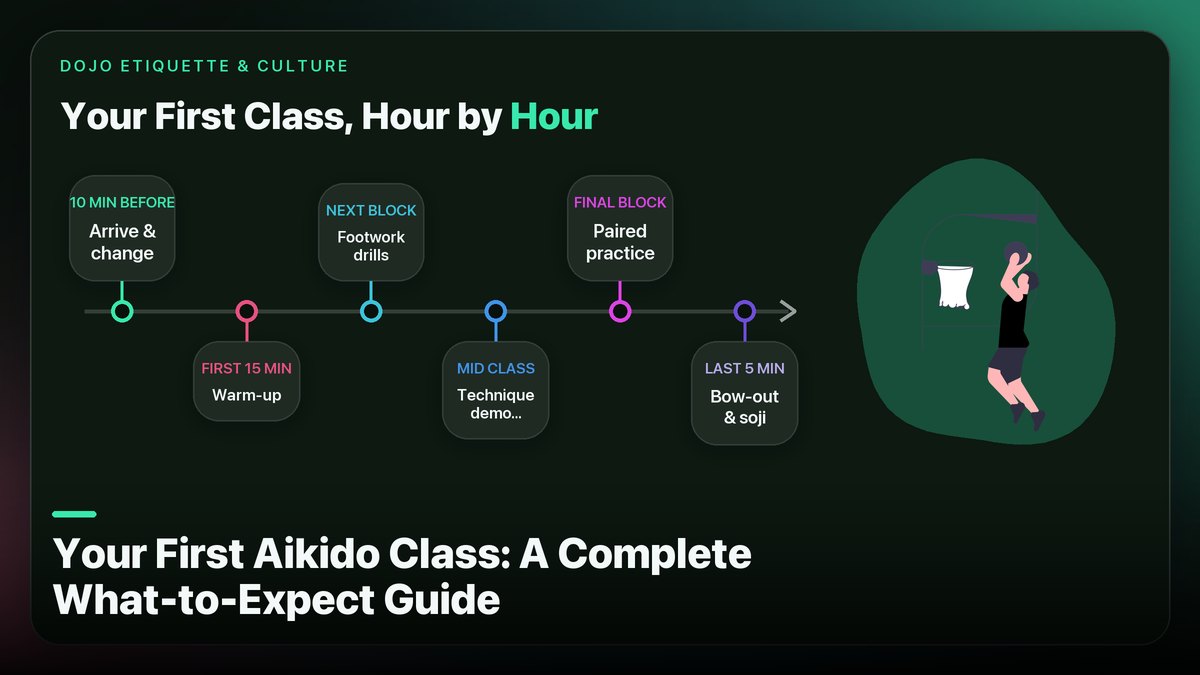
What to wear, what to bring, how the bowing works, and what actually happens for the hour you’re on the mat, told straight so you can stop worrying and just show up.
The scariest part of a first aikido class happens before the class starts. You’re standing at the door of a room you’ve never been in, holding clothes you maybe bought yesterday, about to walk onto a mat where everyone seems to already know the rules. I want to take that part away. A beginner class is one of the friendliest hours in martial arts, and the people inside that room remember their own first night better than you think. If you show up fifteen minutes early with a water bottle and an open mind, you’ve already done most of the hard part. This guide walks you through the rest, in the order it will actually happen.
What to Wear (And Whether You Need a Uniform Yet)
Aikido’s traditional training uniform is the keikogi, usually just called a gi: two heavy cotton pieces, a jacket and drawstring pants, plus a belt called the obi that holds the jacket closed. White is the standard color for beginners nearly everywhere in the US and Canada, and a full set costs somewhere in the $60 to $120 range depending on the weight of the cotton. If you want background on how the uniform evolved across Japanese martial arts, the overview of the keikogi is a good ten-minute read.
And you don’t need to buy any of it before your first class. That’s the part that matters most. Almost every dojo keeps a box of loaner gis in various sizes, and a trial class is exactly what the loaner box exists for. If the dojo has no spare uniform, wear something you can move in. Think sweatpants without zippers and a plain t-shirt. Avoid shorts, because kneeling on mat burn is real; avoid anything with buttons or jewelry that can catch a partner’s sleeve; skip the baggy shirt that rides up the first time someone grabs your wrist.
Feet stay bare on the mat, always. You’ll take your shoes off at the edge before stepping on, so clean socks or bare feet, and trim your toenails. One of those details nobody mentions until it matters, it always eventually matters.
Nobody at the dojo will remember what you wore. They’ll remember whether you were willing to fall down and get back up.
What to Bring vs. What the Dojo Provides
The short version: bring almost nothing. Aikido dojos are low-gear compared to, say, starting hockey. Most training halls already have everything the practice needs on the walls or in the closet.
| Item | You bring | The dojo provides |
|---|---|---|
| Uniform (gi) | Only after you decide to keep training; ask about loaners first | Loaner gis for trial classes at most dojos |
| Belt (obi) | Comes with the gi, or the dojo lends one | Someone will happily show you how it ties (there’s an art to it) |
| Water | A bottle you can keep at the edge of the mat | A drinking fountain at many community dojos |
| Mat space | Nothing, just be on time | The tatami itself, swept before and after every class |
| Weapons | Nothing on day one | Wooden swords (bokken) and staffs (jo) for later classes |
| First aid | Any tape or supports your body already needs | A small kit somewhere near the office, usually |
If there’s one thing I’d add beyond that table, it’s a small towel. An hour of aikido involves more close contact with other people’s sleeves than newcomers expect, and you’ll be glad for it by the halfway point.
Arriving: The Fifteen Minutes That Set the Tone
Show up about fifteen minutes before the posted start time. This is normal dojo culture, not over-eagerness, since it gives the instructor time to greet you and find a loaner gi in your size before pairing you with a patient senior student. Walk in, take your shoes off at the door or mat edge, and say hello to the first person who makes eye contact. That’s the whole entrance exam.
Right away, a few things will catch your eye. The mat area, the tatami, is treated as a clean space, so street shoes never touch it and you’ll step on and off at the same spot. At the front of most dojos hangs a framed photograph, usually of Morihei Ueshiba, the founder, and there’s often a small shelf or altar beneath it (some dojos keep flowers or a stick of incense there, some keep nothing at all). You don’t have to do anything about that yet. Bowing toward it, and toward the instructor, is something the regulars do. You’ll pick it up by watching in about four minutes flat.
Someone will hand you a waiver and probably a loaner uniform, then point you toward a changing area. Waiver first, gi second. If the gi feels stiff and strange, that’s because it is, for everyone, for roughly their first month. Also, leave your phone in your bag. Classes run phone-free on the mat almost everywhere, and the quiet is half the point.
Bowing In: What the Ritual Actually Means
Classes in most traditional dojos open with a short formal sequence, and knowing what’s coming makes it feel like a ceremony instead of a pop quiz. Students line up seated, usually in rows with the most senior students at the right end near the instructor. A senior student calls the class to attention with a phrase like “ki o tsuke,” everyone bows toward the front of the dojo together (that’s shomen ni rei), then bows toward the instructor (sensei ni rei), who bows back. Partner practice later begins and ends with a small bow to your own partner, plus a spoken phrase or two.
The bow itself, in Japanese contexts generally, is called ojigi, and it’s worth understanding that a bow in a Japanese martial art is closer to a handshake than to worship. The entry on ojigi covers how the gesture works in daily Japanese life, where bowing shows up at funerals, job interviews, even convenience stores, and the dojo version sits in that same lineage of mutual respect. You’re acknowledging the space, the teacher, the person about to grab your wrist. Nothing more is being asked of you.
One reassurance for anyone worried about the quasi-religious look of the front-of-room shrine (the kamiza): practices vary. Some dojos lean traditional, some barely nod to it. Both are common across North America. You bow as a sign of respect to the tradition rather than a statement of belief. In the years I’ve been around dojos, I’ve trained alongside devout members of half a dozen religions and a comfortable number of atheists, and nobody has ever been asked to profess anything.
Warm-Ups: Rolling Before You’re Ready to Roll
After the bows, the instructor leads warm-ups, and this is where aikido differs from most martial arts in one important respect. Expect some stretching, wrist and shoulder circles, loosening exercises, and then the surprise. Falling practice. From your very first class you’ll work on ukemi, the art of receiving a technique safely, starting with rocking drills and forward slides, maybe a gentle somersault over one shoulder with a slap of the mat. There’s a reason, and it’s a good one. Falling well is the skill that keeps partner practice safe for decades, so it’s trained from minute one rather than left until you need it.
Go slowly here, and I mean that as practical advice rather than politeness. The temptation in a first class is to copy the shape of what the advanced students are doing, but a senior student’s forward roll is the product of a few thousand repetitions, and your version on night one should be small, slow, and boring. Knees, then shoulder, then slap. The mat is more forgiving than your pride assumes, but only if you keep your chin tucked.
By the end of warm-ups, roughly ten or fifteen minutes have passed and the nervousness most beginners arrive with has usually burned off. Which is exactly the design. Something about being busy with your body leaves no room left over for anxiety.
Partner Practice: The Heart of the Hour
You’ll spend most of class taking turns throwing and being thrown.
The middle of class is partner work, and the first thing that will happen is a senior student or the instructor will walk you through the partner bow and the phrase onegai shimasu, which means something like “please train with me.” You’ll say it to your partner at the start of each round and arigato gozaimashita at the end. They sound like a mouthful. By the third time, they aren’t, and I think most people end up liking the ritual more than they’d expect, because it turns every round into a small handshake instead of a contest.
What nage does
Your partner will attack in a pre-agreed way, a wrist grab or a slow strike, and you’ll practice the response the instructor just demonstrated, maybe three or four repetitions before switching. The teacher walks the mat correcting details. Your shoulders are up. Your feet are crossed. You’re muscling it. Expect a lot of small, kind corrections. Expect the technique to feel completely impossible for the first half hour, then suddenly click for one repetition out of nowhere. That single click is the feeling people come back for.
What uke does, and why it’s half the art
Being the attacker, the uke, is a role, not a loss. Uke gives a real, committed attack at a speed both partners can handle, then follows the technique into a safe fall. Doing that well is a skill with its own years of depth, which is why Aikido Journal has published essay after essay on what makes good ukemi. As a beginner, your job is simpler: attack honestly at a slow pace, fall where you’re guided, tap the mat or your partner the instant anything hurts, then get up smiling if you can manage it. Your partner in that first class was once on the ground in a borrowed gi doing exactly the same thing.
Something I’d warn you about: the hands-on closeness. Aikido practice involves wrist grabs and elbow contact, with occasional moments where your partner’s sleeve is your only handle on the situation. It can feel intimate for the first few classes if you’re not used to contact sports, and that fades fast. Dojos are good at this. If a grip or a position ever feels wrong, say so, immediately, to your partner and then to the instructor if needed. Every serious dojo treats that as normal communication, and any partner who doesn’t isn’t someone you’ll be paired with twice.
The Japanese Words You’ll Hear (Don’t Memorize, Just Recognize)
Nobody hands you a vocabulary sheet. Japanese terms just float around the room, and after a few classes they stop being foreign. Sensei means teacher. Tatami is the mat. Uke and nage, you’ve met. Ma-ai is the distance between partners, the gap that decides whether an attack can even land. Rei is the bow itself. And the headquarters style practiced at most dojos traces back to the Aikikai Foundation in Tokyo, which is why a class in Ohio and a class in Osaka can share the same vocabulary.
Two phrases earn themselves a little study before class one, though. The opening request is onegai shimasu. The closing thanks is arigato gozaimashita. Write them on your palm if it helps. Nobody will laugh at your pronunciation, because roughly half the room was mumbling them nervously a year ago. I still mumble a little, if I’m being honest.
The bow and the words do real work. They turn a room of strangers into people who have agreed, out loud, to take care of each other for the next hour.
The Hour at a Glance
Every dojo runs its own rhythm, but a beginner class in the US or Canada tends to look something like this:
- Bow in. Line up, seated bow to the front of the dojo and to the instructor, about two minutes.
- Warm-ups. Stretching plus wrist and shoulder loosening, then basic falling practice, ten to fifteen minutes.
- Footwork solo drills. Walking irimi and tenkan steps up and down the mat until the pivot stops feeling like dance choreography, five to ten minutes.
- Partner techniques. The instructor demonstrates, pairs work a grab or strike response, everyone switches roles each round, thirty minutes or so.
- Bow out. The line forms again, bows are exchanged, class ends. Senior students stay to sweep and stack the mats.
Notice what isn’t on that list: sparring, competition, anything resembling a fight for points. Most styles of aikido don’t have matches at all, which is either a feature or a bug depending on what you’re looking for, and for a nervous first-timer it’s almost always a feature. You will never be asked to “win” anything on your first night. Or ever, honestly.
The Worries Everyone Has (Answered Straight)
“I’m not in shape for this.” Neither was anyone else on their first night, and aikido is kinder to the unfit than it looks. You can do the whole class at your own pace, sit out any drill by stepping to the edge of the mat, and no one will say a word beyond “feel better.” The conditioning builds on its own schedule, about fifteen classes in, when you realize the warm-up stopped feeling like a workout.
“Too stiff, too old, too uncoordinated.” The average beginner class in North America skews adult, with plenty of students starting in their thirties and forties, some well past retirement age. Stiffness is close to the norm, and uncoordination is why there are mirrors and patient seniors. I’ve watched a sixty-year-old accountant with two left feet become one of the most reliable ukes in his dojo over about two years, mostly by just showing up Tuesdays and Thursdays.
“I’ll be the only beginner.” Possibly, and briefly, but it matters less than you’d fear. Dojos assign seniors to newcomers on purpose, because teaching a beginner is considered good training for the teacher, which means your confusion is literally useful to somebody. A little flattery that happens to be true.
“What if I bow wrong or say something dumb?” You’ll bow slightly off, mispronounce something, and step on the mat with your left foot when the room used the right. Nobody cares. Etiquette in a beginner context is graded on obvious effort, and effort is the one thing fully in your control. I said fifteen minutes earlier that you should arrive early; on reflection I’d say the real rule is just don’t arrive late, because late arrivals walk onto a mat full of seated people mid-bow, which is the one entrance nobody enjoys making.
“Is it dangerous?” It’s a full-contact martial art with throws and joint locks, so a sprained wrist is a real possibility over the long run, about on par with recreational basketball. Injuries in beginner classes are rare, mostly because beginners move slowly and fall from low heights under close supervision. Tap early. Tap clearly. Speak up. The risk drops a lot after that.
After Class: The Part Nobody Tells You About
Class ends with the bow-out, and then something nice usually happens. People linger. Good sign, usually. The senior student who worked with you will ask how it went, someone will mention when the next beginner class meets, and you’ll probably be handed a schedule and a rate sheet. This is a fine moment to ask the questions you saved up: what a month of classes costs, whether there’s a beginner-only series, what the testing path looks like, and how the AikiWeb community and dojo directories can help if you ever move cities and need a new mat to call home.
Physically, expect two things the next morning. Muscles you forgot you had, mostly forearms and hips, plus the tops of your feet, and a vague sense that the world moved a little slower yesterday than it usually does. Both pass in a day or two. The part that doesn’t pass is the question you’ll catch yourself asking by Wednesday: whether you could make the Thursday class. If you’re asking it, the answer is yes, and the borrowed gi will be hanging on a hook with your name on it by next week.
Sources and notes. Class structure and etiquette described here reflect common practice at Aikikai-affiliated and independent dojos across the US and Canada; individual dojos vary, and your instructor’s word beats any article. External links were checked and working as of October 2026. For more on this site, start with what aikido actually is, then the companion guides on dojo etiquette for beginners, tying your belt (obi), and ukemi, the rolling and falling basics you’ll meet in your first warm-up. This is training guidance for a supervised martial-arts class, not medical advice; for any injury or health concern, see a qualified professional.
Leave a Reply