The wooden sword is the cheapest training partner you’ll ever have. This guide covers the four foundational cuts, a rep scheme that builds without wrecking your shoulders, and what to look for when you buy your first bokken.
My first bokken cost forty dollars at a martial arts supply table set up in a community center hallway, and I bought it mostly because the guy running the table let me hold it. Forty dollars, no plan. That was a mistake in one way, since I had no idea what I was supposed to do with the thing, and a very good decision in another, because solo sword practice ended up doing more for my aikido than almost anything else I did off the mat. Suburi, the word for those repeated solo cuts, sounds exotic until you translate it. It just means “empty swing.” No partner, no target, no drill sergeant. You, a wooden sword, and a patch of floor where you won’t break anything. This article assumes you’re a beginner with a new bokken and no instructor standing nearby, which describes most people who own one.
One thing before we start. Every dojo teaches weapons a little differently. The details here reflect common Aikikai-style practice in North American dojos, because that’s what I know best, and your own sensei’s version takes precedence over anything you read online, mine included. If your school does suburi differently, or doesn’t do weapons at all yet, ask before you build habits.
What Suburi Actually Is
“Empty swing” — repetition of solo cuts with the wooden sword.
Suburi is the practice of repeating basic sword cuts, over and over, by yourself. That’s the whole definition, and I think it’s worth stating plainly because beginners sometimes imagine there’s a hidden layer of complexity waiting underneath. There isn’t, really. The cut is simple on purpose; the depth comes from doing it ten thousand times. The overview of suburi on Wikipedia traces the term and its place in kendo and aikido training, where it’s been used for generations as a way to build the body before the body is trusted with a partner.
Why does an aikido student need sword work at all? This confuses people in their first year, and the answer I got from my own teacher was unsatisfying at the time. The sword shows you what your body is doing. Your posture, your balance, the path your hands travel, the timing of your footwork, all of it gets exaggerated and made visible when you hold a stick that extends your arms by three feet. Try to cut while leaning back and the bokken tells on you immediately. A good swing ends with your weight where it belongs; a sloppy one ends with you tipping forward like a drinking bird toy. The sword doesn’t care about your excuses, which is exactly what makes it useful. Many aikido lineages, including the one practiced at the Aikikai Hombu Dojo in Tokyo, treat weapons work as a core part of the curriculum rather than a side hobby, because it cleans up everything else.
A short history note first, and I promise it earns its place. Morihei Ueshiba, aikido’s founder, was deeply skilled with the sword and spear before he ever formulated aikido, and the empty-hand techniques people picture when they think of the art carry sword logic inside them. The sword came first. The angle of an irimi entry, the way the leading hand shapes a spiral, the timing of a tenkan turn, all of these live inside the empty-hand shapes you will drill in your first months on the mat, whether anyone mentions the connection or not. When you do suburi, you’re practicing the parent skill that aikido’s empty-hand movement grew out of, and that context makes the solo work feel less arbitrary than “swing a stick a hundred times.” You’re rehearsing the shape of the whole art, one cut at a time.
You also don’t need a dojo to do it. A garage, a backyard, a cleared corner of an apartment, a parking lot at 6 a.m. if your neighbors are forgiving. No commute, either. That’s the actual appeal for most people, I suspect. Class happens twice a week on someone else’s schedule; the bokken hangs on your wall the rest of the time, asking when you’re going to pick it up.
Buying Your First Bokken
First, the good news. A first bokken does not need to be expensive, exotic, or pretty. The standard hardwood training bokken sold by any martial arts supplier will carry you through your first several years, and it should cost somewhere in the forty to seventy dollar range. What follows is what I’d check before handing over money, in rough order of importance, plus one strong opinion.
Weight first. A typical red or white oak bokken runs about 450 to 550 grams, roughly a pound. That’s the right zone for a beginner. Much heavier weapons exist, and they tempt people who want to “make it count,” but a heavy bokken teaches you to muscle the cut, which is the opposite of what suburi is for. You’ll know you’re muscling it because your shoulders will be on fire within five minutes and your cuts will look like you’re chopping firewood. Start standard.
Wood second. Red oak and white oak are the common choices. White oak is denser and a bit more durable; red oak is slightly lighter and usually cheaper. Either is fine. Avoid pine or any softwood bokken, which dent, splinter, and occasionally crack mid-swing, none of which you want happening at head height in your living room. Spend the extra ten bucks. Also skip bokken with a glossy varnish, which gets slippery the moment your hands sweat, and they will sweat.
Shape third. You want the classic curved katana-shaped training bokken, not the straight aikido-style “Iwama” shape and not a kendo-shaped shinai substitute. Actually, let me soften that, because plenty of Iwama-style schools train with the straight shape and there’s nothing wrong with it. Buy the shape your dojo uses, because walking into your first class with the wrong-shaped bokken is the equivalent of showing up with left-handed scissors. The bokken article on Wikipedia covers the common shapes and their uses if you want the full taxonomy.
Length last. Standard length (about 102 centimeters, around 40 inches) fits nearly all adults. If you’re significantly shorter than about five foot four, a slightly shorter child-sized or women’s model can actually help your form, because a bokken that’s too long drags on the floor during some movements and ruins your posture compensation without you noticing. Weight matters more than length, though, so don’t overthink this one.
Used bokken are worth considering too, by the way. A worn one with honest dents has character, costs half as much, and the wear tells you it was swung rather than displayed. I like them. The only thing I’d check on a used one is that there are no deep cracks running along the grain near the tip, because that’s the spot where old oak lets go first, and it lets go without much warning. While you’re shopping, grab a cheap saya (scabbard) only if you enjoy owning nice things; it’s strictly optional for practice. If you want a sense of what else the community discusses around training gear and dojo life, the forums at AikiWeb have decades of threads from practitioners of every style, and a search there will answer almost any beginner question you come up with at midnight.
Grip, Stance, and the Shape of a Cut
Everything in suburi rests on a small number of physical details, and getting them right early saves you a year of undoing bad habits. Take your time on this section before you chase rep counts.
The grip (te-no-uchi)
Hold the bokken with both hands, left hand near the very end of the handle (the kashira), right hand a hands-width above it if you’re right-handed. Reverse that for left-handers. Your grip should be firm enough that the bokken doesn’t slide or rotate in your hands when you swing, and relaxed enough that your forearms aren’t braced hard the whole time. There’s a phrase you’ll hear. The grip should be like holding a small bird, tight enough it can’t escape, loose enough you don’t crush it. I found that image annoying for about a year before it suddenly made sense around my five hundredth swing. The power of the cut comes from the whole body arriving together, and if your forearms are clenched from the start, they’ve got nowhere to go.
Watch two common beginner grip faults. The first is the “death grip,” white knuckles from start to finish, which tires you out fast and makes the cut stiff and telegraphed. The second is letting the bottom hand slide off the end of the handle during big swings, which usually means the bokken is slick or your hands are too close together. Fix the first by shaking out your hands between sets. Simple, and it works. Fix the second by checking hand placement every twenty reps or so, because hands migrate when you’re tired and nobody notices it happening.
The stance (kamae)
The basic ready position is hanmi, the same staggered stance you use in empty-hand aikido practice: feet about shoulder-width apart along a line, one foot forward, most of your weight settling into the balls of the feet with the knees soft. If you’ve read our piece on blending and tenkan movement, you already know this stance from the empty-hand side, and the weapons version will feel familiar within a session or two. Keep it narrow. The bokken rests raised in front of you, angled up and slightly to the right, tip pointing roughly at your imaginary opponent’s throat. From the side, your body should make a narrow profile, same as in the empty-hand art.
The cut itself (hasuji and kirioroshi)
Three things have to arrive at the same moment for a cut to be correct: the blade reaches its target line, your forward foot plants, and your body weight commits forward. If the blade arrives first, you’re arm-swinging. If the foot arrives first, you’re stabbing at air with a late stick. All three at once, or the cut isn’t really yours. When everything lands together, the cut has what practitioners call hasuji, correct blade path, and you can feel the difference immediately because the bokken stops feeling heavy. A well-timed cut feels almost weightless at the bottom of the arc. A badly timed one feels like you’re fighting the wood the whole way down.
One more principle surprises every beginner. You cut with the bottom two or three inches of the blade, the monouchi. The middle is wrong. The tip is too. Aim small. Think of the last few inches of the bokken as the business end, and let the rest of the weapon be the delivery system. This is why swinging a bokken is nothing like swinging a baseball bat, where you want contact in the fat middle. The baseball instinct is strong, I still catch myself doing it when I’m tired, and it produces a shallow, slapping cut instead of a committed one.
A well-timed cut feels almost weightless. A badly timed one feels like you’re fighting the wood the whole way down, and the wood always wins.
The Four Cuts to Learn First
Different schools count different core suburi sets, anywhere from five to twenty individual movements. Ignore the big lists for now. Four cuts will keep you busy for your first year, and they’re the ones your empty-hand aikido leans on most, and nobody at your dojo will care that you skipped numbers five through twelve.
Shomen uchi (straight overhead cut)
The foundational cut. Raise the bokken up and slightly back over your head, then bring it straight down the centerline, finishing with the blade stopping at about the level of your own forehead (in solo practice you stop short of your body, of course), hands ending in front of your solar plexus. The whole movement should come from the hips and the settling of your weight, with the arms mostly along for the ride. One detail I wish someone had told me in week one. Don’t raise the sword by lifting your shoulders up around your ears. Shoulders down. The backswing comes from a small turn in the hips and a rise in the center of the body. If your shoulders creep up, your neck gets involved, and then everything downstream gets tight and short.
Yokomen uchi (diagonal side cut)
Raise the bokken the same way as shomen, then cut diagonally down across the front of your body, as if tracing a line from the top of your partner’s ear toward the opposite shoulder. Your hands finish off to the side of your hip rather than in the center. The path of the blade should be a clean diagonal, not a horizontal swipe that dips at the end. Clean diagonals only, no matter how tired you get. In paired practice, yokomen is the attack that most aikido techniques against a strike are built to answer, so the solo version of it is you rehearsing the attack your partners will feed you. Getting it clean on your own makes you a much better training partner in class, and people notice.
Kesagiri (diagonal downward cut)
Cut down along the opposite diagonal, from your own high right toward the low left, like the sash of a robe, which is literally what the name refers to. Functionally, it’s the mirror logic of yokomen with a different intent, and the two of them together teach your shoulders to work independently of your hips, which is a skill with no shortcut. The finish matters here. Let the cut come to a full, settled stop at the bottom before you return to kamae. Let it settle. Beginners tend to let the bokken bounce or wobble at the bottom of kesagiri because the diagonal path is harder to arrest cleanly than the vertical one. A stopped blade, held still for a half-beat, is how you know the cut was yours rather than the bokken’s momentum.
Kiri-kaeshi (left-right alternating cuts)
Now the combination drill: a shomen cut, then a diagonal cut to the left, shomen, diagonal to the right, and so on, flowing continuously without pausing at kamae between cuts. This is the one that starts to feel like aikido instead of like sword-shaped exercise, because the transitions between the cuts are where the blending movement lives. Start slow. Your body turns, your weight shifts from foot to foot, and the bokken keeps moving through the changes. It feels awkward for a while, and then one day it clicks and you understand why people call weapons practice the skeleton of the art. If you only have five minutes, do kiri-kaeshi for those five minutes and you haven’t wasted them.
How Many Reps, and How to Build Up
Most articles get vague right about here. Let’s use actual numbers. The classic suburi standard you’ll hear quoted in dojos is three hundred to five hundred cuts per session, and some traditions go well past a thousand. Those numbers assume conditioned shoulders and years of practice. A beginner who swings a bokken three hundred times on day one will very likely wake up the next morning unable to lift their arms to brush their teeth, and then won’t pick the bokken up again for two weeks. I base that prediction on watching it happen to a training partner, and also on doing it myself.
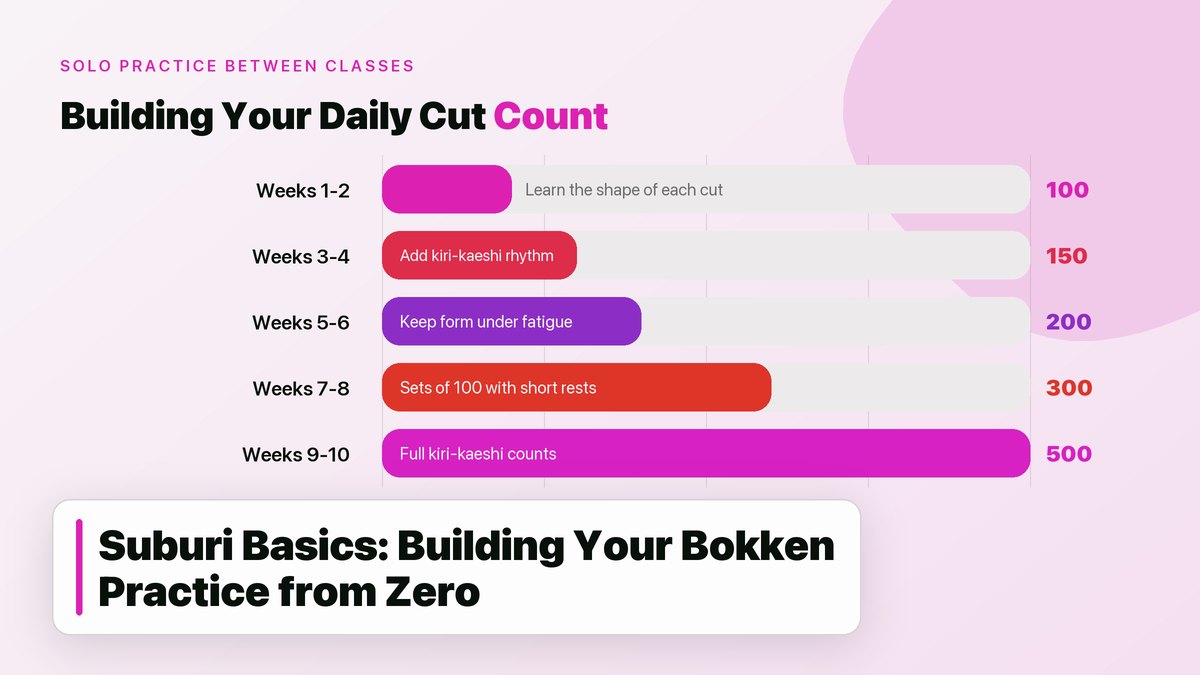
The progression below builds from a hundred total cuts to a sustained five hundred per session over about ten weeks. It assumes three or four short sessions per week, roughly fifteen to twenty minutes each, which is about the length of a coffee break and fits between dinner and dishes without requiring any real negotiation with the rest of your evening, at least in my house. That’s more effective than one long weekend session, for the same reason that two aikido classes a week beats one double class. The nervous system consolidates frequency, not volume, and your shoulders need the recovery days between sessions more than they need heroic single efforts.
| Weeks | Total cuts per session | How to split it | What to watch for |
|---|---|---|---|
| 1–2 | 100 | Shomen 40, yokomen 30, kesagiri 30. Rest between sets. | Sore forearms are normal; sharp shoulder pain is not. Check grip tension, you’re probably over-squeezing. |
| 3–4 | 150 | Shomen 60, yokomen 40, kesagiri 50. | If the shoulders creep up, film one set from the side on your phone, because the truth lives in the recording. |
| 5–6 | 200 | Shomen 80, yokomen 60, kesagiri 60. Add one slow set of 20 with a three-second pause at the bottom of each cut. | The slow set exposes timing cheats the fast sets hide. |
| 7–8 | 300 | Shomen 100, then kiri-kaeshi 100, then yokomen and kesagiri 50 each. | Kiri-kaeshi at volume is where form falls apart first, so slow it down before adding more. |
| 9–10 | 400 | Kiri-kaeshi 200, shomen 100, yokomen 50, kesagiri 50. | Breath starts to matter. Exhale on each cut, don’t hold air. |
| 10+ | 500 | Continuous rotation: 100 shomen, 200 kiri-kaeshi, 100 yokomen, 100 kesagiri. | This is the standard dojo warm-up level. From here the practice shifts into maintenance mode. |
A few notes on using the table. The split between cuts isn’t sacred. Favor your weak cut. Shifting reps toward whatever feels sloppiest is good self-coaching, and shomen deserves the biggest share early because everything else inherits its shape. The week boundaries are approximate. Some people will hit five hundred by week six, some will want twelve weeks, and both are fine, the table is a scaffold rather than a contract. What matters is that you arrive at volume through gradual loading, because the connective tissue in your shoulders and elbows adapts slower than your enthusiasm does, and tendon complaints from sword work take months to fully settle once they start.
Counting is its own small skill, by the way. I use sets of twenty-five with a quiet count under the breath, because counting past about thirty in my head reliably fails and I end up doing 180 cuts and calling it 200. Or I set a timer and count sets instead of individual cuts. Some people use a mala-style counter on the sword rack. Whatever gets you honest numbers without breaking your concentration on the cut itself.
You don’t rise to the level of your ambition on the mat. You fall to the level of what your shoulders can repeat without complaint, so build the shoulders first and let the ambition catch up.
Safety and Small Spaces
Most suburi injuries are embarrassingly avoidable, and nearly all of them happen at home rather than in the dojo, because at home there’s no instructor watching and no sprung floor. A few rules I hold to, some learned by violation.
Clearance above all. You need enough room to swing overhead without hitting anything, which in practice means a ceiling you can reach with the bokken raised plus a foot, and no light fixtures, fans, or hanging plants anywhere near the arc. Ceiling fans are the classic casualty. A garage with open rafters works. A finished basement with seven-foot ceilings does not, and I say that as someone who put a dent in a rental’s ceiling track lighting in 2019. That dent cost me part of a security deposit, and the landlord kept asking questions.
Flooring matters less than you’d think but more than you’d hope. Bare concrete or tile transmits every bit of vibration up through your feet and ankles over a few hundred reps. A thin rubber mat, an old yoga mat, or even a patch of grass outside changes the feel of the session considerably. Swing in socks on hardwood and you’re one sweaty-foot pivot away from learning why dojos don’t allow that.
The backswing zone deserves special respect. Beginners fixate on where the blade lands and forget that the sword travels the same distance behind them on the backswing. Check your six. A wall, a pet, a child wandering in to ask a question, a television. My rule is that if anyone else is home, the door to the practice space stays closed and I’ve told them I’m swinging wood for the next fifteen minutes. Pets in particular treat a moving bokken as either a threat or an invitation, and neither ends well.
Check the bokken itself before every session, and I mean actually look at it. Run a hand along the blade for cracks, wiggle the tip to feel for looseness in the grain, and check for splinters. Ten seconds, every session. A cracked bokken usually gives warning in the form of a new vibration or a buzzing feel through the grip before it fails, so if the sword suddenly feels different, stop and inspect. Trust the change. Finally, never do suburi tired in the specific way that means “had a drink.” Coordination is the whole practice, and dull coordination plus a rigid wooden object at head height is a bad combination. This is the one piece of safety advice that feels preachy and also happens to be the most common cause of home injuries I’ve heard about at seminars.
Connecting Solo Practice Back to Class
Solo suburi earns its keep when it shows up in your paired work, so it’s worth being deliberate about the handoff rather than hoping it happens on its own. Then it pays rent. The connection runs through a few specific skills: your posture under pressure, the shape of your strikes when you take the role of attacker, and the timing of your entries. You’ll also develop what practitioners call a feel for maai, the working distance between you and a partner, and there’s no way to drill maai alone with full honesty, but solo practice at least keeps the body honest about the rest. If you want the paired side of this, our guide to ikkyo, the first technique most students learn, covers how these body habits show up the moment someone actually grabs your wrist.
There’s also a quieter benefit, and after years of practice I’d argue it’s the main one. Twenty minutes of suburi is moving meditation with a feedback mechanism. The counting occupies the chatty part of the mind, the physical feedback (tired forearms, a blade that won’t stop clean, breath that runs short) keeps you honest, and the repetition does for the nervous system what footwork drills do for a dancer. It adds up. On days when I can’t make class, fifteen minutes of kiri-kaeshi leaves me more settled than almost anything else I could do with that time, including the couch and the phone. Regular solo practice also means class time gets spent on the parts that actually require a partner, because you’ve already rehearsed the cut a few hundred times that week and your partner isn’t waiting while your body figures out which end of the bokken is which.
When you’re ready to go deeper, the archives at Aikido Journal are one of the best reading rooms in the art, decades of interviews and essays from senior teachers on exactly this question of how weapons work feeds empty-hand skill. And if you take nothing else from this article, take the habit: pick up the bokken most days, even for five minutes, even badly. The hundredth session looks completely different from the first, and nobody remembers the first.
Related reads on this site: what aikido is, explained for beginners, ukemi: rolling and falling basics, dojo etiquette for beginners, and blending and tenkan movement. External links checked and working as of October 2026; terminology follows common Aikikai usage in North American dojos, and your own dojo’s usage takes precedence.
Leave a Reply